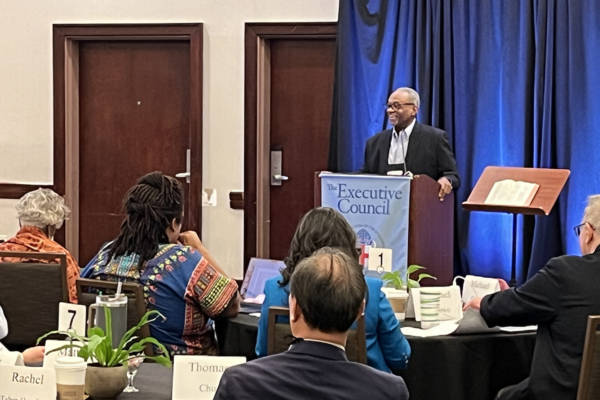
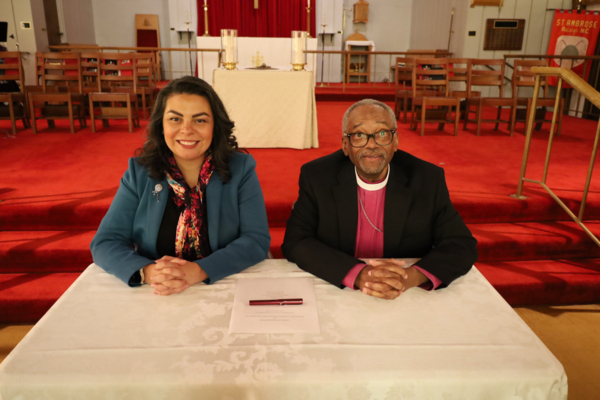
Affirming the importance of "meeting Christ in the other... in service and in love," Presiding Bishop Frank Griswold preached October 30 in St. John's Cathedral in Taipei, opening a two-day visit to the Diocese of Taiwan during two weeks of dialogue with church leaders in Asia.Text of the Sunday-morning sermon - in which Griswold identified the true self as "confident, open and eager... a self receptive to the sometimes strange, amazing and unsettling ways in which God chooses to make himself known" - follows here.
Comparing language and religion as "ways of thinking and understanding in the world... of seeing the world and our place within it," Griswold also underscored the importance of interfaith awareness and a "stance of humility" adopted by individuals and the wider church.
The Presiding Bishop's visit to Taiwan -- a 14-congregation diocese of the U.S.-based Episcopal Church - concludes October 31 with lectures and dialogue at St. John's University in Tamsui.
Taiwan's Bishop David J. H. Lai and his wife, Lily, welcomed Griswold and his wife, Phoebe, together with three senior staff members from New York's Episcopal Church Center, to Taipei.
- - - -
Cathedral Church of St. John
Taipei, Taiwan
October 30, 2005
The Most Rev. Frank T. Griswold
Presiding Bishop and Primate
The Episcopal Church, USA
Readings:
Micah 3:5-12
1 Thessalonians 2:9-13, 17-20 (with 4:13-18)
Matthew 23:1-12
Ping An ("Peace," in Mandarin).
My brothers and sisters in Christ, it is a great joy for me as your Presiding Bishop to visit the Diocese of Taiwan and my brother Bishop David Lai. Shortly after I met your bishop he presented me with a tea pot and some of the very fine tea that is grown here. The result has been a complete transformation in what I consider to be a good cup of tea. Since then he has regularly supplied me with fresh supplies. When I get up in the morning and make an early cup of tea I give thanks for David's gift of friendship and offer a prayer for my brothers and sisters here in Taiwan.
Though this diocese is far removed from the United States geographically, you are as close to my heart as those I see every day.
The Episcopal Church includes 11 dioceses beyond the continental United States in many different countries. We are greatly blessed as a church by their richness of culture and history. And, we are blessed, and inspired, by their witness to the gospel - often through times of upheaval and adversity. These dioceses remind us that Christ embraces the world with his outstretched arms upon the cross, and draws all people to himself in compassion and love.
Historically the Episcopal Church has been made up of people like me: white and English-speaking. But, increasingly we are becoming a multiracial and multicultural church. For example, in the congregations of the Diocese of New York where the Episcopal Church Center is located, the Eucharist on Sunday morning is celebrated in 18 different languages, among them Chinese. And here I must apologize that I am unable to address you this morning without the help of a translator.
Religions, forms of language
Languages, and the way they are structured, convey not only meaning but also ways of thinking and understanding in the world. Some languages, for example, have no way of conveying past or future and therefore locate all of reality in the present. Those who are shaped by such languages see the world very much in terms of what is taking place right now. Anxiety about the future or regret about the past is not part of their experience.
Religions provide ways of seeing and understanding the world and our place within it. In a way they too are forms of language. They provide ways in which to make meaning of our existence. As in the case of language, some forms of religion focus on the past or the future while others center their attention on the present moment. The present is their only reality.
Christianity is very much a religion of language: it is rooted in the understanding of God as One who speaks. He speaks the world into being in the Book of Genesis. He speaks his covenant with the children of Israel to Moses. He speaks through the prophets calling his wayward children back to lives of faithfulness and relationship. He speaks his mercy and compassion into human form in the person of Jesus - God's Word made flesh.
Speech for the children of Abraham - that is Jews, Christians and Muslims - speech is the medium of divine self-disclosure. And it is in response to God's word variously spoken - that is the Old Testament, the New Testament and the Koran - that different patterns of worship and ways of behaving and being in the world develop and evolve.
One of the great sadnesses of the world at present is that religions that might listen to one another and make common cause around the things that they share often confront one another with defensiveness and judgment. How sad this is when they share so much - above all compassion and mercy and love as the ground of all human relationships. How sad it is when instead of making common cause they make judgments of one another that divide the human community rather than unite it.
Since Christ's outstretched arms upon the cross embrace the whole of humanity, everyone - whether they are able to acknowledge it or not - has been reconciled to God in Christ. As a Christian, therefore, I am obliged to approach these who name themselves as part of other faith groups as brothers and sisters. I am obliged to look through the lens of my own Christian identity and seek out those things we have in common. I must do this in a genuine spirit of inquiry and curiosity. I must acknowledge that God's activity is not restricted to what we know or believe about God.
"My ways are not your ways," as God declares through the prophet Isaiah, and therefore Christ "through whom all things were made," as we confess in the Nicene Creed, can be present in other religious traditions, albeit it in a hidden or unacknowledged way.
Stance of humility
In today's gospel reading Jesus focuses his attention upon the religious leaders and teachers of his day. These are the members of the clergy and the bishops, you might say. He accuses them of using their offices and authority for their own ends - for their own ego gratification. Their special titles and apparel set them apart. And, instead of service to the community in the name of God's justice and compassion, they use their position to dominate and control and call attention to themselves.
Here I need to confess that as Presiding Bishop and Primate of the Episcopal Church, I am frequently clothed, as I am this morning, in golden vestments. I am addressed as the Most Reverend and sometimes as "your grace." This obliges me to listen with particular care to the words of Jesus and admit that self regard can quite easily turn a ministry of service into a desire to be served.
Here Jesus' words at the conclusion of the reading are so very important: "All who exalt themselves will be humbled, and all who humble themselves will be exalted." To exalt one's self is to make oneself the center of one's attention. Exalting oneself means seeing the world and others solely in reference to oneself and one's own need for approval, recognition and status in the eyes of others. In this state a person may do good to others, but in doing so there is the expectation of gratitude and appreciation in order that one's ego may be satisfied.
A person can also exalt himself or herself by using one's status or social, religious or national identity to judge others and find them deficient or wanting or in some way lesser. Here I think of the man in the gospel who says: "I thank you, God, that I am not like the sinner who stands beside me." The man's sense of his own virtue and righteousness depended upon condemning another who also stood before the Lord.
In contrast, to adopt a stance of humility is to be undefended before others. It is to focus one's attention upon the other in the spirit of Jesus who came, as he tells, not to be served but to serve and to give himself away for the sake of others. In so doing the paradox of the gospel becomes real in our lives: we find our true selves by losing ourselves - a self no longer self-constructed, but a self shaped by the Holy Spirit and conformed to the image of Christ who is the source of our true identity.
The true self is confident and open and eager. It is a self receptive to the sometimes strange, amazing and unsettling ways in which God chooses to make himself known - ways which could be threatening to us if our own security were our first concern.
To be open to the mystery of God in unlikely places or persons involves struggle and sometimes a loss of certitude that we are right or that we possess he fullness of truth. We see this struggle again and again in the pages of the Bible as both individuals and communities of believers are faced with the expansive reality of God's profligate and boundless mercy which embraces the whole world and all humanity.
My dear brothers and sisters, it is my prayer that our church, with its ability to make room for wide-ranging opinions and understandings of God's ways, may be a humble church: a community of faithful men and women in Taiwan, New York, Haiti, Alaska, Latin America and everywhere people gather week by week to break the bread of life and share the cup of salvation. It is my prayer that we may be open to meeting Christ in the other, whoever that may be. It is my prayer that we will be able to meet others not with defensiveness or a need to be right but in service and in love. This is a love not of our own making, but the love of Christ which is poured into our hearts by the Holy Spirit. May we be faithful. May I be faithful.
Amen.