The Episcopal Church Welcomes You
» Site Map   » Questions    
Jump To

Email to Friend


Share

A conversation about prison ministry with Petero Sabune

'Why are we doing this? We do it because Jesus said so'

[Episcopal News Service] Prayer. Study. Action. Reflection.

The Rev. Canon Petero Sabune believes that prison ministry is based on those four steps. Once the fourth step of reflection is reached, it's important to start over with the first.

He has based his lifelong vocation to prison ministry on that process.

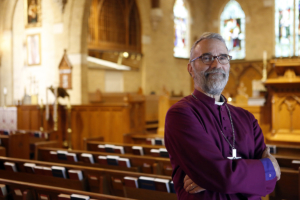
Sabune is the pastor chaplain at Sing Sing Prison, a maximum security facility in Ossining, New York, about an hour's drive north of New York City. Most Americans know it simply as "Sing Sing "--a bleak and hard place depicted regularly in popular TV shows and movies.

But Sabune, 55 years old, sees beyond the bleakness of Sing Sing. That's because Sabune is more than just a priest who works in a prison. He is a laborer for the Lord, doing his work in places where people tend to recoil in fear. He sees the face of the Lord in the prisoners with whom he interacts every day.

In 25 years of ordained ministry, Sabune has been called to small struggling parishes as well as large, "tony" New York City churches. He has worked in street ministry, served as a cathedral dean, and has stood twice for election as a bishop. But no matter where or what his calling, prison ministry remains the backbone of his life's work.

Pointing to his ever-present Bible, he inquired, "Why are we doing this? We do it because Jesus said so."

His passion for his work is evident through the intensity of his expressive eyes and the caring manner he displays to his listeners.

Recently Sabune was named a Trinity Fellow by Trinity Parish, New York City [http://trinitywallstreet.org/outreach/?grants-fellows]. This $20,000 grant enabled him to focus on reconciliation work in Africa. He and two other clerics - a Roman Catholic priest and a UCC pastor -- will take their work and knowledge to prisons in Kigali, Rwanda. Why Rwanda? "Because they invited us," he simply explained. "It's not different from any place in the world. They invited us and we said we will come."

Through recent interviews, Sabune shared his prison ministry work and provided insight into the man who walks daily among God's outcasts.

Meet Petero Sabune

Sabune was born in 1952 in Uganda, a country he left as a 16-year-old, fleeing the ruthless dictator Idi Amin. With sorrow evident in his voice, Sabune revealed that Idi Amin killed both his brother and his sister.

Sabune learned about God and about life at the knee of his father, a priest who worked with refugees.

Sabune was educated in the United States. As a 1977 Vassar graduate, his undergraduate degrees were in political science and English. After seminary at Union Theological Seminary in New York City, he was ordained in 1981 by Bishop Paul Moore of New York. 

He and his wife, Maureen, have four children: Haba, 26, currently in medical school; Rini, 24, a high school teacher; Bing, 20, working in Morocco; and Nzaba, 17, a high school junior—plus two dogs and three cats. They are also the "adopted" parents of the children of Sabune's deceased siblings: his sister's daughter, Kami, 29, and his brother's son, Richard, 20.

In his work as a parish priest, Sabune has served churches in two dioceses—in the Diocese of New York: Grace, White Plains, Saints John, Paul and Clement, Mt. Vernon, Trinity Parish and St. James (both in New York City); in the Diocese of Newark, Incarnation, Jersey City, and Trinity and St. Paul's Cathedral as dean. Wherever he was called, prisons remained an important part of his ministry. "I kept doing it no matter what parish I was in."

Sometimes he encountered parishioners who were not supportive, "not initially." But, reservations fell, Sabune revealed, after "a bit of education, a bit of the gospel mandate."

Well known in the Episcopal Church, Sabune is active on all levels. "Currently I serve on Executive Council," he stated. "I chair the prison ministry network for Province II and for the Diocese of New York."

A life dedicated to prison ministry

"For me, it's a gospel mandate," Sabune explained, pointing to the Bible which he keeps close to his side and citing key passages:

Matthew 25: "…for I was hungry and you gave me food, I was thirsty and you gave me something to drink, I was a stranger and you welcomed me, I was naked and you gave me clothing, I was sick and you took care of me, I was in prison and you visited me." Then the righteous will answer him, "Lord, when was it that we saw you hungry and gave you food, or thirsty and gave you something to drink? And when was it that we saw you a stranger and welcomed you, or naked and gave you clothing? And when was it that we saw you sick or in prison and visited you?" And the king will answer them, "Truly I tell you, just as you did it to one of the least of these who are members of my family, you did it to me."

Hebrews 13 -- 3: "Remember those who are in prison, as though you were in prison with them; those who are being tortured, as though you yourselves were being tortured."

Student field work opened his eyes. "At seminary you had a choice of field work assignments. Mine was prison. That's my introduction to prison ministry."

A quarter of a century later, he never left it. "I have been blessed with work in prison ministry. Prison ministry is very foundational in terms of gospel mandate."

Sabune has participated in prison ministry in a variety of contexts. One in particular involved collaboration between the New Jersey courts, Rutgers University and the cathedral in Newark. "You could go to the courts and have the kids sentenced to you, depending on the crime," Sabune said.

The kids, he continued, were under 18 years old. The courts released them to go to the cathedral where "they did their homework. Students from Rutgers came to tutor them and to get credit. The partnership worked. It was a win-win."

Noting that "there has been an explosion of prisons," he reflected on the state of prisons and prisoners. "Prisons are a mirror of society. We're not treating the causes. We're treating the symptoms. We know it's drugs. We know it's guns. We know that."

He has served as Sing Sing's pastor chaplain for five years. "My office is 10 doors in," he explained. Ah, but that means it's 10 doors out. He smiled and agreed, "Going to a prison is not for everyone."

Admitting "Sing Sing is a tough place," his eyes light up as he talks about the inmates, their interests, devotion, Bible study and the sacraments. "I've done about 49 baptisms there," he said.

Sabune's feelings about prisoners are strong and his body language punctuates his commitment. "They are a hidden population. So you don't see them. But you pray and hope that you touch one person or 49 or the people at Bible study every night. It's what has been thrown away or has been discarded that is being transformed and made new. That's what we're trying to accomplish in our daily life."

Often asked to speak about prison ministry and to teach others about it, Sabune developed a four point process which he believes is critical. "I encourage Christians in their faith to do three things as a regular discipline of prison ministry: first is to pray; second is to study; and third is to act. Then, there is reflection."

Prayer

"The first line of defense for Christians is prayer. Without prayer, we can't do it."

Holding his Bible, Sabune continued, "We encourage and we invite people to pray. We can give you the name of a person to pray for. We have people praying for each other. If you are praying for each other, you are praying in solidarity inside and outside. You build up a rhythm of prayer."

He went on, "You might say 'I'm going to pray. I can't go to prisons. I'm afraid of prisons, but I feel something in me.'" 

As for the incarcerated, "They may never meet you, they might not know who you are. But they are praying for you. And you are praying for them."

Promising to provide the name of someone to pray for, he challenged, "Pray and see what happens. You'll be surprised what you'll get out of it. The power of prayer is one of the most powerful instruments we have as Christians."

Study

He always encourages people to study and learn about prisons, prisoners and their plight. "Do you know what happens when someone gets arrested?" he asked. "You need to understand" their experiences in order to minister to them. "People don't understand what happens when you get arrested. You get booked. Fingerprinted. Indicted. Tried. Sentenced. Imprisoned. Then get out."

He recommended three books: They All Come Back by Jeremy Travis; Dwight Johnson's The Blueprint of Time, chronicling what happens to the family when a child is arrested; and Life on the outside: The prison odyssey of Elaine Bartlett, addressing the issue of the impact on children.

"Prison," Sabune stated, "is social, economic, political incarceration. For our purposes, it's also spiritual. What happens when you lock up a 16 year old kid? We need to learn."

Action

After prayer and study, action is the natural next step, and there are many forms of action. Anyone can do prison ministry, he said, even from the comforts of home and hearth.

"There's so many ways you can help. People can visit, can pray, can call, can send books, can send cards -- cards are very, very big --Mother's Day cards, Father's Day cards."

His list of suggestions continued: Write. Accompany children to visit an imprisoned parent. Knit a sweater or a hat. Provide presents for the incarcerated—men and women—to give to their children for holidays and birthdays. Be with, care for and feed children while their parents are visiting. "You stay with the children because they are traumatized," he explained. "They are ashamed that their parents are in prison."

Sabune pointed to what he named "a real issue" -- providing visiting family with appropriate clothing. "Sometimes people who have traveled far have been stopped from visiting loved ones because they might be wearing inappropriate clothing, especially women. There are people [at the prison] with clothes and assistance. It's simple but it's critical. They travel for hours and then are at the gate and they can't visit. There are people waiting with a blouse or a pair of pants. This is a big help."

Reflection

Reflection is not the last step; rather, it's an introduction to re-starting the process. To Sabune, prison ministry should cycle, but never end.

"Prayer is God is calling you to do. Study what it is you want to do. And then act on what you have studied and prayed about. Then the last piece of that is reflection. And then go back."

He credited the Episcopal Church with the dedication and compassion to undertake effective prison ministry. "We're doing a lot more than we give ourselves credit for. We're inside. We're outside. We're doing summer camps. We're helping reentry. If you come to any prison you find Episcopalians and Christians helping every day."

Sing Sing may be a maximum security prison whose mere name frightens most people, but to Petero Sabune, it's his church.

"I'm a pastor. It's the parish work that I do."

NOTE: Watch the Rev. Canon Petero Sabune talk about prison ministry in the multimedia presentation on Episcopal Life Online

-- - Neva Rae Fox is a communications specialist for the Episcopal Church.

» Respond to this article

2007

Search

Browse by Topic:

Multimedia »

To watch this video on your browser, download the current Adobe Flash Player.
Listening Process embarks on new phase
Copyright © 2008 Episcopal Life Online