
Editorial note: This content is updated and adapted from “The Episcopal Street Action Handbook,” a collaboration originated by Jerry Maynard, Kimberly Jackson, Chris Corbin, and members of The Episcopal Church Center staff.
As Episcopalians, our faith calls us to stand in solidarity with vulnerable people, to proclaim justice and peace, and to love our neighbors. This toolkit offers spiritual grounding and practical resources for faithful presence at protests and public demonstrations.
These materials integrate spiritual care, nonviolence training, and the logistics of safe, peaceful, Christian witness. Most of these resources come from organizations outside The Episcopal Church.
What is a Protest Chaplain?
A protest chaplain is someone who can offer spiritual grounding and care before, during, and after a demonstration. Chaplains can be a reminder of the sacred amid struggle by leading services and prayers, as well as by listening and providing a calming presence. Their pastoral authority and presence can help de-escalate tensions.
Resources for Organizing Protests
- Organizing for Power, Organizing for Change: See resources for nonviolent direct action organizing on the Action Resources page. (Organizing for Power, Organizing for Change)
- Organizing Public Demonstrations (Community Toolbox)
Training Resources
- Bystander Intervention Toolkit (American Friends Service Committee)
- De-escalation Resources (Hands Off!)
- Peaceful Practices: A guide to healthy communication in conflict (Mennonite Central Committee)
- Peaceful Protest & Protest Safety Resources (The Leadership Conference on Civil and Human Rights): This document contains links to numerous resources from member organizations
- Staying Safe During a Protest (NAACP)
- Tips for Preparedness, Peaceful Protesting, and Safety (Human Rights Campaign)
- Tips to Stay Safe during PRIDE (Anti-Violence Project)
- Accompaniment: For volunteers seeking to accompany neighbors to immigration court, see regional trainings offered under “Immigration Court Accompaniment Volunteer programs” in The Episcopal Church’s Immigration Action Toolkit.
Know Your Rights Resources
“Know your rights” trainings and resources are especially helpful prior any demonstration. Certain resources below are particularly useful for immigrant communities with or without U.S. citizenship and those who work with them.
- Know Your Rights (Civil Liberties Defense Center)
- Know Your Rights (Immigration Legal Resource Center)
- Know Your Rights: Immigrants’ Participation in Protests (National Immigration Law Center)
- Protesters’ Rights (ACLU) (en español)
- National Lawyers Guild: The NLG provides legal support for protests and offers a variety of online resources.
Spiritual Resources
- A Biblical Approach to Protest (Reformed Theological Seminary)
- Climate Justice Movement Chaplaincy (Unitarian Universalist Ministry for Earth)
- The Class of Nonviolence (Colman McCarthy, Center for Teaching Peace)
- Find downloadable prayers, songs, and outlines for services before and after a demonstration below.
Vulnerable Populations
Because the current administration has escalated federal-level immigration enforcement and has used racial profiling in those efforts, people without U.S. citizenship should carefully consider the risks of participating in protests, particularly those without documentation or with temporary status.
Since the risks of public action vary by individual identity and comfort level, some may understandably focus on less-visible ways to participate. Honoring the ways others take action while assessing how to best use one’s own capacity is an important communal aspect for engagement. Non-public action might include preparing communications to organize local protests, social media monitoring and posting, sign-making, etc.
Media Engagement
Contact The Episcopal Church’s Office of Public Affairs at media@episcopalchurch.org for support in reaching out to local or national news media outlets in advance of protests or rallies.
What to Bring
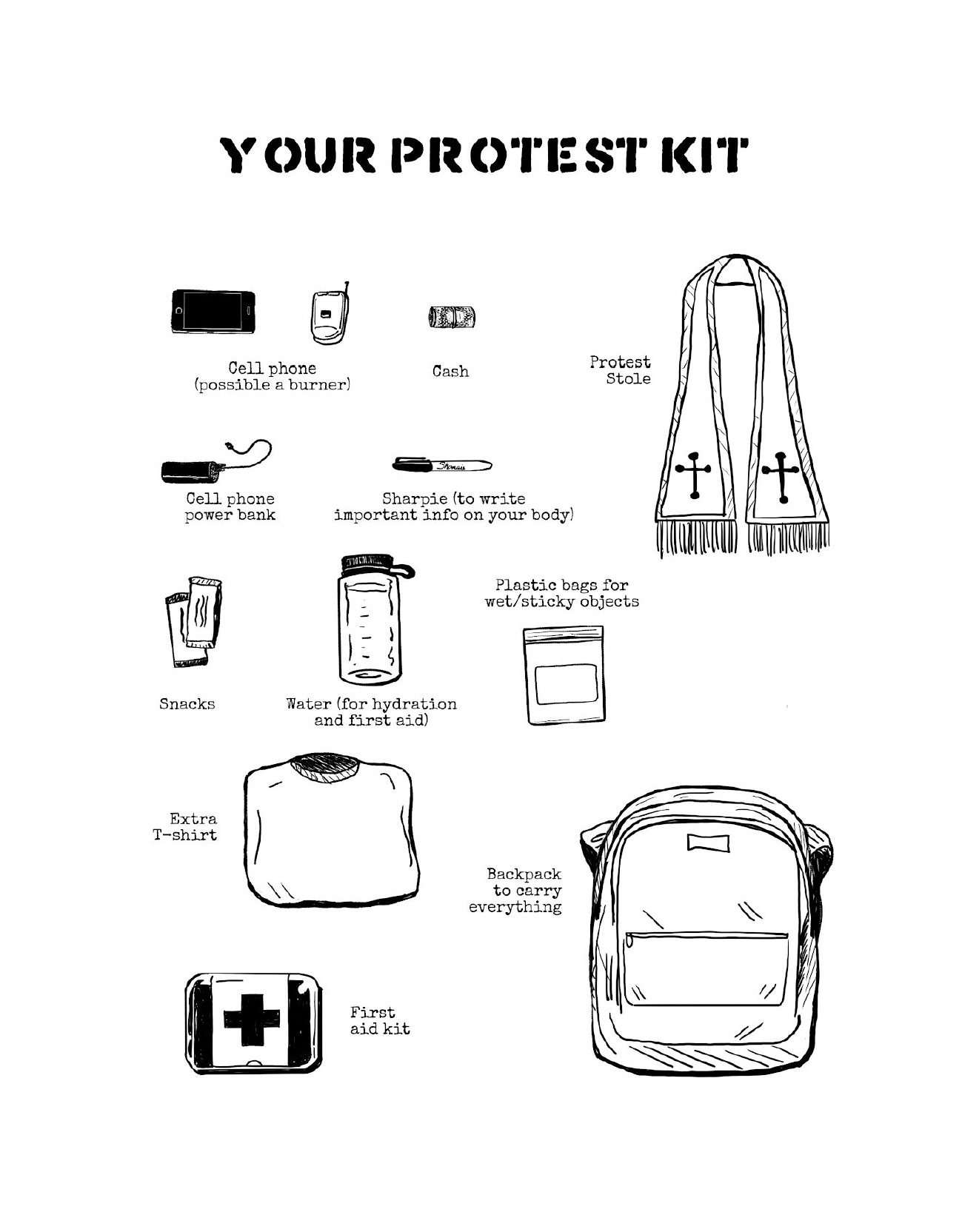
Cash
Cell phone (be aware phones may be searched)
Cell phone power bank
Backpack to carry everything
Extra T-shirt
First-aid kit
Protest stole
Sharpie (to write important information on your body)
Snacks and water (for hydration and first aid)
Plastic bags for wet/sticky objects
Know Before You Go
- Write these on your arm:
- Emergency contact name and number
- Lawyer’s number or legal hotline (National Lawyers Guild 212-679-6018 or search for your local chapter)
- Allergies / medical info
- Tell someone your route and return time.
- Charge your phone and bring a small power bank.
- Pack light: ID, water, snacks, cash, first aid, weather gear, mask, hand sanitizer
- Leave behind: valuables, contact lenses, credit cards
Suggested Orders of Service
Liturgy Before the Protest
Ingathering
Opening Words
Words of Motivation
Community Building
Scripture
Sending Forth
Service After the Protest
Ingathering
Opening Words
Words of Reflection
Community Building
Prayers
Closing