
This page is available in: Español
Bible Study: Easter Sunday (A) – April 5, 2026
April 05, 2026
RCL: Acts 10:34-43; Psalm 118:1-2,14-24; Colossians 3:1-4; Matthew 28:1-10
Opening Prayer |
Almighty God, who through your only-begotten Son Jesus Christ overcame death and opened to us the gate ofeverlasting life: Grant that we, who celebrate with joy the day of the Lord’s resurrection, may be raised from the death of sin by your life-giving Spirit; through Jesus Christ our Lord, who lives and reigns with you and the Holy Spirit, one God, now and for ever. Amen.
Context |
She watched him die.
Up close.
Close enough to see what empire does when it wants to make a point.
Close enough to hear his final breath rasp against the weight of his body.
It’s been three days since the horror. She makes her way to the tomb before sunrise. Grief doesn’t sleep. She pulls her wrap tighter, though it does little against the icy ache that has settled behind her ribs. She expects a sealed grave. Stone over the entrance. Closure.
But the mouth of the tomb stands open.
Frantic, she looks for Jesus—his body—but finds an empty tomb. “They have taken him,” she concludes. That’s the only story she’s got. Theft is more plausible than resurrection. She runs to tell Peter and the other disciple.
Now, the men run. One outruns the other. The body is gone. Linen wrappings where flesh had been. The head cloth is folded neatly, almost domestic, like someone tidying up before leaving the room. One of the men believes, though neither understands. Then they leave.
She stays.
She weeps without restraint. The sounds of her unguarded lament—the wailing and howling—fill the garden. Tears blur her vision. Two figures in white ask her, “Woman, why are you weeping?” She repeats the only story that makes sense to her right now: “They have taken my Lord.”
She turns and sees a man standing in the soft morning light. Still hazy with grief, she assumes he must be the gardener. Which, in a way, is not entirely wrong.
She sees. And she does not see.
Then he says her name.
“Mary.”
Theological Reflection |
He says her name.
And suddenly the world steadies.
You can almost feel it—the way grief loosens its grip for a second, the way the mind that has been spinning and spinning finally grabs onto something solid again.
The resurrection had already happened, but she didn’t know it. She had seen him and not known him. She had stood in the garden with the risen Christ and not recognized him.
Grief does that. It narrows the world. It scrambles the signal.
The tomb was empty.
And so was Mary.
Until he spoke her name.
But when she hears her name in his voice, in her teacher’s voice—“Mary”—two recognitions happen at once. Suddenly, she knows who he is. And just as suddenly, she remembers who she is.
To be called by your name is to be relocated inside love. And that may be the truest sound of resurrection.
The world had already changed.
Now she could see it.
That moment of recognition tells us something about how resurrection actually works. In many ways, this story is about all the ways resurrection is missed.
If resurrection depended on our clarity, we would miss it.
Thankfully, Jesus doesn’t wait until Mary’s theology sorts itself out. He moves toward her confusion and grief. The turning point is not her recognition of him. It is his recognition of her.
Notice what changes the moment. It is not Mary’s understanding. It is Jesus speaking her name.
And that matters because the resurrection did not occur in a peaceful world. Resurrection can unfold while grief is still present. Mary is still weeping even as Jesus stands before her.
Empire humiliated Jesus publicly. Rome exposed and reduced him. Crucifixion was theater—a warning, a spectacle, a stripping of dignity. Empire works through public spectacle and coercion. Empire says: You are what we label you. It assigns identity through accusation and spectacle.
But resurrection responds to humiliation not with louder spectacle but with intimacy. God responds to public shaming with personal naming. God works through personal address and recognition. God says: You are who I call you.
“Mary.”
In that moment, nothing external has changed. The empire still stands. The grief is still real.
But her place in the world is restored. She is not erased. She is not reduced to a witness of violence. She is still herself—known, located, addressed.
“Mary.”
The first miracle is that he is alive. The deeper miracle is that love survives death. Deeper still, the violence meant to erase him does not get the last word. And the deepest layer may be this: Love is stronger than the forces that try to rename us, to shrink us, to tell us who we are allowed to be.
This is why the moment heals: not because grief vanishes, but because the voice she trusted—the voice that knew her before the cross—is still speaking.
Resurrection restores her place in a world that has become unlivable. It does this by calling her back into relationship.
“Mary.”
This matters because before we understand anything at all, we are called. Before our eyes adjust to the light, we are already seen. Before we take a single step toward God, we discover that God has spoken our name.
The tomb was empty.
But Mary was not abandoned.
The world is still violent all these years after Easter. Rome is still Rome. Death still exists. The empire still stands.
Grief says: “There is no future.”
Resurrection says: “There is no end.”
In a world of resurrection, we combat grief with the next right thing. And the next right thing is not escape. It is witness.
Easter does not lift us out of a suffering world; it restores our place within it.
Now restored, Mary is sent by Jesus.
“Go.”
And she goes.
She becomes the apostle to the apostles while Rome is still in power. Her identity restored, her vocation is revealed.
As Leonard Cohen wrote, “Love is not a victory march. It’s a cold and a broken hallelujah.” Faith is praise rising from a life that still aches, from a heart that has not finished grieving.
The empire still stands, even now. But resurrection restores our footing inside it. It restores our capacity to live faithfully despite it.
Mary is not healed of the cross. She is sent out through it.
Morning light spreads across the garden where she had been crying, touching the same dirt, the same stone, the same leaves trembling in the breeze.
And in that moment, the world starts over.
Reflection Questions |
- When in your life have you feel like Mary in the garden? When has grief or exhaustion has narrowed your vision?
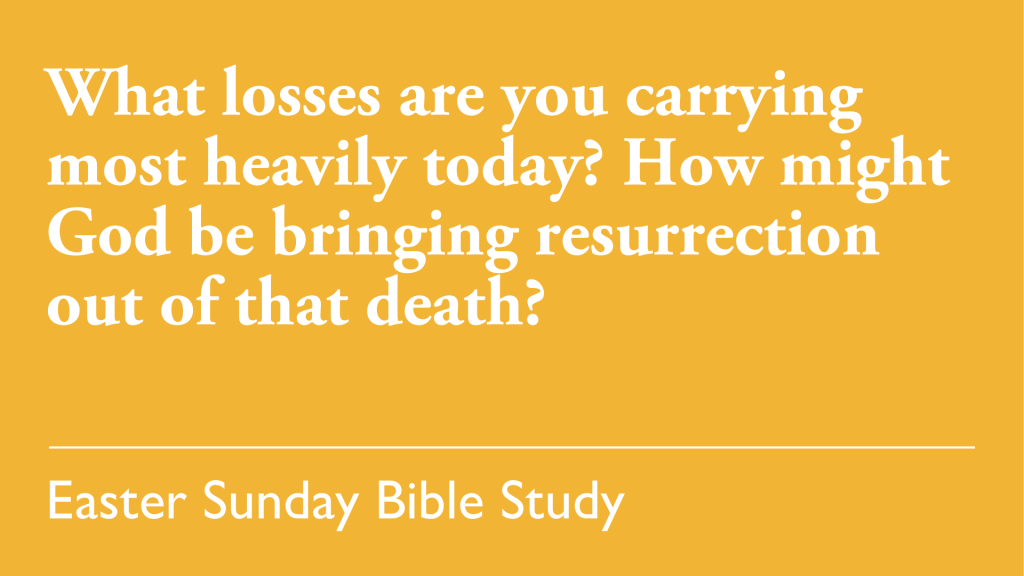
- What losses are you carrying most heavily today? How might God be bringing resurrection out of that death?
- What helps you to hear God speak your name, restoring something true about who you are?
Faith in Practice |
Sometime this week, take a quiet moment and write your name at the top of a page.
Sit with the story of Mary in the garden and imagine Christ speaking your name the way he spoke hers—with love. Then answer this question: “If I believed I was truly known and called by God, the next faithful step I would take is…”
Let the answer be small and honest. Resurrection often begins that way.
Tina Francis is a seminarian and writer preparing for ordination in the Episcopal Church. She is completing her Master of Divinity at the Seminary of the Southwest in Austin, Texas, where she lives with her husband and son. Born to South Indian parents and raised across Dubai, Canada, and Seattle, she carries a love for stories that cross borders. She finds God in conversation, shared meals, and a well-made cup of masala chai.
This page is available in: Español
Don’t forget to subscribe to the Sermons That Work podcast to hear this sermon and more on your favorite podcasting app! Recordings are released the Thursday before each liturgical date.
Receive Free Weekly Sermons That Work Resources!


This page is available in: Español