
Glossary of Terms
Believer’s Baptism
A term describing the practice of baptizing only those who consciously and knowingly affirm their faith in Christ. The practice normally requires prior instruction and precludes infant baptism. In contrast, the Episcopal Church allows infants and younger children to be presented for baptism by their parents and sponsors who “make promises in their own names […]
Bell, Bernard Iddings
(Oct. 13, 1886-Sept. 5, 1958). A leading American educator. He was born in Dayton, Ohio. Bell received his B.A. from the University of Chicago in 1907 and his S.T.B. from the Western Theological Seminary in 1912. He was ordained deacon on May 29, 1910, and priest on Dec. 18, 1910. From 1910 until 1913, Bell […]
Bell, Wilbur Cosby
(Apr. 1, 1881-Apr. 6, 1933). Theologian and Seminary Professor. He was born in Augusta County, Virginia. Bell received his B.A. from Hampden-Sydney College in 1900 and his M.Div. from the Virginia Theological Seminary in 1905. He was ordained deacon on June 16, 1905, and priest on Feb. 4, 1906. Bell began his ministry at Trinity […]
Bells and Smells
” Colloquial term for the elaborate ritual style common in many Anglo-catholic parishes. In this expression, “bells” refers to the ringing of bells at various points during the eucharist. “Smells” refers to the use of incense. This term is used pejoratively by some, playfully by others.
Bene Esse
See Esse, Bene Esse, Plene Esse.
Benedicite, omnia opera Domini
Canticle from the Apocryphal book, Song of the Three Young Men, verses 35-65. It is also known as the “Benedicite.” It appears as Canticles 1 and 12 in the BCP (pp. 47-49, 88-90) and has been used at the morning office since the fourth century. The Benedicite is a continuation of the canticle Benedictus es, […]
Benedict of Nursia
(c. 480-c. 547). The “Patriarch of Western Monasticism.” He was born in Nursia in Umbria, Italy, and then educated at Rome. He did not like the degenerate life of the city, and withdrew to the country, where he lived as a hermit in a cave at Subiaco. Gradually a community grew up around him. Sometime […]
Benedictine Spirituality
Shaped by the Rule of St. Benedict (c. 540), Benedictine spirituality is essentially monastic. It focuses on the desire to seek God under the guidance of an abbot. The abbot was originally elected for life. The monks' chief work (opus Dei) is the praise of God, in the form of a community recitation or chanting […]
Benediction
A blessing pronounced by a bishop or priest at the conclusion of a worship service. In a general sense, it may refer to any prayer that closes a meeting or gathering. See Benediction of the Blessed Sacrament.
Benediction of the Blessed Sacrament
A service of devotion to the Blessed Sacrament. In this service a large Host is placed in the luna of a monstrance on the altar so that the Host is visible to the congregation. The Host is censed while it is in the monstrance and used to bless the congregation by making the sign of […]
Benedictus
See Benedictus Dominus Deus.
Benedictus Dominus Deus
Canticle based on Zechariah's hymn of thanksgiving at the circumcision of his son, John the Baptist (Lk 1:68-79). The hymn blesses God “who has come to his people and set them free,” and celebrates the prophetic ministry that John the Baptist will have as forerunner of the Messiah. It is also known as “The Song […]
Benedictus es, Domine
Canticle based on the Apocryphal Song of the Three Young Men, verses 29-34. The canticle offers glory and praise to God, and concludes with a doxology. It is also known as “A Song of Praise.” It appears as Canticles 2 and 13 in the BCP (pp. 49, 90). It is recommended for use in the […]
Benedictus qui venit
The anthem “Blessed is he who comes in the name of the Lord. Hosanna in the highest,” which follows the Sanctus in the eucharistic prayer. It may be sung or said. The term is from the Latin first words of the anthem. It is included in all Rite 2 eucharistic prayers of the BCP, and […]
Bennett, Dennis Joseph
(Oct. 28, 1917-Nov. 1, 1991). The “father of charismatic renewal in the Episcopal Church.” He was born in London, England. His family moved to the United States when he was ten years old. He graduated from San Jose State College in 1944. Two years later he entered the University of Chicago Divinity School and received […]
Benson, Richard Meux
(July 6, 1824-Jan. 14, 1915). A founder of the Society of St. John the Evangelist. He was born in London. Benson received the M.A. at Christ Church, Oxford, in 1849. He was ordained deacon in 1848 and priest in 1849. In 1850 he became vicar of Cowley, two miles from Oxford. A sermon preached by […]
Berakoth (singular Berakah)
The Hebrew word for blessings. Typically, they begin, “Blessed are you, Lord our God, King of the universe,” followed by naming that for which God is blessed, such as “who brings forth bread from the earth.” Scholars distinguish between berakoth and hodayoth prayers. The latter begin, “We give you thanks.” Jewish liturgical prayers have tended […]
Berkeley Divinity School
One of eleven Episcopal seminaries in the U.S. It was founded by Bishop John Williams of Connecticut. It began in 1849 as the theological department of Trinity College, Hartford, and opened as a divinity school on Oct. 2, 1854, at Middletown. In 1928 it moved to New Haven and was affiliated with Yale University. On […]
Berkeley, George
(Mar. 12, 1684-Jan. 12, 1753). Priest and educator. He was born in Kilcrin, near Thomastown, Kilkenny, Ireland, and educated at Trinity College, Dublin. He was ordained in 1707, and in 1724 he became dean of Derry, where he became very interested in supporting the churches in colonial America and in converting the Native American tribes […]
Berkeley, William
(1606-July 9, 1677). Colonial governor of Virginia. He was born in or near London and educated at Queen's College and Merton College, Oxford University. He was governor of Virginia from 1642 until 1652, when he was forced out of office during the interregnum. When the English monarchy was restored in 1660 he became governor again […]
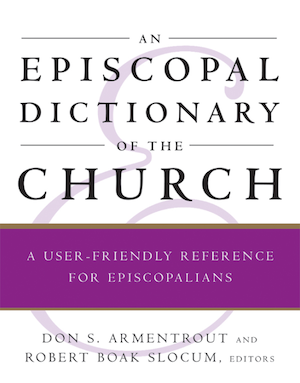
Glossary definitions provided courtesy of Church Publishing Incorporated, New York, NY,(All Rights reserved) from “An Episcopal Dictionary of the Church, A User Friendly Reference for Episcopalians,” Don S. Armentrout and Robert Boak Slocum, editors.