
Glossary of Terms
Enlightenment, The
An intellectual and cultural development which emphasized the ability of human reason to grasp the ultimate meaning of life and creation in terms of self-evident truths. It was widespread in western Europe during the seventeenth and eighteenth centuries. The Enlightenment upheld the autonomy of human reason and reason's adequacy to grasp and shape the world […]
Enmegahbowh
(c. 1813-June 11, 1902). American Indian priest and missionary. He was born on the north shore of Rice Lake, Ontario, Canada, and was a member of the Chippewa (Ojibwe) Nation. His name means “one-who-stands-before-his-people.” After he was baptized by a Methodist preacher he took the name John Johnson. Some time before 1850 he was given […]
Enriching Our Worship
A collection of supplemental liturgical materials prepared by the Standing Liturgical Commission (1997) and published by Church Publishing Incorporated. It includes resources and forms for Morning and Evening Prayer, Order of Worship for the Evening, the Great Litany, and the Holy Eucharist. The canticles and prayers represent the recovery of ancient biblical and patristic images, […]
Entrance Rite
The liturgical gathering of the people as the worshiping community at the beginning of the eucharist. The entrance rite prepares the congregation for the liturgy of the word. Until the fourth or fifth centuries, the eucharistic liturgy typically began with the celebrant's salutation and the first reading. As Christian worship became more formalized, entrance rites […]
Ephrem
(Ephraem) of Edessa (d. June 373). Early church theologian. He was born at or near Nisibis, in modern-day Turkey. Ephrem lived at Nisibis until 363, when he moved to Edessa. He lived there as an anchorite or hermit. He is remembered for his exegetical, theological, and especially poetic writings. Ephrem has been called the “Lyre […]
Epiclesis
The invocation of the active presence of the Holy Spirit in the eucharistic prayer so that the bread and wine may become the body and blood of Christ. The presider at the eucharist may extend his or her hands over the gifts at the epiclesis. The term is based on the Greek word that means […]
Epiphany Season
A season of four to nine weeks, from the Feast of the Epiphany (Jan. 6) through the Tuesday before Ash Wednesday. The length of the season varies according to the date of Easter. The gospel stories of this season describe various events that manifest the divinity of Jesus. The coming of the Magi is celebrated […]
Epiphany, The
The manifestation of Christ to the peoples of the earth. The winter solstice was kept on Jan. 6 at some places during the first centuries of the Christian Era. In opposition to pagan festivals, Christians chose this day to celebrate the various manifestations, or "epiphanies," of Jesus' divinity. These showings of his divinity included his […]
Episcopal
1) Concerning the Episcopal Church. Used in this sense, the adjective “Episcopal” is always capitalized. For example, “The Episcopal liturgy will be used at the wedding.” Similarly, “The Episcopal priest attended the ecumenical gathering.” 2) Concerning a bishop or bishops. Used in this sense, the adjective “episcopal” is not always capitalized. For example, an episcopal […]
Episcopal Academy of Connecticut
This school was founded at Cheshire, Connecticut, in 1794 to “serve the double purpose of a preparatory school and a university.” Sometimes it was referred to as “Seabury University.” The academy opened in 1796 and admitted boys and girls until 1836, when it became a boys' school. It never developed into a college. It closed […]
Episcopal Academy, Merion, Pennsylvania, The
The vestry of Christ Church in Philadelphia, Pennsylvania, founded The Episcopal Academy on Jan. 1, 1785. It opened on Apr. 4, 1785. The president of the board of trustees was the rector of Christ Church, the Rev. William White. Among the founders were Robert Morris and Francis Hopkinson, signers of the Declaration of Independence, Edwin […]
Episcopal Ad Project
This ministry was started at St. Luke's Episcopal Church, Minneapolis, in 1978. The Rev. Dr. George Harvey Martin, the rector, asked for help from advertising professionals to write ads which would invite people into the Episcopal Church. Martin asked for help from Tom McElligott, Jr., the son of an Episcopal priest in the Diocese of […]
Episcopal Church Annual, The
An annual directory of the Episcopal Church. It contains the names and addresses of all parishes and diocesan offices, bishops, priests and deacons, seminaries, publications, conference centers, social agencies, religious orders, and other agencies. It also contains national church statistics and information on all the provinces in the Anglican Communion. Its historical predecessors go back […]
Episcopal Church Center
The national headquarters for the Episcopal Church, located in New York City. It includes the executive offices of the Presiding Bishop. It is the place where the fiduciary responsibilities for the Domestic and Foreign Missionary Society are carried out; a focal point for the work of General Convention; a center for ecumenical and interfaith engagement; […]
Episcopal Church Flag and Seal
On Oct. 16, 1940, the House of Bishops and the House of Deputies adopted an official flag for the Episcopal Church. This was the 251st anniversary of the day the General Convention ratified the Constitution and Canons and adopted the BCP. It was designed by William M. Baldwin (d. 1942), a member of the Cathedral […]
Episcopal Church News
(Jan27, 1952-Aug. 18, 1957). This journal continued The Southern Churchman, which began publication in 1835. The first volume of Episcopal Churchnews was published on Jan. 27, 1952. It was weekly until Sept. 20, 1953, when it became bi-weekly. It carried the motto "Catholic for every Truth of God, Protestant against every error of man." It […]
Episcopal Church Seal
See Episcopal Church Flag and Seal.
Episcopal Church, The
A conference of three clergy and twenty-four lay delegates met at Chestertown, Kent County, Maryland, on Nov. 9, 1780, and resolved that "the Church formerly known in the Province as the Church of England should now be called the Protestant Episcopal Church." On Aug. 13, 1783, the Maryland clergy met at Annapolis and adopted the […]
Episcopal Clerical Directory
A compilation of clergy biographies was first published in 1898. Over the years it was variously called Lloyd's Clerical Directory, The American Church Directory, and Stowe's Clerical Directory. In 1956 the name was changed to The Clergy Directory. In 1972 it was changed to The Episcopal Clergy Directory. Since 1974 the title has been Episcopal […]
Episcopal Divinity School (EDS)
EDS was established at Cambridge, Massachusetts, on June 6, 1974, by the merger of the Philadelphia Divinity School and the Episcopal Theological School, Cambridge, with the encouragement of the Episcopal Church's Board for Theological Education. The faculty and student body are mostly Christians, but other faith communities are represented as well. The mission of EDS […]
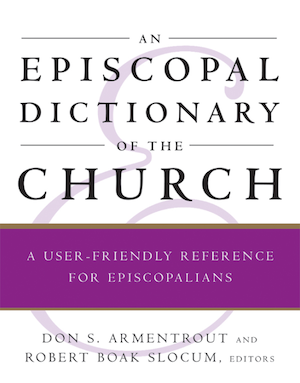
Glossary definitions provided courtesy of Church Publishing Incorporated, New York, NY,(All Rights reserved) from “An Episcopal Dictionary of the Church, A User Friendly Reference for Episcopalians,” Don S. Armentrout and Robert Boak Slocum, editors.