
Glossary of Terms
Martyrium
A church built over a martyr's tomb or relics. The term may also indicate a church built in honor of a martyr. See Relics; see Reliquary.
Martyrs of Japan, The.
Francis Xavier, a Jesuit, first brought Christianity to Japan in 1549. Christianity spread rapidly, causing resentment and leading to persecution. On Feb. 5, 1597, twenty-six Christians-six European Franciscans, three Japan (Nippon Sei Ko Kai), which is the Anglican Church in Japan. These martyrs are commemorated in the Episcopal calendar of the church year on Feb. […]
Martyrs of Lyons
In 177 a persecution of the Christians in Gaul (France) took place. The five persons most savagely persecuted were Attalus, Blandina, Maturus, Sanctus, and Pothinus, the first Bishop of Lyons. Nothing is known about Attalus. Blandina was a virgin slave girl, Maturus a recent convert, and Sanctus a deacon. Pothinus is believed to have been […]
Martyrs of New Guinea
( Eight missionaries and two Papuan martyrs who died at the hands of Japanese invaders in 1942. The first Protestant missionaries to Papua New Guinea were sent by the London Missionary Society in 1870. Anglican missionaries reached New Guinea in 1891. In 1898 the Anglican Diocese of Papua New Guinea was established and remained a […]
Martyrs of Uganda
( The Church Missionary Society began work in Uganda in 1877. At the end of the twentieth century the Anglican Church accounted for about 25% of the population of Uganda. On June 3, 1886, 32 young men, pages in the court of King Mwanga of Buganda, were burned to death on a large single pyre […]
Mary and Martha of Bethany
( Mary, Martha, and Lazarus of Bethany were a family and very close friends of Jesus. Mary and Martha were disciples of Jesus who offered him hospitality. Martha provided him food and other courtesies. Mary, who chose the “better part,” sat at Jesus' feet and listened to his teaching. The story shows clearly that these […]
Mary Magdalene, Saint
( A disciple of Jesus, she was from the city of Magdala in Judea, hence the surname Magdalene. She was the woman Jesus delivered from evil spirits. Mary was among the women who accompanied and supported Jesus and the apostles. She was present at the crucifixion. Mary was also the first to witness the resurrection, […]
Mary the Virgin, Mother of Our Lord Jesus Christ, Saint
( Mary the mother of Jesus has been an object of veneration in the church since the apostolic age. She has been a favorite subject in art, music, and literature. Her humility and obedience to the message of God at the time of the Incarnation have made her an example for all ages of Christians. […]
Maryland, Diocese of
This diocese was organized on Aug. 13, 1783, at Annapolis. On Oct. 12, 1868, the General Convention voted to divide the diocese and place some of the Maryland counties in the new Diocese of Easton. The 1895 General Convention created the Diocese of Washington and placed four Maryland counties in it. The Diocese of Maryland […]
Mason, Lowell
(Jan. 8, 1792-Aug. 11, 1872). An American educator, composer, and hymnal editor. He was born in Medfield, Massachusetts. Mason was a very gifted and energetic person, and his work as a compiler of hymn books began while he was organist and choirmaster of the First Presbyterian Church, Savannah, Georgia. The Boston Handel & Haydn Society […]
Mason, Lucy Randolph
(July 26, 1882-May 6, 1959). Labor activist and suffragette. She was born in Clarens, Virginia, and grew up in Richmond, where her father was an Episcopal priest. In 1914 Mason was appointed industrial secretary of the Richmond YMCA where she worked to get protective labor legislation for women and children and for workmen's compensation. When […]
Mass
A term for the Holy Eucharist. It is primarily used by Anglicans, Roman Catholics, and Lutherans. It appeared as a part of the title of the service in the first BCP of 1549. It is included by the Catechism in a list of names by which the eucharist is known (BCP, p. 859). It is […]
Mass of the Pre-Sanctified
See Pre-Sanctified, Mass of the.
Massachusetts, Diocese of
The Diocese of Massachusetts was organized at Boston on Sept. 8, 1784. The 1901 General Convention voted to divide the diocese and established the Diocese of Western Massachusetts. The Diocese of Massachusetts consists of the following counties: Barnstable, Bristol, Dukes, Essex, Middlesex, Nantucket, Norfolk, Plymouth, and Suffolk, and the township of Southborough in Worcester County. […]
Master (or Mistress) of Novices
See Novice Guardian or Novice Master or Novice Mistress.
Master of Ceremonies, or M.C.
The person present in the liturgy to direct the movements of the various ministers and people involved and to coordinate a sustained ceremonial style throughout. A master of ceremonies, when designated, also takes responsibility for any rehearsals of the liturgy. The term “minister of ceremonies” (not gender-specific or hierarchical in its connotations) may be used […]
Matins
An early morning worship service, the first of the canonical hours. The name comes from the Latin matutinus “pertaining to the morning.” It is one of the canonical hours, which developed as special times or hours for prayer and devotion. Matins, sometimes spelled “mattins,” was the longest of the services of the breviary. It consisted […]
Matter (Sacramental)
The material or gesture constituting the outward and visible sign of a sacrament. A valid sacrament also requires the appropriate form, minister, and intent. In this sacramental context, form refers to the words of prayer that express the meaning of the sacrament and the matter used in the sacrament. In baptism, the matter is water; […]
Matthew, Apostle and Evangelist
According to Mark, he was the son of Alphaeus. He was a Jewish tax collector working for the Roman government at Capernaum. Matthew is called Levi in the accounts of his call to discipleship in Mark and Luke, but he is always referred to as Matthew in the lists of the apostles. It is possible […]
Matthew’s Bible
English Bible issued in 1537. It was based on the work of William Tyndale, Miles Coverdale's Old Testament, and the work of Conrad Pellican. It was edited by John Rogers (c. 1500-1555), who used the alias “Thomas Matthew.” This Bible was printed at Antwerp. It was dedicated to Henry VIII, and licensed by him for […]
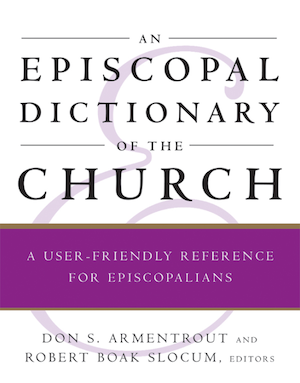
Glossary definitions provided courtesy of Church Publishing Incorporated, New York, NY,(All Rights reserved) from “An Episcopal Dictionary of the Church, A User Friendly Reference for Episcopalians,” Don S. Armentrout and Robert Boak Slocum, editors.