
Glossary of Terms
Missouri, Diocese of
Jackson Kemper was consecrated the Missionary Bishop of Missouri and Indiana on Sept. 1, 1835. On Nov. 16, 1840, the Diocese of Missouri was organized at Christ Church, St. Louis, which became Christ Church Cathedral on May 22, 1888. The General Convention of 1889 voted to divide the Diocese of Missouri. The Diocese of Missouri […]
Mite Box
” See Blue Box (UTO).
Miter, or Mitre
Liturgical headgear and insignia of bishops and other prelates. It is typically worn by bishops in procession and when pronouncing episcopal blessings. It is removed during prayer, including the eucharistic canon. The term is from the Greek for “turban.” The miter is shield-shaped and pointed at the top. It may be made of silk or […]
Mixed Chalice
The practice of mixing a little water with the wine that will be consecrated at the eucharist. The BCP states that this practice “is customary” (p. 407). It probably is derived from ancient Jewish custom. It was likely observed by Jesus at the Last Supper. It was the invariable practice of the early church, and […]
Mizeki, Bernard
(c. 1861-June 1896). Catechist and martyr in Rhodesia. He was born on the coast of Mozambique, and moved to Capetown, South Africa, in search of employment when he was a teenager. In Capetown he met Frederick Puller, a member of the Society of St. John the Evangelist. Puller baptized Mizeki on Mar. 9, 1886, and […]
Modalism
Modalism, or modalistic monarchianism, is a pre-Nicene teaching about the relation of Christ to God. First taught by Noetus of Smyrna at the end of the second century, modalism was also taught at Rome by Praxeas, Sabellius, and others. Modalism took several forms. Praxeas taught that Word and Spirit were simply names (or modes) of […]
Modernism
The term for the thought of some late nineteenth- and early twentieth-century Roman Catholic scholars who sought to embrace the results of recent advances in history, science, and philosophy. They trusted catholic tradition but mistrusted scholastic theology. They insisted on the complete freedom of scholarly research from ecclesiastical interference. Extreme modernists asserted that it was […]
Modeste, Leon Edgar
(b. Aug. 19, 1926). Director of General Convention Special Program. He was born in Brooklyn, New York. Modeste received his B.A. in 1950 from Long Island University and his M.S.W. in 1953 from the Columbia University School of Social Work. He also studied at the Graduate School of Business at Columbia University. Modeste taught at […]
Mollegen, Albert Theodore
(Feb. 17, 1906-Jan. 22, 1984). Seminary professor and theologian. He held the chair of New Testament Language and Literature and later the Clinton S. Quin Chair of Christian Ethics at Virginia Theological Seminary from 1936 until his retirement in 1974. As one of Paul Tillich's first American students, Mollegen became one of Tillich's most sympathetic […]
Monarchianism
From the Greek monos, “one,” and arche, “source” or “principle,” monarchianism is a teaching about God which flourished in the second and third centuries. It stressed the unity (or monarchy) of God rather than the three persons, Father, Son, and Spirit. Monarchianism occurred in two forms. Dynamic monarchianism, more properly called adoptionism, held that God […]
Monastery
A place where members of religious orders live in community, usually under the monastic vows of poverty, chastity, and obedience. The orderly life of prayer, work, and study is carried out in the context of the “hours of the day” or “divine offices” and the daily eucharist. The brothers in a monastery or sisters in […]
Monastic
A person who devotes his or her life to religious vows and who lives in community (in or associated with a monastery) or as a solitary. Monastic communities lead a life devoted to God in a monastery, in relative isolation from the world. Although monastic vows differ from tradition to tradition, they normally include poverty, […]
Monica, or Monnica
(c. 331-387). Mother of Augustine of Hippo. She was probably born in Tagaste, North Africa. Monica married Patricius, who may have been a nominal Christian. She was the mother of three children: Augustine, Navigius, and Perpetus. Most of the information about her is in Augustine's Confessions (Book IX). She was deeply committed to Augustine's conversion […]
Monk
A member of a male monastic community. See Monastic.
Monk, William Henry
(Mar. 16, 1823-Mar. 1, 1889). British music educator, composer, and organist. He was born in London. Much of Monk's life was spent as an organist and choirmaster in London parishes. He served as musical editor for the important British hymnal, Hymns Ancient & Modern. It is said that the title of this hymnal came from […]
Monophysitism
A christological teaching that the person of Christ consisted of a single divine nature or a united divine and human nature in which the human was absorbed by the divine. The full humanity of Christ was not upheld. The term comes from the Greek monos, “one,” and physis, “nature.” The teaching is associated with Eutyches, […]
Monothelitism
From the Greek monos, “one,” and thelema, “will.” A seventh-century christological teaching advocated by Sergius of Constantinople, Cyrus of Alexandria, and others. It presented the Person of Christ as having one divine will under which his human will was subsumed. Monothelitism was consistent with the Chalcedonian Definition concerning the two natures of the Person of […]
Monstrance
A frame or vessel, typically made of gold or silver, used to display the consecrated bread of the eucharist for veneration or Benediction of the Blessed Sacrament. Also known as an ostensorium. The term is from the Latin “to show or display.” The monstrance has a round, flat window in which the consecrated bread is […]
Montana, Diocese of
On Oct. 15, 1880, the House of Bishops established the Missionary District of Montana. It has had its own bishop from that time to the present. It was preceded by two larger jurisdictions. On Oct. 19, 1865, the House of Bishops resolved “That all those portions of our country, North of a line running along […]
Montanism
A charismatic Christian sect which appeared in Phrygia in Asia Minor during the closing years of the second century. Montanism was founded by Montanus and his assistants, Priscilla and Maximilla, who considered themselves to be inspired by the Holy Spirit. Their “revelations” carried the adherents of the new sect to extreme and unorthodox claims. All […]
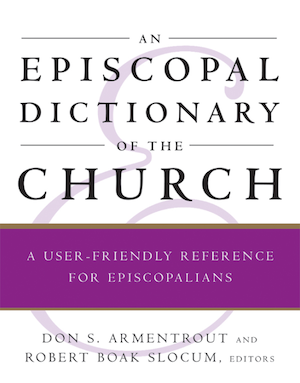
Glossary definitions provided courtesy of Church Publishing Incorporated, New York, NY,(All Rights reserved) from “An Episcopal Dictionary of the Church, A User Friendly Reference for Episcopalians,” Don S. Armentrout and Robert Boak Slocum, editors.