
Glossary of Terms
Muhlenberg, William Augustus
(Sept. 16, 1796-Apr. 8, 1877). A leading Episcopal priest of the nineteenth century. He was born in Philadelphia and baptized in the Lutheran Church. When the vestry of St. James' Episcopal Church gave his widowed mother a free pew, she attended that church and William grew up an Episcopalian. He graduated from the University of […]
Mulford, Elisha
(Nov. 19, 1833-Dec. 9, 1885). Social Gospel leader. He was born in Montrose, Pennsylvania. Mulford graduated from Yale in 1855. He studied theology at Union Theological Seminary, New York, and Andover Theological Seminary. He traveled in Europe and studied in Berlin, Heidelberg, and Halle. Mulford was ordained deacon on Apr. 20, 1861, and priest on […]
Muller, James Arthur
(Dec. 23, 1884-Sept. 5, 1945). Historian and theologian. He was born in Philadelphia. Muller received his B.A. in 1907 and his Ph.D. in 1915, both from Princeton University. He received his M.A. from Harvard in 1910 and his B.D. from the Episcopal Theological School in 1910. Muller was ordained deacon on June 5, 1910, and […]
Murphy, Edgar Gardner
(Aug. 31, 1869-June 23, 1913). Social Gospel theologian and southern liberal. He was born in Fort Smith, Arkansas, and studied at the University of the South, where he was deeply influenced by William Porcher DuBose. He also studied at the General Theological Seminary, but he received no degree from either school. He was ordained deacon […]
Murray, John Gardner
(Aug. 31, 1857-Oct. 3, 1929). The first elected Presiding Bishop. He was born in Lonaconing, Maryland, and educated at Wyoming Seminary, near Wilkes-Barre, Pennsylvania. In 1879 he entered Drew Theological Seminary, Madison, New Jersey, to study for the Methodist ministry, but he had to withdraw to help support his family when his father died. While […]
Murray, Pauli
(Nov. 20, 1910-July 1, 1985). First African American woman priest. She was born in Baltimore, Maryland, and raised in Durham, North Carolina. Murray graduated from Hunter College in 1933, and from Howard University Law School in 1944. Her senior thesis at Howard challenged the separate-but-equal principle behind segregation. It was used by lawyers in the […]
Musical Settings
A term commonly used for music provided for prose texts from the BCP that cannot be used with metrical tunes. The Hymnal 1982 provides such music (the items whose numbers are preceded by the letter S). Volume VI of the Church Hymnal Series provides musical settings for the Gradual Psalms, Alleluia Verses, and Tracts. The […]
Mutual Ministry
A term given to the concept of shared ministry and leadership in a congregation. Mutual ministry is an approach to Christian ministry that is lived out of the promises made in baptism. It sees the ministry of the whole congregation as the primary ministry. All members of the congregation are doers of ministry. Deacons and […]
Mutual Responsibility and Interdependence in the Body of Christ (MRI)
This manifesto was issued by the Pan Anglican Congress in Aug. 13-23, 1963, in Toronto, Canada. It pointed to three central truths: 1) the church's mission is to respond to the living God; 2) we are united in Christ; 3) it is time to find a new level of expression and corporate obedience. The manifesto […]
Myers, Chauncie Kilmer
(Feb. 14, 1916-June 27, 1981). Bishop and leader in urban mission. He was born in Schuylerville, New York. Myers received his B.A. from Rutgers in 1937 and his S.T.B. from the Berkeley Divinity School in 1940. He was ordained deacon on May 27, 1940, and priest on Dec. 21, 1940. Myers served as a Resident […]
Mystagogy
From the Greek mystagogos, the term refers to a process of initiation into “mysteries.” It may take place after baptism at the Easter Vigil, lasting throughout the Great Fifty Days of the Easter season. It involves the integration of adult neophytes into the life of the church. It is less strictly defined than the catechumenate. […]
Myth
The term has been used in many different ways over the centuries. Its most common use refers to a story or explanation which is unhistorical or fictional. In the past it referred to stories about gods from other religious traditions or about human heroes or heroines. Myth is used to communicate ideas or values that […]
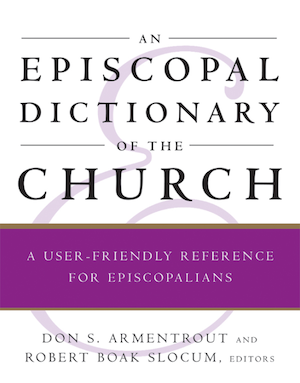
Glossary definitions provided courtesy of Church Publishing Incorporated, New York, NY,(All Rights reserved) from “An Episcopal Dictionary of the Church, A User Friendly Reference for Episcopalians,” Don S. Armentrout and Robert Boak Slocum, editors.