
Glossary of Terms
Restoration, The
The reinstatement in 1660 of the English monarchy under Charles II of the House of Stuart after the interregnum of the Commonwealth and Protectorate. On May 8, 1660, Charles II was proclaimed king by Parliament. He returned to England from the continent on May 25. With his return, the Church of England was restored, and […]
Restoring of Things Profaned
A form in the BOS for restoring to sacred use a church building, an altar, or other consecrated objects that have been profaned. It may precede the first church service after an act of vandalism or desecration. Portions of the prayer may be repeated for pastoral reasons at subsequent services on that day. The bishop […]
Resurrection of Jesus
The belief that Jesus was raised bodily from the dead by God on the third day after Jesus' crucifixion and burial, exalting him to the near presence of God in eternal glory. The resurrection of Jesus is at the heart of Christianity (Acts 2:22-36). Christian faith would be meaningless without the resurrection of Jesus (1 […]
Retable
The term may refer to a raised shelf or ledge behind the altar. This shelf is also called a gradine. The altar cross, altar lights, and vases of flowers may be placed on it. The tabernacle may also be placed on it. The term may also refer to a frame above and behind the altar […]
Retreat
A period of time, in a “place apart” from daily life and work, which normally includes silence, reflection, and may include some form of still, meditative prayer which may be combined with brief periods of activity and study. Retreats often focus on particular themes of the church year. Retreats may be communal, though they can […]
Reverence
1) Great respect, honor, or veneration. It may be associated with awe, devotion, and love. For example, the BCP notes the “Hebrew reverence and reticence with regard to the Name of God” (p. 583). The Preface to the 1789 BCP states that “the procuring of reverence, and the exciting of piety and devotion in the […]
Reverend, The
An adjective used in formally addressing a member of the clergy. It is from the Latin reverendus, “worthy of reverence.” It is intended to be descriptive. The term is incorrectly used as a noun title (like bishop or sister) to refer to a member of the clergy. For example, it is appropriate to say “the […]
Revised English Bible
A 1989 revision of the New English Bible (1970) that was intended to make it more suitable for public worship. “You” is used instead of “thou” in addressing God. The Revised English Bible also opted for inclusive language for people. The Roman Catholic Church joined the Protestant communions of the British Isles in sponsoring the […]
Revised Standard Version Bible (RSV)
The RSV is a revision of the American Standard Version (ASV) of the Holy Scriptures (1901), which was an American modification of the British revised version of 1881-1885. In 1937 the project of revising the ASV was authorized by the National Council of Religious Education. The RSV was completed in 1952 and published by the […]
Revised Standard Version of the Bible, an Ecumenical Edition, The (“RSV Common Bible”)
A 1973 revision of the Revised Standard Version that was completed with the cooperation of members of the Protestant, Roman Catholic, and Eastern Orthodox churches. The inclusion of the Apocrypha or Deutero-canonical books with the thirty-nine books fo the Protestant canon make it acceptable to Roman Catholics. The addition of 3 and 4 Maccabees and […]
Revised Version of the Bible, The
In 1870 the Convocation of Canterbury appointed a commission to revise the King James Version of the Bible. The intention was not to make a new translation but to make necessary changes called for by Hebrew and Greek manuscripts not available at the time of the Authorized Versions, and also to clarify some of the […]
Revival
Christian worship characterized by intense and personal emotional experiences, fervent preaching, and extemporaneous prayer. It has served as a primary technique for evangelism in much of American Protestant Christianity. Several periods of revivalism swept through the American churches, beginning with the Great Awakening in the eighteenth century. Revival spread through the denominations under the leadership […]
Rhode Island, Diocese of
Organized at Newport on Nov. 18, 1790, it voted to declare Bishop Samuel Seabury of Connecticut “Bishop of the Church in this State.” From July 20, 1798, until Sept. 10, 1803, Rhode Island was under the jurisdiction of Bishop Edward Bass of Massachusetts. On May 29, 1810, Rhode Island participated in the organization of the […]
Richard, Bishop of Chichester
(c. 1197-Apr. 2 or 3, 1253). Bishop and clerical reformer. He studied at Oxford, Paris, and Bologna. Richard became university chancellor at Oxford around 1235. He was later appointed chancellor by the Archbishop of Canterbury, Edmund of Abingdon. Richard also served as chancellor of Canterbury under Boniface of Savoy. Richard was ordained priest in 1243, […]
Ridley, Nicholas
(c. 1500-Oct. 16, 1555). Bishop and Protestant martyr. He was born in Willimoteswick, Northumberland. Ridley attended Pembroke Hall, Cambridge, where he later became a fellow. In 1527 he was ordained priest. He then studied at the Sorbonne in Paris and at Louvain. He returned to Cambridge and in 1540 was appointed the king's chaplain and […]
Right of Sanctuary
See Sanctuary (2).
Right Reverend, The
See Reverend, The.
Righteousness
Living in right relationship with God and others. Unrighteous behavior would tend to undermine right relationship with God. For example, the disobedience of Adam and Eve in the Garden of Eden (Gn 3) was unrighteous because it distorted relationship with God. In the OT, righteousness was understood in terms of the demands of God’s covenant […]
Righter, Walter Cameron
(b. Oct. 23, 1923). Bishop brought to trial for ordaining a homosexual. He was born in Philadelphia, Pennsylvania. Righter received his B.A. from the University of Pittsburgh in 1948 and his S.T.B. from the Berkeley Divinity School in 1951. He was ordained deacon on Apr. 7, 1951, and priest on Oct. 6, 1951. He began […]
Rightmyer, Nelson Waite
(July 19, 1911-Sept. 29, 1983). Historian and seminary professor. He was born in Chester, Pennsylvania. Rightmyer received his M.A. from the University of Pennsylvania in 1935, his Th.B. from the Philadelphia Divinity School in 1935, his Ed.D. from Temple University in 1945, his Ed.M. from Loyola College (Baltimore) in 1961, and his Ph.D. from International […]
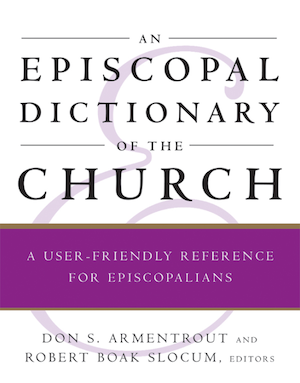
Glossary definitions provided courtesy of Church Publishing Incorporated, New York, NY,(All Rights reserved) from “An Episcopal Dictionary of the Church, A User Friendly Reference for Episcopalians,” Don S. Armentrout and Robert Boak Slocum, editors.