
Glossary of Terms
Salt Lake, Missionary District of
This jurisdiction existed from Oct. 13, 1898, until Oct. 10, 1907. See Utah, Diocese of.
Salutation
A liturgical dialogue of mutual greeting: “The Lord be with you. And also with you.” The salutation calls the people back to attention and adds emphasis to important moments in the liturgy. This dialogue of greeting and response is based on Boaz's greeting to the reapers and their answer in Ru 2:4. At the Holy […]
Salvation
Eternal life in the fullness of God’s love. Salvation is deliverance from anything that threatens to prevent fulfillment and enjoyment of our relationship with God. In the OT, God was experienced as the savior who delivered Israel from bondage in Egypt (Ex 14-15; See Canticle 8, The Song of Moses, BCP, p. 85; Dt 6:21-23). […]
Salvation History
The study of salvation history identifies the theological elements and influences in historical narratives. God's offer of salvation and humanity's response to that offer are expressed and visible in history. The importance of the biblical narratives of salvation history is reflected in the scripture readings for the Easter Vigil of the BCP (pp. 288-291), including […]
San Diego, Diocese of
The 1973 General Convention voted to divide the Diocese of Los Angeles. The primary convention of the Diocese of San Diego met at St. Paul's Church, San Diego, Dec. 7-8, 1973. It includes the following counties: Imperial, a portion of Riverside, and San Diego. On Jan. 25, 1985, St. Paul's Church, San Diego, became St. […]
San Joaquin, Diocese of
The 1910 General Convention voted to divide the Diocese of California, and establish the Missionary District of San Joaquin. It includes the following counties: Alpine, Calaveras, Fresno, Inyo, Kern, Kings, Madera, Mariposa, Merced, Mono, San Joaquin, Stanislaus, Tulare, and Tuolumne. The primary convocation of the Missionary District met at St. James' Church, Fresno, May 9, […]
Sancta sanctis
As early as the fourth century, eastern liturgies contained the Sancta sanctis, “the holy for the holy” or “holy things for holy people,” at a showing of the sacrament to the people immediately before the administration of communion. A typical response of the people was “One is holy, one is Lord, Jesus Christ, to the […]
Sanctification
A theological term which derives from the Latin sanctus, “holy. In its proper sense “holy” refers to the holiness of God, but in a derived sense it applies to all those who are made holy. By extension it thus refers to all those who, in Christ, participate in the holiness of God through baptism. In […]
Sanctorale
The section of a service book such as a missal or breviary that provided the variable portions of services for the fixed dates of the church calendar. The propers for the fixed holy days appeared in the Sanctorale, with the exception of those in the Christmas season which were in the Temporale. The propers for […]
Sanctuary
1) Holy place, usually the worship space of a church. Sanctuary may mean the area around the altar, especially in liturgical churches. It may be separated from the rest of the church by an altar rail. It may refer to the entire chancel area, including the choir and/or the space reserved for the clergy. It […]
Sanctuary Lamp
A lamp or candle which burns near the reserved sacrament when the reservation is near the altar. See Reservation of the Sacrament.
Sanctus Bell
A bell rung by a server during the eucharist to emphasize and call attention to particular moments in the liturgy. The bell may be a small hand bell or set of bells, or a gong rung with a clapper, or the tower bell of the church. The term is based on the practice of ringing […]
Sanctus, The
From the Latin for “holy,” a hymn of adoration and praise which begins, “Holy, holy, holy, Lord God of Hosts.” It typically follows the preface in the eucharistic prayer (BCP, pp. 334, 341, 362, 367, 371, 373, 402, 404). It is sung or said by the celebrant and people. The Sanctus is based on the […]
Sarcophagus
Ancient ornamented coffin in the form of a chest and lid. The term is from Latin words that mean “flesh-eating.” This refers to the belief that a sarcophagus lined with caustic limestone would cause the body of the deceased to dissolve within forty days. Sarcophagi were made of stone, terra-cotta, wood, marble, alabaster, or metal. […]
Satterlee, Henry Yates
(Jan. 11, 1843-Feb. 22, 1908). Bishop and founder of the Washington Cathedral. He was born in New York City. Satterlee received his B.A. from Columbia College in 1863 and studied for the ordained ministry at the General Theological Seminary. He was ordained deacon on Nov. 21, 1865, and priest on Jan. 11, 1867. He began […]
Savage, Thomas Staughton
(June 7, 1804-Dec. 29, 1880). The first medical missionary sent out by the Episcopal Church. He was born in Middletown (now Cromwell), Connecticut, and graduated from Yale in 1825. He received his M.D. from the Yale Medical School in 1833 and graduated from the Virginia Theological Seminary in 1836. Savage was ordained deacon on July […]
Sayre, John Nevin
(Feb. 4, 1884-Sept. 13, 1977). Founder of the Episcopal Peace Fellowship. He was born in Bethlehem, Pennsylvania. Sayre received his B.A. from Princeton in 1907 and his B.D. from Union Theological Seminary, New York, in 1910. He was ordained deacon on Oct. 31, 1911, and priest on Nov. 7, 1912. In 1911-1912 and 1914-1915, Sayre […]
SC.
” See Oil, Holy.
Scapular
A sleeveless garment that hangs from the shoulders to the ankles. The term is derived from the Latin for “shoulder-blades.” The scapular is a wide band of material, usually black, with an opening for the head. It forms part of the regular monastic habit for many religious orders. It is typically worn over a cassock […]
Scarf
See Tippet.
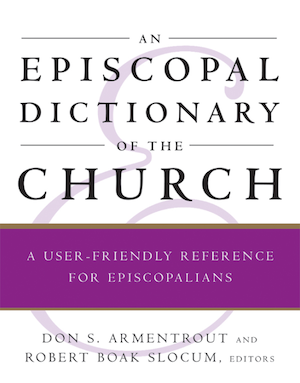
Glossary definitions provided courtesy of Church Publishing Incorporated, New York, NY,(All Rights reserved) from “An Episcopal Dictionary of the Church, A User Friendly Reference for Episcopalians,” Don S. Armentrout and Robert Boak Slocum, editors.