The History of the Good Friday Offering
Welcome to our online offerings for the Good Friday Offering’s centennial year. Here, you’ll find stories, photos, artifacts, and history about the offering – seeing the way societies, the institutional church, borders, liturgical styles, missiology, and so much more have adapted and otherwise changed over 100 years. Each week, join us as we celebrate a century of gifts and rejoice in 2000 years of Good News.
The First Decade: 1922-1932
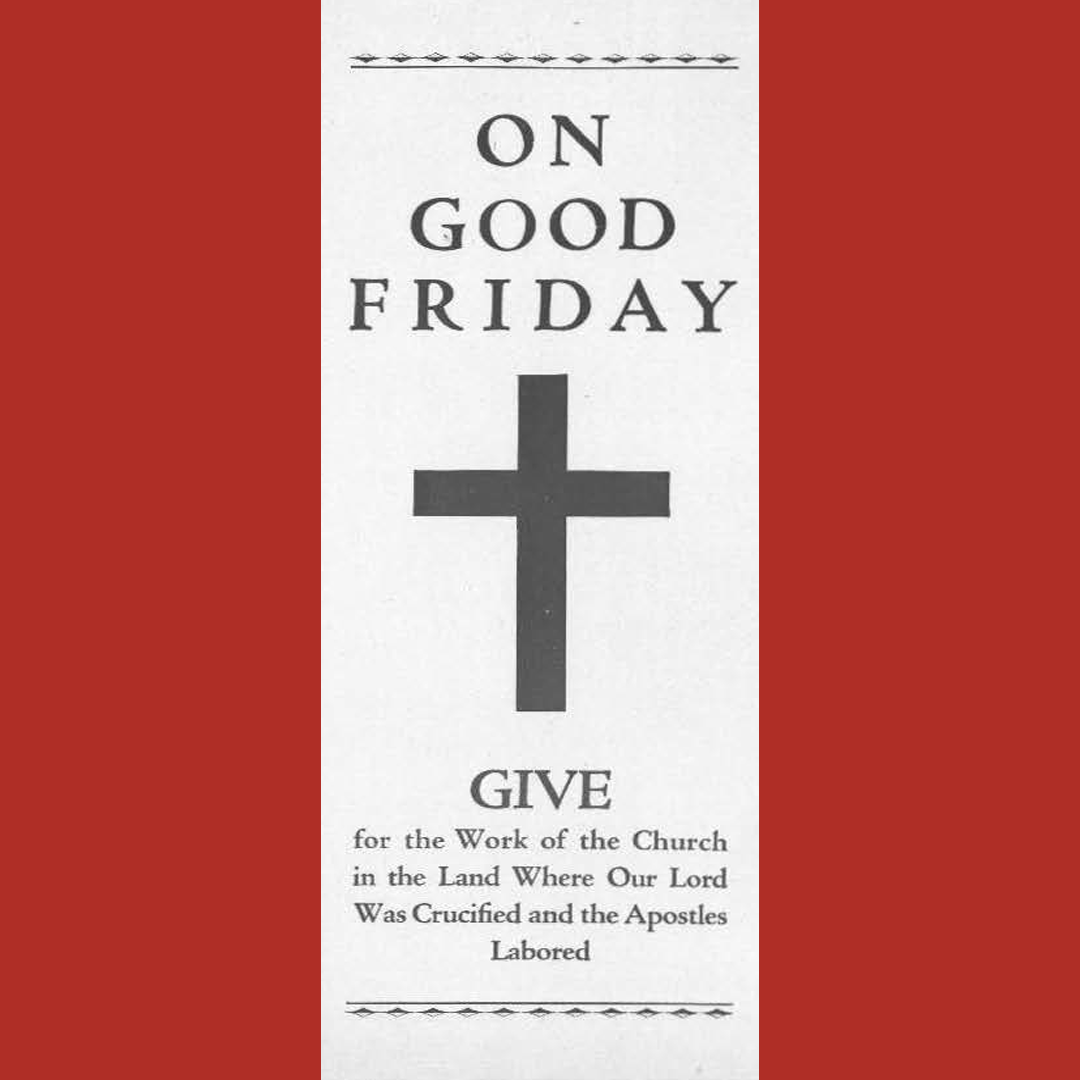
Our Good Friday Offering began in the Roaring Twenties, a time of economic prosperity with a distinctive and vigorous social, artistic, and cultural zestfulness. The western world saw a rapid increase in the growth and use of telephones, films, radio, automobiles, and electrical appliances. Cultural upheaval was the norm, with the enfranchisement of women voters in the United States, the sudden death of President Warren G. Harding, the famous Scopes Trial, in which John Scopes was arrested, tried, and convicted for teaching evolution, and Charles Lindbergh’s and Amelia Earhart’s flights across the Atlantic. The Wall Street Crash of 1929 ended the era, as the Great Depression brought years of hardship worldwide.
This was the American context when the Good Friday Offering was initiated. The Rev. William Chauncey Emhardt, field officer for church work among foreign-born Americans, visited Europe and the Middle East in 1922. His lengthy report to the National Council noted the need for increased communication between Eastern churches and the American Church, and he made a recommendation for regular financial support “for the development of missionary work along educational lines in the Near East at the request of and in cooperation with the authorities of the Native Churches.”
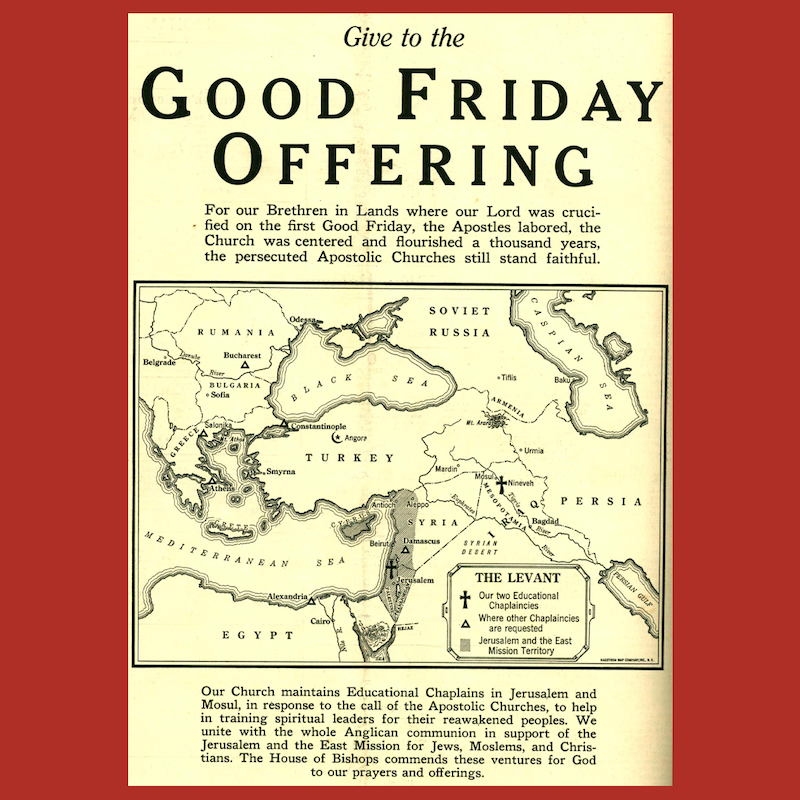
Emhardt’s appeals were heard; the 1923 report of the Department of Missions and Church Extension of the National Council listed the first offering of $18,000 for “work in the Near East.” The first $15,000 of this fund was given to support the Jerusalem and East Mission under the care of Bishop Macinnes of the Church of England. The balance was used to “meet the expense incurred in responding to the request of the ancient Christians in the Near East for aid in training their clergy among more modem lines.”
The amount of money raised by the Good Friday Offering continued to grow in its first five years. By 1928, the Offering amounted to almost $27,000, of which $5,000 was set aside for mission work among Jewish Americans by direction of the General Convention that year. Shortly thereafter, however, instability and poverty resulting from the Great Depression caused giving to drop precipitously, and less than $20,000 was raised in 1931.
Please join us in celebrating a century of gifts and rejoicing in 2,000 years of Good News. Give now at iam.ec/goodfridayoffering or text ‘GFO’ to 91999 (messaging and data rates apply).
1932-1942
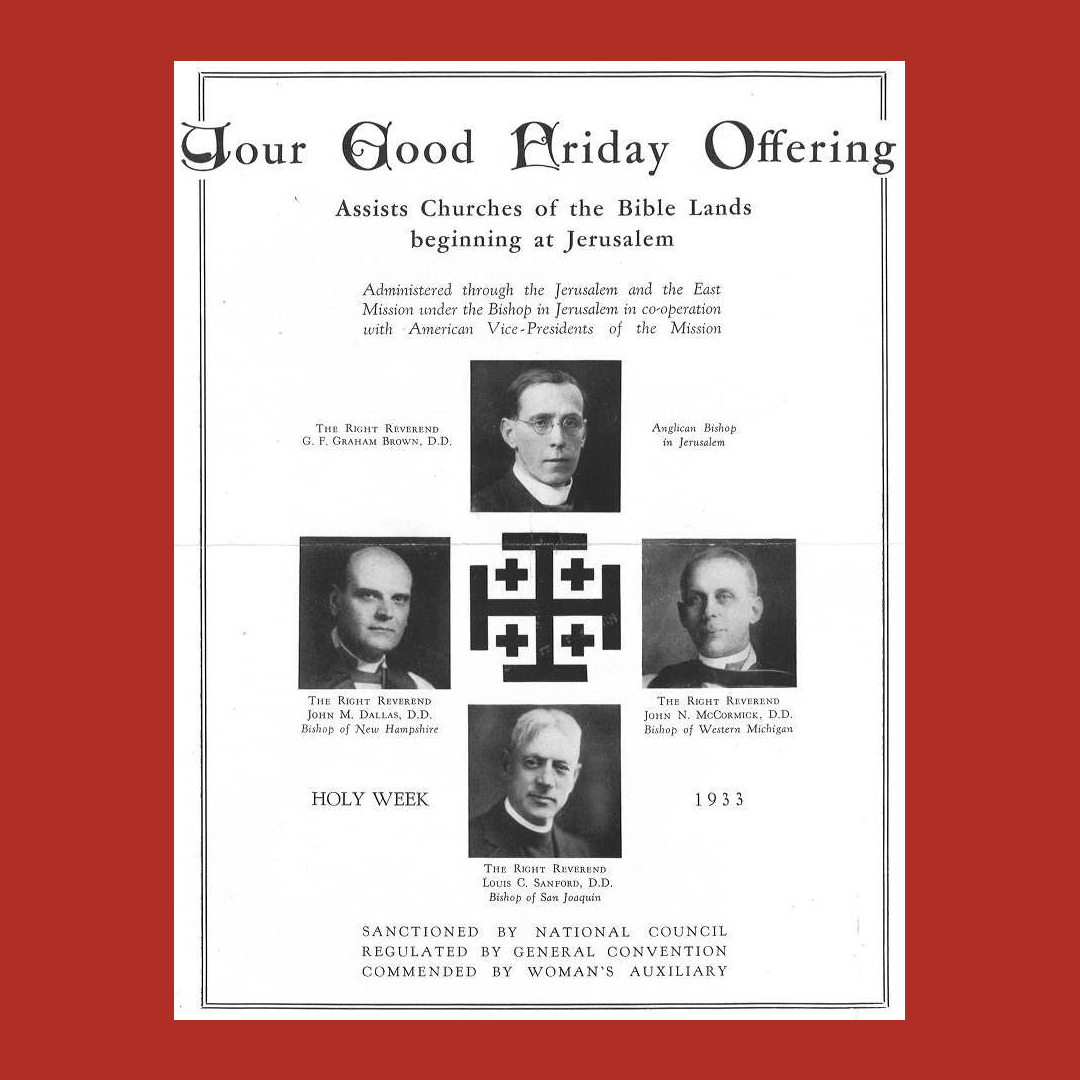
The second decade of the Good Friday Offering was one of pain, anguish, and conflict – though with glimmers of hope interspersed throughout the years.
The country was gripped in the throes of grief as the Great Depression challenged millions of people. But at the same time, the Empire State Building, at that time the tallest building in the world, was opened. Poverty was omnipresent, but at the same time, FDR’s New Deal and the establishment of the social safety net offered a potential way out. The Dust Bowl raged, carrying hundreds of millions of tons of dust from the Great Plains to the East Coast, blanketing New York City and Washington D.C and everything between. This is to say nothing of the turmoil occurring in Europe, as World War II began and would eventually draw in the United States.
During the first decade of the Good Friday Offering, the amount of money raised grew year after year. By 1928, the Offering amounted to almost $27,000, of which $5,000 was set aside for mission work among Jewish Americans by direction of the General Convention that year. Shortly thereafter, however, the Great Depression caused giving to drop steeply, and less than $20,000 was raised in 1931. This would deeply impact operations on the ground in Jerusalem in the Middle East; complaints had already arisen that clergy and staff in the region had been undercompensated and overworked.

The Woman’s Auxiliary, ever one of the most formidable para-church organizations, subsequently resolved to promote interest in the Offering in every parish. Due to their tenacity and passion, along with the faithfulness and generosity of Episcopalians, funds continued increasing through this decade. In 1938, $23,000 was sent. By 1940 that number had grown to $26,000. By the end of this decade, in 1942, the Good Friday Offering had raised $32,000 for ministry in the Holy Land and beyond.
The scope of the work continued to grow as well. By action of General Convention in 1940, fifteen percent of the Offering was committed to the Russian Theological Academy in Paris to “meet the expense incurred in responding to the request of the ancient Christians in the Near East for aid in training their clergy among more modem lines.”
Please join us in celebrating a century of gifts and rejoicing in 2,000 years of Good News. Give now at iam.ec/goodfridayoffering or text ‘GFO’ to 91999 (messaging and data rates apply).
1942-1952
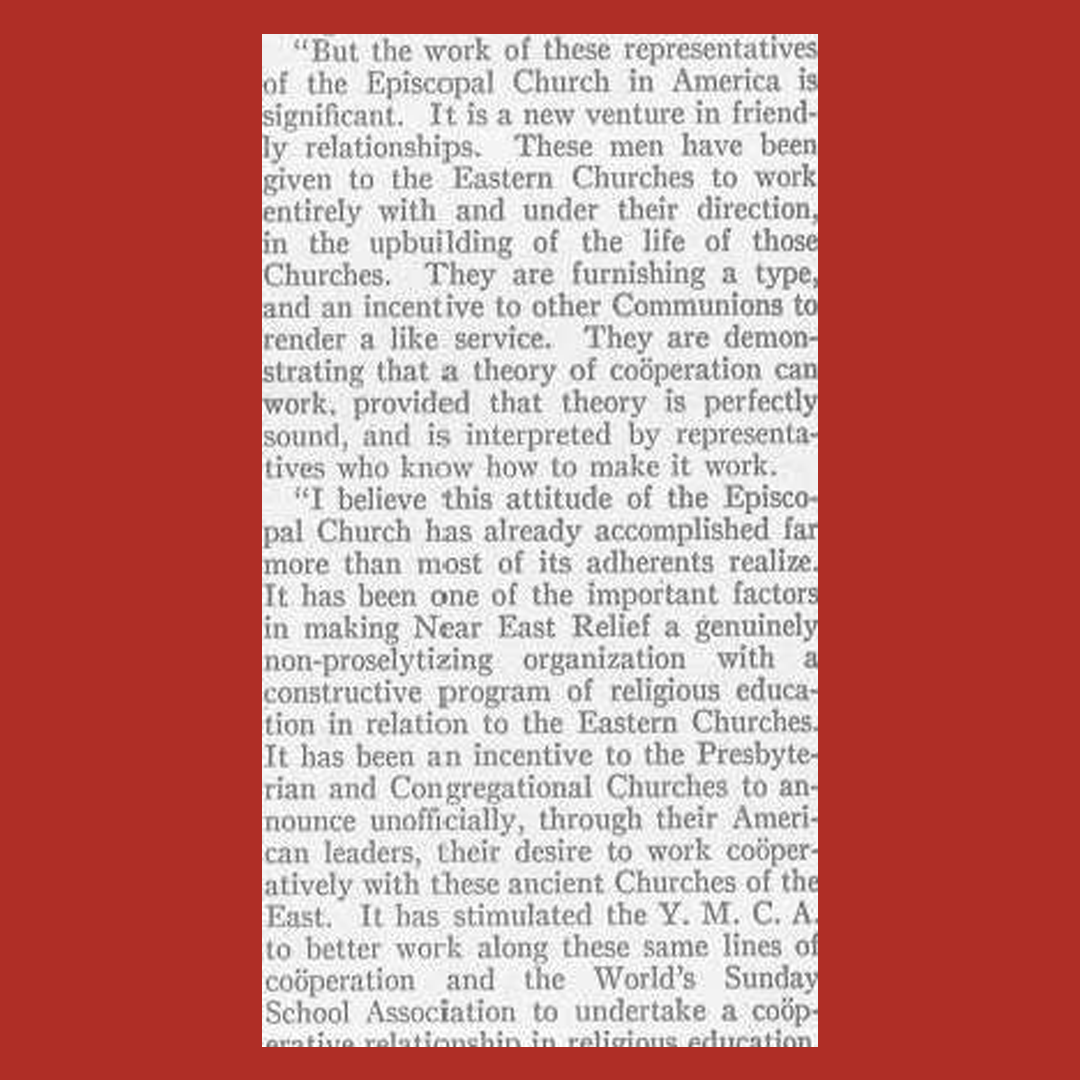
The third decade of the Good Friday Offering started with Hitler and his Nazi troops trampling around the world and, at times, appearing invincible. Things began to change in 1943 with the Battle of Stalingrad, one of the largest and bloodiest conflicts in history. The ferocious fighting occurred during a brutal Russian winter in a starving city devastated by warfare. When all was said and done, the Germans had suffered a humiliating defeat, and the tide of the war had begun to turn. On June 6, 1944, France’s allies arrived on the beaches of Normandy, undertaking the largest seaborne invasion in history. The Allies suffered heavy losses but in time prevailed enabling them to liberate France from Nazi occupation and prepare for an ensuing march on Germany. This was of particular interest to the people behind the Good Friday Offering, who had been making annual gifts to the Orthodox seminary in Paris.
The final battles in Europe of World War II and the surrender of Nazi Germany took place in late April and early May 1945. On Aug. 6, 1945, the United States dropped a single, oddly shaped bomb over Hiroshima, Japan. It was a 9,700-pound uranium bomb, the first of its kind ever dropped in war. Shortly after, another bomb would fall on Nagasaki, forcing Japan to surrender. World War II was over, but the nuclear age had just begun. While there was much celebration in the streets as families and loved ones were reunited, a joyous end to the formal war would not bring about universal peace. As countries and peoples picked up the pieces, a new order was in the making.
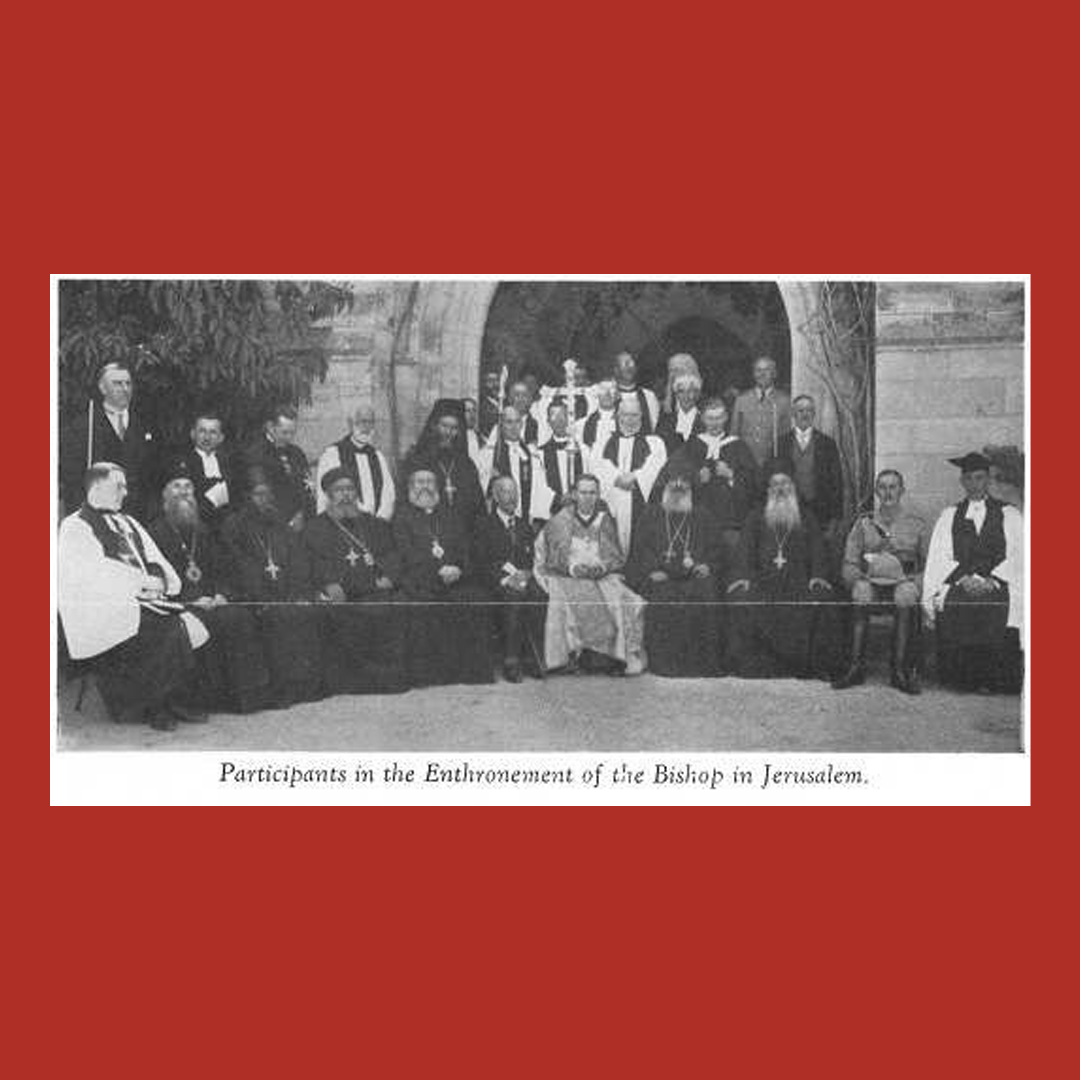
Despite all the hardships of war, Episcopalians remained very generous as the amount raised continued to grow by leaps and bounds. The Offering brought in $26,000 in 1940, $32,000 in 1942, and $43,000 in 1946. Notably, in 1943, a new bishop of Jerusalem from the Church of England was installed; due to the obvious difficulties of traveling the region during the war, the Rt. Rev. Weston Henry Stewart had to be consecrated at Westminster Abbey in London. In 1949, Bishop Stewart would go on to oversee the building of what would become the region’s largest Anglican church, the Church of the Redeemer in Amman, Jordan.
In 1948, the state of Israel was born. Having been scattered across the world and persecuted mercilessly for centuries upon centuries, the world’s Jews now had a homeland of their own. The establishment of the homeland was not without controversy, as a vast number of Palestinian Arabs living in that homeland were displaced. It was a contentious issue then. It remains contentious today. But the history of the Good Friday Offering is replete with examples of Anglicans and so many others working in the region despite differences, joys, sufferings, intense wars, and fragile peace, with the understanding that the Church is called to be a herald of the Prince of Peace himself.
The Rev. Canon Charles T. Bridgeman, an American chaplain and missionary, undertook this ministry personally, expanding agricultural opportunities and establishing schools for students of all faith – all of which were supported by the Good Friday Offering. The records note – in a way perhaps uncharacteristic of a time of deep pain and upheaval – that “In the Church’s six schools, three for boys and three for girls, Jews and Moslems and Christians live together in the happiest fellowship” – a harbinger of how the Offering would continue to grow and develop interfaith work and dialogue that continues today.
Please join us in celebrating a century of gifts and rejoicing in 2,000 years of Good News. Give now at iam.ec/goodfridayoffering or text ‘GFO’ to 91999 (messaging and data rates apply).
1952-1962

The fourth decade of the Good Friday Offering was marked by the post-World War II boom, the dawn of the Cold War, and the Civil Rights movement in the United States. There was a particularly important medical breakthrough in 1953 when a medical researcher named Jonas Salk successfully tested his experimental vaccine for polio on himself and his own family. Civil rights were front-page news in 1954 when school segregation was banned. This decision was a foundation step towards the end of racial segregation but also sparked very quickly a venomous wave of racial violence.
The world was not immune from the continual threats of war; in 1956, the Suez Canal crisis ignited the powder keg in the Middle East as Israel, with the help of British and French troops, invaded Soviet-aligned Egypt. These tensions came in response to Egypt’s nationalization of the Suez Canal. Heavy diplomatic pressure and the threat of economic sanctions ended the hostilities in the same year that it started. The Suez Crisis was the first use of a United Nations peacekeeping force, further cementing the new approach to international relations.
The booming prosperity of the 1950s helped to create a widespread sense of stability and contentment but it would be a fragile one, as the tumultuous 1960s would prove.
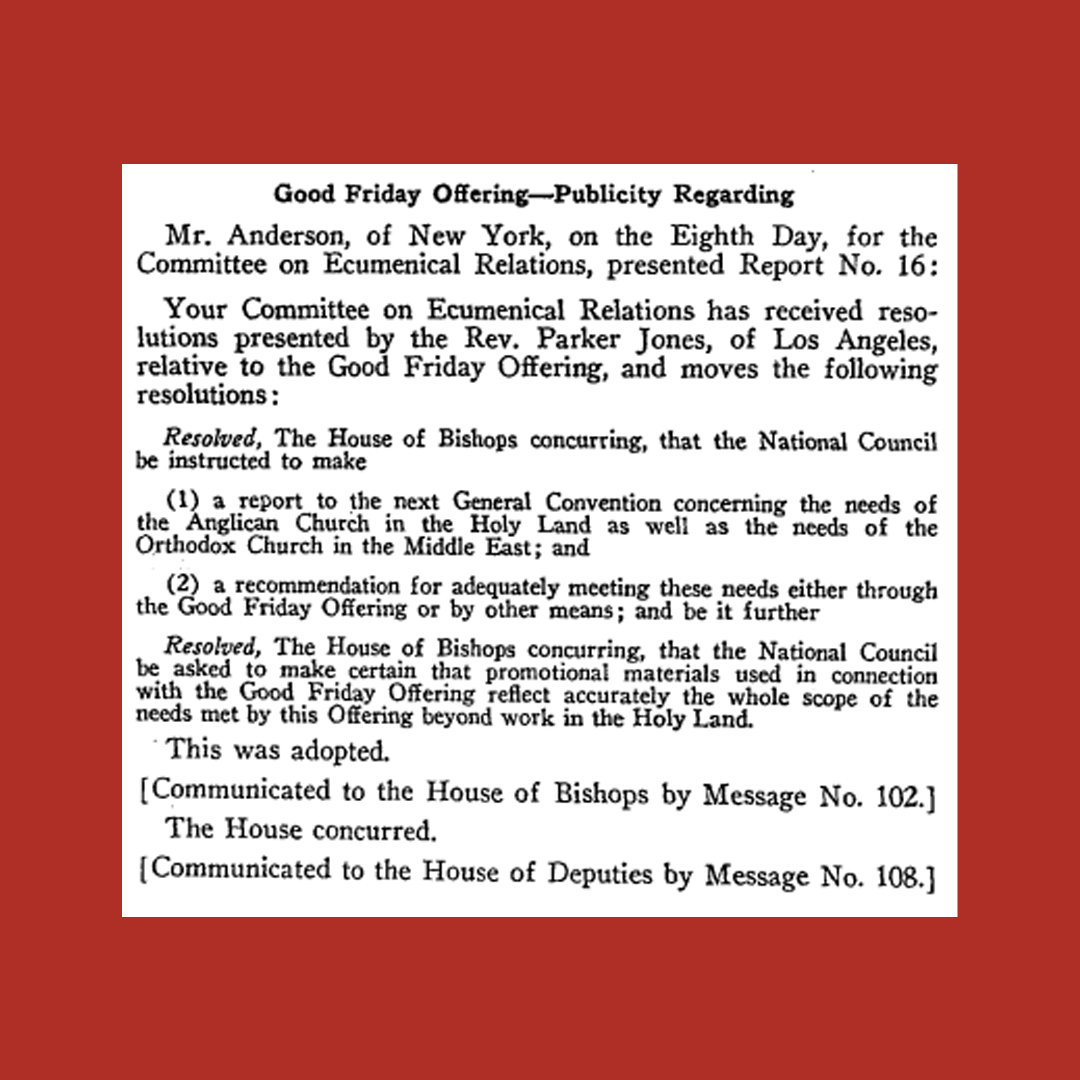
The Good Friday Offering continued to benefit from generous Episcopalians. Beginning in 1955, a base offering of $15,000 was appropriated to the mission in Jerusalem and the Near East, and the National Council was directed to distribute the balance of funds to promote mission work in the region and to support Eastern Orthodox churches.
Occasionally, certain church organizations promoting Anglican-Orthodox cooperation received funds for short periods of time, including such ventures as the Joint Commission on Assistance to the Eastern Orthodox Churches in 1955 and the Joint Commission on Cooperation with the Eastern Churches in 1961.
Please join us in celebrating a century of gifts and rejoicing in 2,000 years of Good News. Give now at iam.ec/goodfridayoffering or text ‘GFO’ to 91999 (messaging and data rates apply).
1962-1972
The fifth decade of the Good Friday Offering saw a transformation of culture with words like “groovy” and “hippie” working their way into the lexicon of the day. Impacted by the Civil Rights movement, anti-war protest, feminism, and the emergence of gay rights, Americans continued their experiences of radical changes over the decade.

If you were alive in 1963, chances are you remember where you were when you heard that President John F. Kennedy was assassinated. This event shattered America’s sense of security and, as we will see in this blog, initiated one of the most turbulent eras in the country’s history. In 1964, Beatlemania was a word we began to understand as we met John, Paul, George, and Ringo, and English rock-and-roll forever changed American music and culture. 1964 also saw Congress authorize the president to take “all necessary measures” to protect American soldiers and their allies from the communist Viet Cong. Within days of this pronouncement, the draft began. The Vietnam War escalated and in 1966, U.S. forces bombed the North Vietnamese capital of Hanoi.
Regretfully, battles were not limited to only one region, as in 1967, Israel and its Arab neighbors once again found themselves embroiled in war. The Jewish state prevailed in what came to be known as the Six-Day War, though the peace would be fragile and lead to retrenchment on every side.
A year after President Lyndon B. Johnson signed the Civil Rights Act of 1964, Bloody Sunday occurred. Civil rights activists marching towards Montgomery, Ala., in pursuit of voting rights were confronted and brutalized on the Edmund Pettus Bridge by armored police, dogs, tear gas, and bullwhips. Much of this was broadcast live. and both politicians and citizens taking a stand against the violence saw the President sign the 1965 Voting Rights Act.
One commentator remarked that 1968 “seemed to deliver a new Earth-shattering headline every week.” In April, a gunman murdered Dr. Martin Luther King, and almost exactly two months later, the headlines would tell of the murder of Robert Kennedy. Chicago was the scene of the 1968 Democratic National where police used tear gas and billy clubs to break up protests. And who could ever forget the summer of 1969, when more than 400,000 young people trooped to the Woodstock music festival in upstate New York? Yet the “peace and love” meant to be generated by the music festival was scattered in 1970 when soldiers of the Ohio National Guard opened fire with live ammunition into a crowd of protestors at Kent State University, killing four students and wounding nine others. The 1972 Olympic Games were also stained with violence, with the murder of 11 Israeli athletes and a West German police officer by Palestinian terrorists at the Munich Olympics. Terrorism had become a global phenomenon.
As we have seen repeatedly, the work of the Good Friday Offering continued through turbulence and upheaval, devoted to its mission of serving the causes of peace and human flourishing in the Holy Land. The Episcopal Church Archives record in 1963 that, “The annual Good Friday Offering of the Episcopal Church is part of a worldwide offering designated for Jerusalem and the East. It supports the work of the Anglican archbishopric centered at the Collegiate Church of St. George the Martyr in Jerusalem; and also the work in Iraq, Iran, the Persian Gulf, Egypt, Sudan, Libya, Israel, and Cyprus. Grants are also made for the work of the Rt. Rev. Najib A. Cuba’in, Bishop of Jordan, Lebanon and Syria, the work of the World Council of Churches in the Near East, and Church World Service for assistance to refugees.”
Throughout the 1960s, throughout continued upheaval both at home and abroad – and especially in the Middle East – the Good Friday Offering for work in the Holy Lands continued to grow and was disbursed to the Joint Commission on Ecumenical Relations, to the Archbishop in Jerusalem, the Bishop in Iran, the Bishop in Jordan, the Diocese of the Sudan and to several ecumenical projects in the Near East.
This Diocesan Press Service release from February 25, 1969, gives a wonderful sense of the ministry of the Good Friday Offering – both then and now:
Episcopalians Support Middle East Ministry
Diocesan Press Service. February 25, 1969 [74-13]NEW YORK, N.Y. — The Middle East is a major world “hot spot” today, as well as being the cradle of Christianity. For both of these reasons the area is of special concern to Christians.
Each year, on Good Friday, Episcopalians are asked to make a special offering for the work of the Church in the Middle East. Through this offering they support the work of the Jerusalem Archbishopric, a jurisdiction which includes both Israel and her Arab neighbors, extending from the Persian Gulf to the Turkish border.
Its five Dioceses are Jerusalem; Egypt and Libya; Iran; Jordan, Lebanon and Syria; and The Sudan.
Last year Episcopalians contributed $67,917.13 to the Good Friday Offering.
In compliance with a resolution passed in 1967 by the General Convention, $15,000 of this amount was sent to the Jerusalem and the East Mission. This British missionary society works specifically in the Archbishopric, and the money contributed to it, along with $2, 900 specifically for the Archbishopric, goes to support the overall work in the Middle East.
The Diocese of Iran received $10,000 from the Offering, $5,000 to support the Diocesan school program and $5,000 to support missionary and service efforts of the Diocese.
The Diocese of the Sudan received $10,000. Due to the unstable situation in the Sudan, many priests in the southern part of the country have had to flee their homes and are now refugees. The money contributed from the Good Friday Offering will be used to aid these homeless clergymen.
A grant of $5,000 to the Diocese of Jordan helps that Diocese in coping with a bank account freeze instituted after the six-day war in 1967 and still in effect, making it difficult to pay clergy salaries, to obtain school fees, etc.
The Rev. Canon John Zimmerman, who represents the Episcopal Church on the staff of the Archbishop in Jerusalem, is also supported from the Offering. During 1968 the amount allocated for this purpose was $9,960.27.
St. George’s College, a central Anglican college being established in Jerusalem, received $2,912 for a lecture room.
Ecumenically, the Offering enables the Episcopal Church to assist in the work of the Orthodox and Eastern Churches in the Middle East. Social and educational projects of these Churches were aided with a grant of $5,000. This money went, in part, to a Greek Orthodox and to an Armenian Orthodox seminary in Lebanon.
The construction of a new Coptic Cathedral in Cairo was helped with a contribution of $500 and work among students of all Christian Churches aided with a grant of $1,500 toward the support of Gabriel Habib, a Greek Orthodox layman who serves as representative in the Near East of the World Student Christian Federation and of the Youth Department of the World Council of Churches.
Please join us in celebrating a century of gifts and rejoicing in 2,000 years of Good News. Give now at iam.ec/goodfridayoffering or text ‘GFO’ to 91999 (messaging and data rates apply).
1972-1982
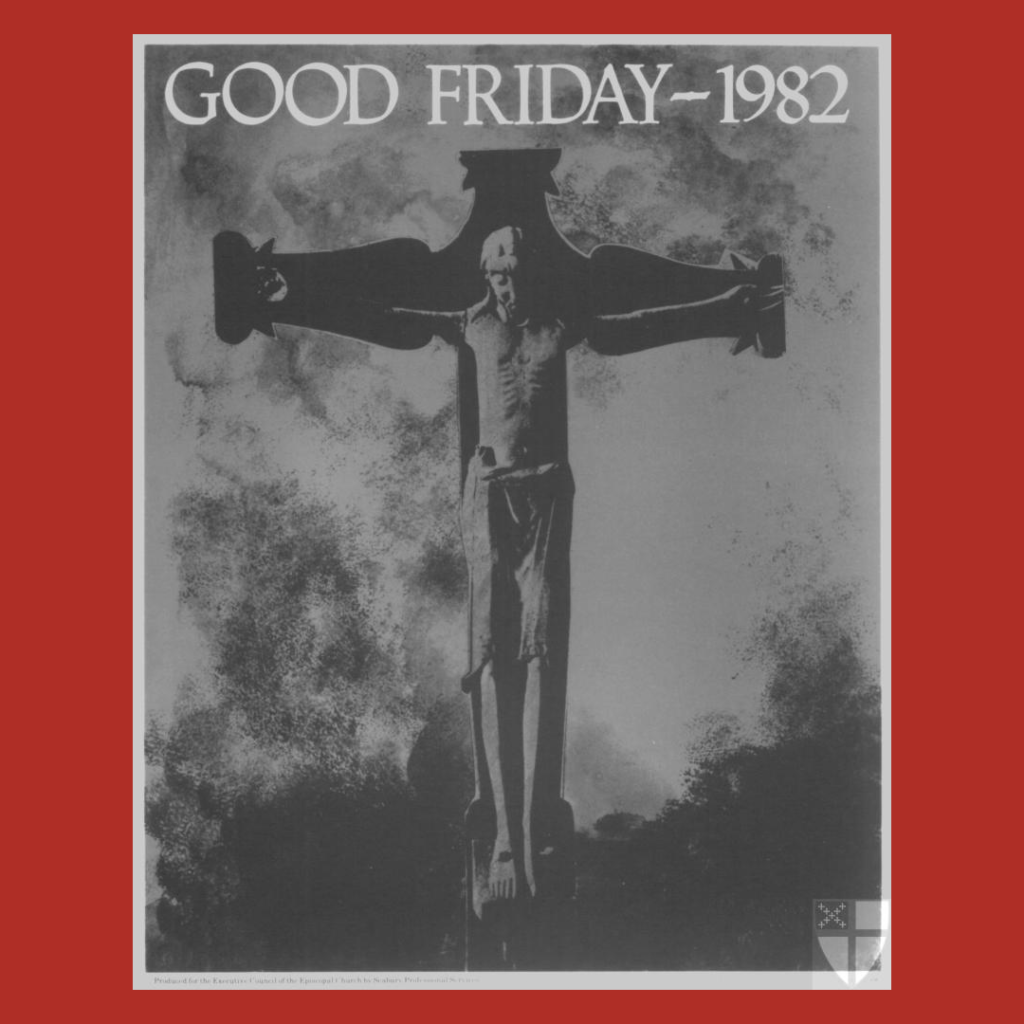
Changes also came to Anglicanism in the Middle East; the region, formerly under the jurisdiction of the Archbishop of Canterbury or his delegate, became an autonomous province in 1976. The province consisted of the Dioceses of Jerusalem, Egypt, Cyprus and the Gulf, and Iran. Heartened by the independence of the church, which was no doubt made possible in some part by support from the Good Friday Offering, faithful Episcopalians continued to support ministry in the Middle East. In 1975, Episcopal Church treasurer Matthew Costigan reported to council that total receipts of the Good Friday Offering had broken a record: $77,273.18. By 1978, that would increase to over $80,000.
Issues in history have a habit of reoccurring. As we look at the sixth decade of the Good Friday offering, we arrive in the early 1970s and momentous changes occurring within The Episcopal Church. On July 29, 1974, two years before General Convention affirmed and explicitly authorized the ordination of women to the priesthood, eleven women were ordained at the Church of the Advocate in Philadelphia, Pennsylvania.
In 1976, the 65th General Convention, meeting in Minneapolis, undertook several new measures of exceptional importance: first and foremost, the approval of the ordination of women to the priesthood and episcopate; second, the adoption of a proposed Book of Common Prayer to replace the book in use since 1928 (this would become the 1979 Book of Common Prayer, still in use today); and finally, the convention formally instituted the Good Friday Offering’s designation as gifts for Christian work in the Holy Land and for fulfilling the needs of Orthodox and Christian churches.
The National Hunger Committee of The Episcopal Church prepared the Lenten Hunger Program for 1979 as a “special time for Episcopalians to pray, study, give, fast and work for the alleviation of hunger.” It was noted that the Good Friday offering would provide opportunities for additional program focus and channels for giving.
Please join us in celebrating a century of gifts and rejoicing in 2,000 years of Good News. Give now at iam.ec/goodfridayoffering or text ‘GFO’ to 91999 (messaging and data rates apply).
1982-1992
The seventh decade of the Good Friday Offering had an inauspicious beginning with a major recession beginning in the United States. The decade was plagued by incidents of violence and terrorism around the world; in 1983 a suicide bomber detonated a truck bomb that killed 307 people, including 241 Americans, at a U.S. Marines barracks in Beirut, Lebanon. In 1984, widespread drought and famine in Ethiopia showed the world painful and heartbreaking images of starvation. The nation was stunned and shaken in 1986 when the Challenger space shuttle exploded shortly after takeoff. The shuttle’s crew included Christa McAuliffe, a teacher who would have been the first civilian in space. Nearly 1 in 5 Americans watched the event live, including legions of schoolchildren. 1987 saw the first episode of The Simpsons and the development of a new drug, AZT, used for the treatment of AIDS. After a prolonged period of growth, the US stock market dropped more than 20% in one day in October.
Closer to the Episcopal world, a ground-breaking event occurred in in 1988 when the Rev. Barbara Clementine Harris was elected suffragan bishop of the Episcopal Diocese of Massachusetts. She would be consecrated the first female bishop in the Anglican Communion on February 11, 1989. Symbolically, the year of her consecration coincided with the collapse of the Berlin Wall the end of the (too-short-lived) political division between the East and the West, the United States and the Soviet Union. Two of the most famous presidential speeches of the Cold War— Kennedy’s “Ich bin ein Berliner” and Reagan’s “Tear Down This Wall” were made there. A new freedom waas experienced when “the walls came a-tumbling down,” so to speak.
Still, turmoil would continue in the Middle East; the Gulf War dominated much of the news for a seven-month period from August 1990 to February 1991 as coalition forces from 35 nations led by the United States fought against the Iraqi invasion of Kuwait. Like so many of the traumatic and life-changing events of the era, live news broadcasts brought the conflicts in living color into the home.
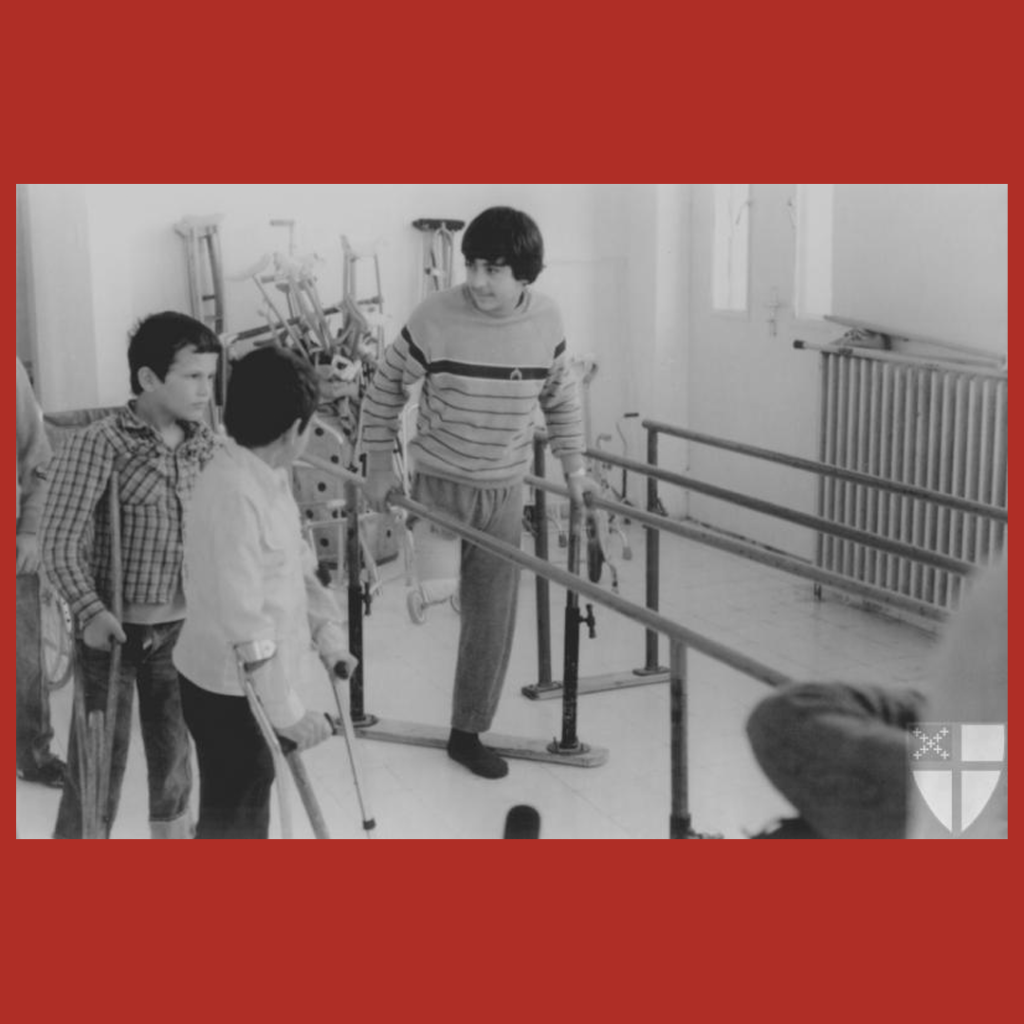
Knowing the precarity of Anglican institutions in the region – but also acknowledging their great dedication – the Rt. Rev. G. Edward Haynsworth, executive for World Mission at the Episcopal Church Center, wrote to bishops of The Episcopal Church: “The Good Friday Offering is the life blood of many of the institutions of the Episcopal Church in Jerusalem and the Middle East.” In another letter to the members of The Episcopal Church, Presiding Bishop John M. Allin wrote, “Unfortunately, the land of our Lord is still a place of war, distrust, conflict, suffering and death. The work of the Church continues in spite of overwhelming difficulties. The witness and courage of this small church is a challenge to all of us,” adding, “The ministry among refugees, displaced persons and orphans must go on if the Church is going to be faithful to its pastoral calling.”
And so, while in 1985, the theme of the Good Friday Offering was “The Good Shepherd, who gives his life for the sheep,” which focused on the mission and ministry of the Episcopal Church in Jerusalem and the Middle East, the church would become more explicit the next year about the implications of the Good Shepherd’s call. In 1986, the plight of refugees, the displaced, the orphaned – all victims of war and other tragedies in the Middle East – were the focal point of the year’s Good Friday Offering. “The Episcopal Church in Jerusalem and the Middle East plays a leading role in that community,” said Presiding Bishop Edmond L. Browning. “It has been assisting the growing number of displaced persons through a wide range of service institutions… If the work is to continue – and it must continue – we must offer our prayers and support at this time of need.” Later in the decade, Presiding Bishop Browning asked that all Episcopalians, as part of their observance of Lent, give special consideration to their sisters and brothers in the Holy Land, in witness to the extraordinary courage and faith of Anglicans in that troubled region of the world.
In 1988, the Good Friday Offering sent $178,000 to Jerusalem and the Middle East, an increase of $40,000 over the previous year’s efforts. The money was shared by the Dioceses of Jerusalem, Egypt, Iran, and Cyprus and the Gulf, which together comprised a single province of the Anglican Communion. The Presiding Bishop, in his Good Friday letter to the parishes, said of the Church in Jerusalem and the Middle East, “The witness of our partner Anglican Church, of necessity, takes many different forms. Sometimes it can be made openly, in ministries of preaching, teaching, healing. Sometimes it must be nurtured carefully, shielded as one might shield the flame of a candle in a frightening storm. Whatever the size or visibility of the witness, though, the churches depend on us — on our prayers, our solidarity with them, and our financial assistance.”
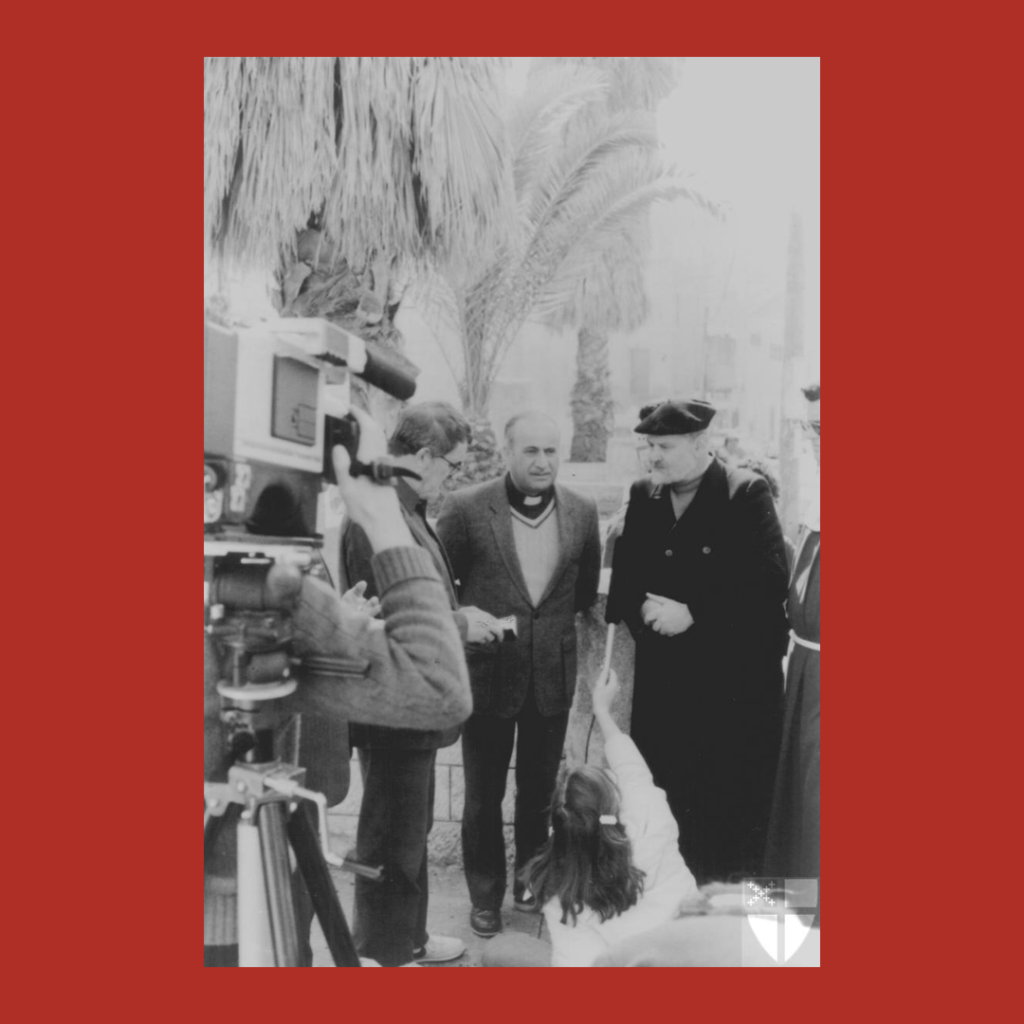
The Rt. Rev. Samir Kafity, Bishop of Jerusalem and President Bishop of the Province expressed his thanks for the 1989 Good Friday Offering, which he considerd essential to the ministry of his Church in the Middle East: “It is indeed a wonderful expression of the concern felt by our brothers and sisters for our situation in the Province. Their kindness and love is so much appreciated and truly a reflection of our Lord’s love in action among us… These actions witness to healing, reconciliation, justice, and peace. These actions are a witness, a testimony, that can be seen by the naked eye. These actions are the testimonies of the people of God, who are the object of the prayers and Good Friday offerings of the faithful of The Episcopal Church in the United States.”
Growing awareness of the plight of Christians and so many others in the Middle East inspired the Good Friday Offering to “wage peace.” The Offering was transformed into a more urgent appeal, in light of the Gulf War; for the first time, the ministry raised $190,000 for the four dioceses of the Anglican province there.
Please join us in celebrating a century of gifts and rejoicing in 2,000 years of Good News. Give now at iam.ec/goodfridayoffering or text ‘GFO’ to 91999 (messaging and data rates apply).
1992-2002
The eighth decade of the Good Friday Offering coincided with the last years of the 20th century – and the first years of the 21st. The presiding bishops of The Episcopal Church, as we have seen thus far, have always been supportive of the Good Friday Offering. In this blogpost, we will cover some of the many comments made through the decade by Bishop Edmond L. Browning and Bishop Frank T. Griswold, III, who served in the role 1986 – 1997 and 1998 – 2006 respectively.
In 1995, Presiding Bishop Browning asked all Episcopalians, as part of their Lenten observance, to pray and give for the ministries “of their sisters and brothers in the Holy Land, in witness to the extraordinary courage and faith of Anglicans in that troubled region of the world.” In his Epiphany letter to Episcopal parishes, Browning said that, “Saint Paul speaks of a ‘debt’ owed to the church in Jerusalem, and he meant to assist the people of his day in addressing that wondrous responsibility. I believe we share that obligation with him and all Christians throughout the centuries.”
Of course, while the Good Friday Offering benefits the dioceses across the province – including Cyprus and the Gulf and Iran – the donation to the Church in this part of the world is intended to symbolize “unity with and passionate concern for those who witness to Christ throughout that region.” In a 1996 letter, Presiding Bishop Browning said that “modern technology makes it possible for us to know about tragedies and disasters all around the world; we are literally bombarded with news and the inherent call to ‘come over and help us!’ We know we need to respond but, unlike Saint Paul, we simply can’t ‘set sail’ each time we are presented with a cry for help. And yet we can be there, we can make our presence felt in tangible ways, we are not powerless to help.” The statement concludes that this opportunity is expressed through participation in the Good Friday Offering.
In 1997, Browning noted the history of the Good Friday Offering, symbolizing unity with those who witness to Christ throughout that region. He wrote, “This is the 75th anniversary of the inauguration of the Good Friday Offering as an institution of The Episcopal Church… The first offering by this name was taken up in 1922, near the end of the life of Presiding Bishop Daniel S. Tuttle.” Funds collected at the time included support for the Dioceses of Jerusalem, Iran, Cyprus and the Gulf, and Egypt and North Africa (the Diocese of Egypt and North Africa is now part of the Episcopal/Anglican Province of Alexandria).
In 1999, Presiding Bishop Frank T. Griswold asked that Episcopalians continue to pray for their sisters and brothers in the Holy Land and to support the Good Friday Offering. He was supported by Bishop Clive Handford of the Diocese of Cyprus and the Gulf, who explained the very real projects supported by the generosity of Episcopalians: “The Good Friday Offering funds played a significant part in enabling the project at Christ Church, Aden to come to completion.” The Christ Church compound includes a clinic for mothers and children, a worship center, and a community center providing an office and a small hostel for Christian workers. He continued, “This whole project has been the key item in diocesan outreach for the past three years and the Good Friday Offering was most important in enabling the initial vision to be realized.”
In 2000, Presiding Bishop Griswold asked that Episcopalians continue to pray for their sisters and brothers in the Holy Land and to support the Good Friday Offering as an opportunity to demonstrate solidarity with Anglicans and all Christians in that region of the world. According to Griswold, “The words of the Bishop of Jerusalem, the Rt. Rev. Riah Abu El-Assal, make plain the importance of the Good Friday Offering: ‘I would like to take the opportunity to share my joy and express my appreciation to The Episcopal Church for working so diligently to support the Diocese of Jerusalem. I have no words to express my deep gratitude. Kindly convey my personal thanks and that of the diocese, clergy and laity to all our brothers and sisters in Christ.’”
Please join us in celebrating a century of gifts and rejoicing in 2,000 years of Good News. Give now at iam.ec/goodfridayoffering or text ‘GFO’ to 91999 (messaging and data rates apply).
2002-2012
Continuing the theme of the last several posts, 2002-2012 remained a time of upheaval in the wider world – terrorism, wars, economic devastation – these were some themes of the decade. Still, The Episcopal Church continued to listen to God’s clarion call to include more people in its leadership. In 2003 the Rev. Gene Robinson became the first openly gay priest consecrated as bishop. In June 2006, the Rt. Rev. Katharine Jefferts Schori was elected Presiding Bishop of The Episcopal Church, in turn becoming the first woman primate in the Anglican Communion.
The Good Friday Offering kept at its mission, as well. In 2007, the 85th year of the Good Friday Offering, Brother James Teets was the manager of partnership services in the Episcopal Church’s Office of Anglican and Global Relations. In a news release, he spoke about the Good Friday Offering as an opportunity for Episcopalians to participate in the life of the church in the Middle East
“The funds are gathered from all the parishes, congregations, cathedrals, missions, all across the Episcopal Church and are dispersed to the dioceses and province itself [in the Middle East] as a gift of the members of the Episcopal Church. The use of the funds is as varied and as widespread as the needs. The funds are governed by the bishops and the provincial office in the Church of Jerusalem and the Middle East, and the bishops decide what is the most important need or needs on their daily plate. It could be theological education, it could be putting a roof on a church building, it could be starting a new church, it could be salaries for a hospital or for a school, or any other kinds of needs.”
In 2008, a unique opportunity presented itself as Presiding Bishop Jefferts Schori presented the Good Friday Offering – a check for $158,801.42 – to the Rt. Rev. Suheil Dawani, Anglican Bishop in Jerusalem, on March 18 at St. George’s Cathedral in Jerusalem. The Presiding Bishop, who was visiting the Holy Land at Dawani’s invitation, said it was a great privilege to be able to present the offering in person: “This offering expresses our own commitment to walk with the Church of Jerusalem and the Middle East as they continue to work toward justice, reconciliation, and peace,” the Presiding Bishop said in a January 6 letter to the congregations of The Episcopal Church. “Through our support of these churches, we are helping to realize God’s vision of shalom.”
Dawani said that part of the gift would go toward completing construction on St. Andrew’s Daycare Clinic in Ramallah, which the presiding bishop visited as part of a tour of the Diocese of Jerusalem’s institutions in the West Bank.
Dawani expressed his appreciation to Episcopalians for their support through the Good Friday Offering. “It’s a mutual ministry,” he said, “because what we are doing here in the Middle East is on behalf of our brothers and sisters in America and around the world. This is a joint ministry, and we thank God that we have this partnership.”
In 2009, the presiding bishop called on her experience from the visit the previous year; in a letter to Episcopal bishops asking for their support of the Good Friday Offering, Jefferts Schori emphasized the broad scope of ministry in the Middle East church: “The Anglican presence in the Middle East extends far beyond the national borders of Israel/Palestine,” she wrote. “Anglicans are working and witnessing throughout the Gulf States, in Syria, Jordan, Lebanon, Iran, Cyprus, across the Mediterranean coast of Africa from Egypt to Algeria, and from Iraq to Ethiopia. The Episcopal Church in Jerusalem and the Middle East strives to be a voice of reconciliation among the religions, and its institutions continue their ministries of compassion, healing, and education, and they serve all the dispossessed and disheartened, whatever their faith tradition.”
In 2011, the presiding bishop began to anticipate the centennial of the Good Friday Offering, which we celebrate this year, when she wrote, “For almost a century, the Good Friday Offering has been a source of support, love, and hope for our brothers and sisters in The Episcopal Church in Jerusalem and the Middle East.” She notes her own experiences in the region, having been “deeply moved by the stories of pain that conflict and division bring to the lives of every person in that province of the Anglican Communion.”
Also in 2011, according to a release from the Episcopal Church’s Office of Public Affairs, recent past Good Friday Offerings had supported projects including the Episcopal Diocese of Jerusalem’s St. Peter’s Elderly Home for Christian Seniors, St. Andrew’s Clinic for Diabetes, educational scholarships, and St. Andrew’s Housing Projects for young Christian couples. In the diocese of Cyprus and the Gulf, offerings had funded the many medical ministries of Ras Morbat Clinic based at Christ Church in Aden, Yemen, including a clinic for mothers and babies, eye care, a vocational school, and ministry to seafarers. According to a note on the 2011 Good Friday Offering website, “Through the work of the Episcopal dioceses in the Middle East, Christians maintain a peacemaking and stabilizing presence in the region, serving their neighbors regardless of faith background.”
Please join us in celebrating a century of gifts and rejoicing in 2,000 years of Good News. Give now at iam.ec/goodfridayoffering or text ‘GFO’ to 91999 (messaging and data rates apply).
2012-2022
The 10th decade concludes our series on the history of the Good Friday Offering. For 100 years, The Episcopal Church has been a faithful partner with the Churches in the Province of Jerusalem and the Middle East in supporting the work and ministry in that place. The Good Friday Offering supports pastoral care, education, and health care efforts by our brothers and sisters, our siblings in Jerusalem and the Middle East.
The General Convention in 2012, meeting in Indianapolis, resolved, “That the work of the American Friends of the Episcopal Diocese of Jerusalem and the Good Friday Offering be commended to all Episcopalians as faithful vehicles for providing economic and other support to the Diocese of Jerusalem and its institutions.”
Presiding Bishop Michael Curry, elected in 2015, has been and continues to be an ardent supporter of this work. In 2016, he wrote, “Our journey as Episcopalians also includes remembering our sister and brother Christians in the Holy Land who maintain the faith which we hold so dear. The political, social, and spiritual challenges are well known. Their witness is an inspiration.”

“Love is at the foundation of the Good Friday Offering of our Church which provides an opportunity for every parish throughout our Church to be connected with the ministry of love and compassion carried out by our Anglican sisters and brothers throughout the Province of Jerusalem and the Middle East,” Presiding Bishop and Primate Michael Curry wrote to the bishops and clergy of The Episcopal Church. “Love is at the heart of the meaning of the cross. Love is at the heart of the life Christ calls us to live. Love is at the heart of the movement Jesus began and which we live in our own time.”
During much of this past decade, the amount raised each year was in the range of $300,000 – $320,000 – astounding sums, given the humble beginnings of this amazing ministry. In the past two years, given the difficulties of COVID and its restrictions, our gifts have been substantially reduced, while needs on the ground have continued to increase. As we celebrate the centennial of the Good Friday Offering, our hope is that a spirit of generosity and sharing may enable our support of some continuing and new and vibrant ministry in the Middle East.

As Bishop Curry said so well last year, “This prior era a century ago reminds us that ours is not the only time in which forces beyond our control affect the lives of God’s people. We are all aware that the COVID-19 pandemic has affected virtually every person on the planet in one way or another… I am sorely aware of the needs of our own families, churches and communities in this most difficult time. For those who are able to give, the Good Friday Offering is a reminder for our Anglican brothers and sisters in the Province of Jerusalem and the Middle East that The Episcopal Church stands in solidarity with them in Jesus’ Name.”
Please join us in celebrating a century of gifts and rejoicing in 2,000 years of Good News. Give now at iam.ec/goodfridayoffering or text ‘GFO’ to 91999 (messaging and data rates apply). For more information, contact Archdeacon Paul Feheley, Episcopal Church Middle East partnership officer at pfeheley@episcopalchurch.org.