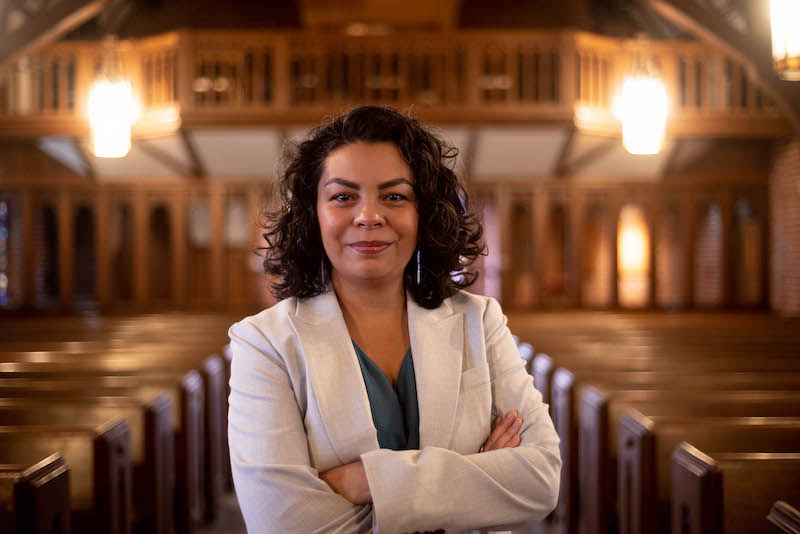
Following are opening remarks, as prepared for delivery, by House of Deputies President Julia Ayala Harris to the Executive Council of The Episcopal Church, which met virtually Feb. 20.
Good morning, Executive Council.
The work before us today may seem merely procedural. But friends, it is also spiritual.
Governance in this church is one of the ways we bear public witness.
Between meetings of General Convention, we are entrusted, for a time, with stewardship of this church. That authority is received. It is shared. And it is temporary. We tend what has been entrusted to us for the sake of the whole church; in honor of the generations who have come before and in care for those generations who will come after.
In seasons of change, questions arise about how we govern, how we communicate, and how we steward the church’s resources. Seasons like this can stretch patience and test trust. Those questions reflect care. They reflect investment. They reflect love for this church and her people.
Transparency, for us, is not a tactic. It is a spiritual discipline.
Transparency requires truthfulness, clarity, accountability, and trust. It is not measured by the volume of information released, but by accessibility, clarity, and faithfulness to the charge we’ve been given.
The letter to the Ephesians calls us to speak the truth in love and to grow up in every way into Christ. Growth requires truthfulness. It requires love.
How we govern shapes who we are becoming as the body of Christ. Healthy governance includes robust debate and hard questions. It includes disagreement. It also requires trust in the discernment of the body once decisions have been made.
We are fiduciaries of more than dollars. We are fiduciaries of trust. And that trust matters deeply in this wider moment.
We meet in a time when democratic norms are strained and Christian language is often distorted for political ends. In recent months, The Episcopal Church has used its voice and action with courage and clarity through litigation, through amicus briefs, and through lay leaders, clergy, and bishops who have spoken against the sins of hate and white Christian supremacy, and organized networks of support for our neighbors living in daily, hourly, constant fear.
We are living in a season when questions of refuge, religious liberty, and the relationship between church and state are again before the courts. The presiding bishop and I have joined amicus briefs in cases concerning religious freedom and access to asylum, and our church remains engaged in litigation challenging the rescission of the federal sensitive locations policy.
These actions were not made lightly, nor without the guidance of the whole church. They arise from the expressed commitments of General Convention and from our shared responsibility to steward the church’s public witness in faithfulness to that discernment and proclamation, grounded in our baptismal covenant, in our ordered life together, and in the conviction that faith must be freely chosen and faithfully practiced without coercion or fear.
Public witness without disciplined internal accountability will not endure. And disciplined governance without moral courage will not inspire.
If our testimony is to remain credible, our governance must be steady, transparent, and rooted in accountability—accountability to one another, to the direction of General Convention, and to God, who sustains, redeems, and restores.
Former House of Deputies President Pam Chinnis reminded this church that leadership is not about power. It is about responsibility. What we hold does not belong to us alone. And we must look honestly at the horizon before us.
We are approaching a generational shift that will reshape who sits in our pews, who leads our ministries, how our communities gather, and how this church is sustained. The next 20 years will not look like the last 50. Some congregations will shrink. Some will close. Others will face difficult decisions about identity and sustainability. These realities are not theoretical. They are already unfolding.
In that environment, stewardship is not bookkeeping. It is mission alignment. It is the disciplined preparation of a church that must endure in a landscape different from the one we inherited.
We are not simply managing an institution, we are stewarding a future. And that future is not ours alone.
So as we turn to this agenda—to reports, to budgets, to strategic updates, and to resolutions—I invite us to carry both the weight and the grace of this responsibility.
Let us do this work with clarity.
With discipline.
And with hope.
And may the Spirit grant us wisdom equal to the moment before us.
Thank you, friends.