
This page is available in: Español
Bible Study: Advent 1 (A) – November 30, 2025
November 30, 2025
RCL: Isaiah 2:1-5; Psalm 122; Romans 13:11-14; Matthew 24:36-44
Opening Prayer
Almighty God, give us grace to cast away the works of darkness, and put on the armor of light, now in the time of this mortal life in which your Son Jesus Christ came to visit us in great humility; that in the last day, when he shall come again in his glorious majesty to judge both the living and the dead, we may rise to the life immortal; through him who lives and reigns with you and the Holy Spirit, one God, now and for ever. Amen.
Context
Isaiah’s prophetic legacy is so vast that scholars believe later parts of the book attributed to him were written in his name and according to his style, long after he had died. It is prophecies from this “school” that informed later interpretations of Jesus’s messianic ministry and, before that, undoubtedly influenced the Virgin Mary’s assent to God’s indwelling with her. Her words in the Magnificat (Luke 1:36-55), while primarily inspired by the Song of Hannah (1 Samuel 2:1-10), hold echoes of Isaiah’s predictions of poetic reversal: swords into ploughshares, spears into pruning hooks…the hungry fed, the humble lifted high.
The excerpts of Isaiah that show up in the lectionary this Advent are drawn from the first part of the book of prophesies, from passages most likely to have been written by the prophet himself. Isaiah addresses the concerns of his day: the Syro-Ephramite War of 735-732 BCE during which time the Northern Kingdom of Israel in Samaria joined forces with Syria against Judah, resulting in an allyship between the southern kingdom and Assyria, a later period of civil unrest against Assyria from 720-710 BCE, and the other eras of political tension. And yet Isaiah’s timely commentary comes in language universal enough to ring through eternity and inspire songs spanning centuries and genres, from medieval chants like “O Come, O Come Emmanuel,” to spirituals like “Down by the Riverside,” to the finale of the musical Les Misérables. There is even evidence suggesting Isaiah’s earliest prophecies were re-appropriated for new situational contexts within his own lifetime.
Theological Reflection
Perhaps the most poignant aspect of the composite work of the book of Isaiah, as it is canonically organized, is that it begins with prophesies against God’s own beloved people before turning to their enemies. Isaiah 1 establishes that the holy city of Jerusalem in Judah—where the Temple with the Holy of Holies is—has fallen into corruption. This ensuing passage from the beginning of chapter 2 thus imagines the future re-establishment of the city which is home to God’s dwelling place on earth. The passage is bookended by terms that will be reconceived centuries later as metaphors for Jesus, who, in Christian theology, is both “word” and “light,” his flesh and blood the new site of divine presence.
In the superscript (2:1), the prophet situates himself and the “word” of God he is tasked with proclaiming relationally: As Isaiah is son of Amoz, the people of Judah are descendants of Jacob. From generation to generation, God is their God. As ever, they long for God’s intervention.
Isaiah’s following portrait of renewal begins in the realm of nature and extends to matters of humankind, expressing a motif of totality. While this prophecy hits close to home, it concerns “all the nations.” The mountain of the Lord’s house—the location of the Temple in Jerusalem—is first elevated to the highest height so that it may once again be the place of pilgrimage that inspired Psalms like today’s (122). This mountain is vaunted for its heavenly proximity to the divine—incomparable with any other earthly pretenders (such as Mount Gerizim, which Samaritans believed was God’s true dwelling). It is from this vantage point that God will instruct the nations and arbitrate between them as a parent would between children. The promise is this: the people who have taken up arms against one another will finally turn to take up the work of revitalization. In a labor of poetic justice, instruments for inflicting bodily harm will be physically beaten into tools for the cultivation of the land and the sustenance of human life. All people will be God’s people, and their work will be to reform and recreate, just as they were formed and created.
Isaiah foretells this will all come about in the abstract “days to come,” which are also the subject of both todays’ appointed Epistle (Romans 13:11-14) and Gospel (Matthew 24:36-44) readings. In these passages, we see how Isaiah’s imagery is refracted across time: in the “armor of light” from St. Paul’s letter to the church in Rome, and in Jesus, the prefigured word, teacher, and arbiter, who instructs his disciples about the Second Coming: “about that day and hour no one knows, neither the angels of heaven, nor the Son, but only the Father.”
Reflection Questions
- Where and how do you recognize God’s presence dwelling in the world around you?
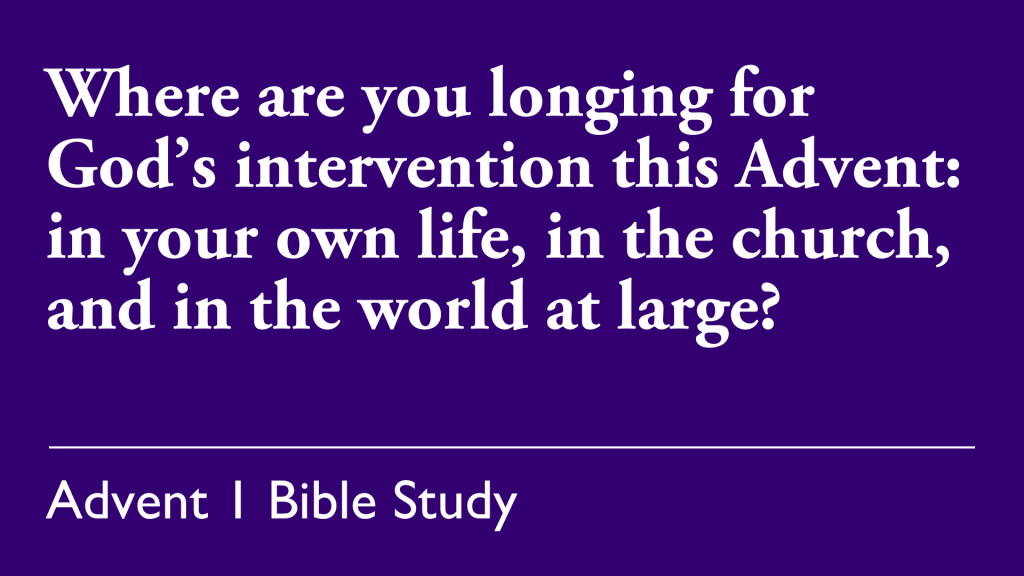
- Where are you longing for God’s intervention this Advent: in your own life, in the church, and in the world at large?
- What instruments of destruction need now to be recast into instruments of restoration? What would that labor look like, and how might you be called to participate in it?
Faith in Practice
Begin Advent by tuning in to your relationship with God first. Consider and take up a spiritual practice for the “days to come,” which will help you to perceive God’s presence in the world around you. Listen to sacred music, light an Advent wreath, or take daily walks to admire your neighbors’ holiday lights as you pray, “Come, let us walk in the light of the Lord!” Let this practice sustain you as you open your imagination, asking how you might participate in the divine labor of repairing the earth.
The Reverend Molly Cooke (she/her) is a cradle-dreidel Episcopalian from an inter-religious family in southeastern Pennsylvania and was ordained to the priesthood in June 2025 in the Diocese of Southern Ohio. She is currently serving Saint Mark’s Episcopal Church and School in Fort Lauderdale, Florida as their School Chaplain and Parish Curate. Before discerning a call to ordained ministry, Molly earned her Bachelor’s degree in Linguistics from Georgetown University and worked as a research coordinator studying language acquisition in d/Deaf and hard-of-hearing children at Ohio State University. A Bible and liturgy nerd, Molly’s professional passions include cultivating intergenerational spiritual formation, building an inter-religious community, studying biblical languages, and advocating for accessibility in sacred spaces. Molly and her fiancé Dan are the doting human servants of three rescue pets: Oreo and Samoa the Cook(i)e cats, and Samson the hound mutt.
This page is available in: Español
Don’t forget to subscribe to the Sermons That Work podcast to hear this sermon and more on your favorite podcasting app! Recordings are released the Thursday before each liturgical date.
Receive Free Weekly Sermons That Work Resources!

This page is available in: Español