
This page is available in: Español
Bible Study: Advent 3 (A) – December 14, 2025
December 14, 2025
RCL: Isaiah 35:1-10; Psalm 146:5-10; James 5:7-10; Matthew 11:2-11
Opening Prayer
Stir up your power, O Lord, and with great might come among us; and, because we are sorely hindered by our sins, let your bountiful grace and mercy speedily help and deliver us; through Jesus Christ our Lord, to whom, with you and the Holy Spirit, be honor and glory, now and forever. Amen.
Context
Every good story has a plot twist. Chapter 34 of Isaiah ends in flames: smoke, desolation, judgment, the smell of loss hanging in the air. The people of Israel are exiled, their homes destroyed, their faith threadbare. If this were a television show, the episode would fade out on despair.
But then—cut to Isaiah 35. The music changes. The desert begins to hum. Against all reason, joy enters the scene. It’s as though the Spirit slipped this poem out of order: a word of gladness smuggled into the ruins. The turn is so audacious, it feels divine—from dust to music, just like that.
Isaiah’s audience is a scattered people. Their temple lies in ruins. They are strangers in Babylon, missing home, missing God, missing the version of themselves they used to recognize. But the prophet doesn’t try to explain the suffering or tidy it up. He does something stranger. He speaks joy into the silence.
“The wilderness and the dry land shall be glad,” Isaiah proclaims. It’s absurd and beautiful and somehow believable all at once. The Hebrew word yasisu—“be glad”—carries a tremor of embodied joy: the laughter that breaks through tears, the pulse that restarts hope.
This passage falls on the third Sunday of Advent, which is traditionally called Gaudete Sunday—using the Latin word for “rejoice.” It’s that mid-Advent breath when the church trades violet liturgical colors for rose, as if to say, “Yes, waiting is weary work, but joy is part of the waiting too.” Yet the joy Isaiah offers isn’t the Hallmark kind. It’s not about pretending the desert isn’t real. It’s the kind of joy that takes the desert seriously and still believes something living can grow there.
Theological Reflection
Isaiah’s vision redefines salvation as movement, not escape. “The eyes of the blind shall be opened, the lame shall leap, the tongue of the speechless sing.” The verbs dance off the page. But this passage is not about fixing broken people; it’s about repairing broken belonging. The prophet dreams of a community where those once left out of the circle are restored to it. Healing here is not about perfection; it’s about participation.
As we read on, the story shifts again. A new image rises: a highway of holiness stretching through the desert, a road for the paduyim—the ransomed, those bought back from bondage. It’s not a private path for the pious; it’s the way home for the lost and the limping. Historically, this way led the exiles back to Jerusalem. Spiritually, it winds through every wilderness the human heart can wander—grief, shame, addiction, fatigue, despair—and somehow still leads home.
Even fools, Isaiah says, cannot lose their way there. There’s tenderness in that line, like a divine inside joke. It’s a reminder that no one is too far gone, too confused, or too clumsy for redemption. God travels with those who thought they’d been left behind, remapping desolation into dialogue.
And here’s the thing about joy: it doesn’t erase the ache. The chapter closes, “They shall obtain joy and gladness, and sorrow and sighing shall flee away.” But even here, the sigh lingers. Every heart knows that tension—the half-healed, half-home feeling of living between promise and fulfillment. To rejoice is not to forget exile; it’s to trust that the lingering ache itself is holy.
And so, the camera pans out one last time. The desert, now in bloom. The people, walking the Holy Way—foolish and beloved, with laughter and lament braided together.
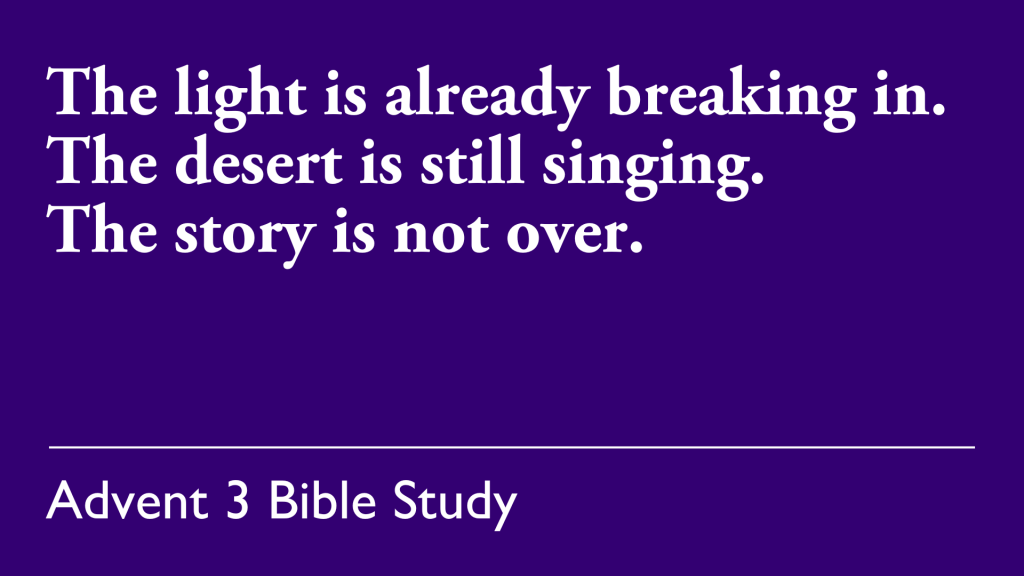
Isaiah’s prophecy still hums under the world’s noise today. It urges us to rebuild what is broken, re-green what is barren, mend what has fallen apart. This is the Advent invitation: to practice resurrection in miniature. To choose joy as resistance. To walk the road home together. The light is already breaking in. The desert is still singing. The story is not over.
Reflection Questions
- Where in your life might God be clearing space for something new to grow?
- How do you feel God inviting you to “practice resurrection in miniature”?
- When have you experienced healing in this way: as belonging rather than perfection?
- Who in your life or community still wanders in exile? What might the Holy Way home look like for them? How walk together with them?
- How can we practice joy as resistance? Where are you being called to mend what is broken?
Faith in Practice
This week, do something small but holy—one act that makes a bit more room for life to grow. Write that apology note, plant something green, fix what’s torn, or cook for someone who needs the comfort. When you light the Advent candle, name the ache that’s still here and let it sit beside your joy. Don’t rush to certainty; pray instead for courage to keep walking the road between ruin and bloom, trusting that God is already turning the desert into dialogue.
Tina Francis is a seminarian and writer preparing for ordination in the Episcopal Church. She is completing her Master of Divinity at the Seminary of the Southwest in Austin, Texas, where she lives with her husband and son. Born to South Indian parents and raised across Dubai, Canada, and Seattle, she carries a love for stories that cross borders. She finds God in conversation, shared meals, and a well-made cup of masala chai.
This page is available in: Español
Don’t forget to subscribe to the Sermons That Work podcast to hear this sermon and more on your favorite podcasting app! Recordings are released the Thursday before each liturgical date.
Receive Free Weekly Sermons That Work Resources!

This page is available in: Español