
Glossary of Terms
Bernard
(1090-Aug. 20, 1153). Influential monk who was called the “Pope maker” and “the uncrowned emperor of Europe.” He was born in Fontaines, France, and entered the Cistercian monastery at Citeaux, France, in 1113. In 1115 he established a Cistercian monastery at Clairvaux and became its abbot. In 1130 both Innocent II and Anacletus II claimed […]
Berry, Martha McChesney
(Oct. 7, 1866-Feb. 27, 1942). Founder of Berry College. She was born and grew up at Oak Hill, a cotton plantation near Rome, Georgia. She inherited a substantial estate in her early twenties when her father died. In the 1890s she started a Sunday School in the Blue Ridge mountains north of Rome, where her […]
Bethany, College of the Sisters of, Topeka, Kansas
On Feb. 2, 1861, the Kansas legislature granted a charter for “The Episcopal Female Seminary of Topeka.” On June 10, 1861, the school opened with thirty-three students. On July 9, 1872, Bishop Thomas Hubbard Vail obtained a new charter which changed the name to the College of the Sisters of Bethany. Vail named it in […]
Bethlehem, Diocese of
The General Convention of 1871 voted to divide the Diocese of Pennsylvania. On Nov. 8-10, 1871, the primary convention of the Diocese of Central Pennsylvania met at St. Stephen's Church, Harrisburg. The 1904 General Convention voted to divide the diocese again. On May 26, 1909, the name was changed to the Diocese of Bethlehem. It […]
Betrothal
A free and faithful promise of future marriage between two persons. It was an ancient Roman custom for a man to give a woman a ring as a sign of betrothal. The usefulness of betrothal was associated with prenuptial arrangements involving the couple and their families, such as dowry. Mary was betrothed to Joseph, but […]
Bexley Hall
It was founded on Nov. 4, 1824, by Bishop Philander Chase and the Diocese of Ohio as “The Theological Seminary of the Protestant Episcopal Church in the Diocese of Ohio.” It was incorporated by the Ohio State Assembly on Dec. 29, 1824, and opened at Worthington. In 1828 it moved to Gambier as Kenyon College […]
Bible, The
Holy Scriptures of the OT and NT, written under the inspiration of the Holy Spirit, containing all things necessary to salvation The OT reveals God’s mighty acts in creation, the deliverance of the people of Israel from bondage in Egypt, and the making of the old covenant with the chosen people. God’s saving will for […]
Bidding Prayer
An informal intercessory prayer, covering a wide variety of concerns such as the church, the state, the living and the dead, and public and private necessities. It followed the sermon and the dismissal of the catechumens in the early church. The celebrant bid a particular intention of prayer, and the congregation joined in silent prayer […]
Bier
A stand or frame on which a corpse, or a coffin containing a corpse, rests during the burial rite. A bier may also be used to carry the corpse or coffin into the church building and to the grave.
Bilateral Dialogues
Ecumenical dialogues that are held between two churches (“two-sided”), rather than “multilateral” or between many churches. Typically, each of the two churches appoints about ten representatives to the dialogue, and it meets once or twice a year to consider past disagreements and seek ways toward unity. In recent years the Episcopal Church has participated in […]
Bioethics
The ethics of life. As a field of study bioethics has expanded from an initial focus on medicine and health care to a focus on life itself. It includes both the goods of human life and the goods of the natural order. Bioethics was initially shaped by the discipline of ethics but has come to […]
Biretta
Stiff, brimless, three- or four-sided cap worn by clergy on ceremonial occasions. It is black if worn by a priest, and purple if worn by a bishop. The biretta may be ornamented by a pompon. It is rarely used in the Episcopal Church, except in some parishes with an Anglo-catholic piety.
Biretta Belt
Slang expression for dioceses in the vicinity of the Great Lakes that were once considered to be characterized by Anglo-catholic practices. The term is derived from the traditional fondness of some Anglo-catholic clergy for wearing birettas. Use of this hat was considered by some to be an emblem of Anglo-catholicism. The term is dated and […]
Bishop
One of the three orders of ordained ministers in the church, bishops are charged with the apostolic work of leading, supervising, and uniting the church. Bishops represent Christ and his church, and they are called to provide Christian vision and leadership for their dioceses. The BCP (p. 855) notes that the bishop is “to act […]
Bishop and Council
In some dioceses, Bishop and Council is the group which exercises all powers of the diocesan convention between meetings of the convention. It consists of the bishop; bishop coadjutor, if there is one; bishop suffragan, if there is one; and a designated number of clergy and lay persons. Bishop and Council may not elect a […]
Bishop Coadjutor
Assistant bishop with the right of succession upon the resignation of the diocesan bishop. Before a bishop coadjutor is elected, the diocesan bishop must consent to such an election and state the duties which will be assigned to the bishop coadjutor when duly ordained and consecrated.
Bishop Payne Divinity School
A former seminary of the Episcopal Church to train African American men for the ministry. On Oct. 2, 1878, the Virginia Theological Seminary (VTS) opened a branch seminary for Negroes in connection with St. Stephen's Normal and Industrial School, Petersburg, Virginia, under the Rev. Thomas Spencer (1852-1904). In 1884 the name was changed to the […]
Bishop Potter Memorial House
This training house for women church workers was opened in Philadelphia in 1867. Mr. and Mrs. William Welsh of St. Mark's Church, Philadelphia, were the leading founders. It was named after the Rt. Rev. Alonzo Potter, Bishop of Pennsylvania, 1845-1865. The women formed a sisterhood with a Protestant emphasis. In 1877 the name was changed […]
Bishop Seabury University
Intended predecessor of the Seabury Divinity School. James Lloyd Breck went to Faribault, Minnesota, in 1858, with the desire to establish a university. It was to be called the Bishop Seabury University after the first bishop of the Episcopal Church. It was never realized, but the Seabury Divinity School, first called Seabury Divinity Hall, was […]
Bishop Visitor or Protector
The bishop named to have an official, canonical relationship with a religious order. Each order must designate a Bishop Visitor or Protector, who serves as guardian of the order's constitution and arbiter of last resort for issues of conflict in the community. The Visitor or Protector may be the bishop in whose jurisdiction the order […]
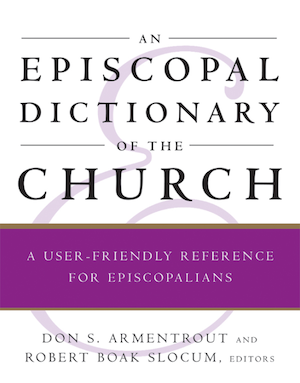
Glossary definitions provided courtesy of Church Publishing Incorporated, New York, NY,(All Rights reserved) from “An Episcopal Dictionary of the Church, A User Friendly Reference for Episcopalians,” Don S. Armentrout and Robert Boak Slocum, editors.