
Glossary of Terms
Epistle
Literally, a letter, the name was given to the first of the two NT readings in the eucharist. The majority of these passages were taken from the epistolary literature of the NT, such as the letters of Paul to communities of Christians in various places. On occasion, other books (Acts, Revelation, or OT readings) were […]
Epistle Side
See Gospel Side.
Epistoler
The lector who reads the epistle in the liturgy of the word at the eucharist. The term “epistle” may be applied to any NT reading at the eucharist, including a selection from the epistles, Acts, or Revelation. The epistoler may be vested, depending on local custom.
Eremitic
Concerning the solitary life of a hermit. In Christianity, the earliest hermits were the Desert Fathers of third-century Egypt. Some religious orders, like the Carthusians, retain elements of the eremitic lifestyle in their rule. They live in separate dwellings but gather for meals and worship. See Hermit, Hermitess.
Erie, Diocese of
When the Diocese of Northwestern Pennsylvania was organized in 1910, it was called the Diocese of Erie. It used that name until Nov. 14, 1981, when the name was changed to the Diocese of Northwestern Pennsylvania.
Eschatology
Theology of the last things, the end of time and history, the coming of the Kingdom of God. Use of the term dates from the nineteenth century. It is from the Greek, eschatos, “last.” Eschatology concerns the final end and meaning of all things, but it is possible to distinguish individual, social, and universal aspects […]
Eschaton
The term (from the Greek, eschaton, “last”) denotes the end of history when God will act decisively to establish the divine rule of justice and peace throughout the created order. Jesus refers to the eschaton as “the Kingdom of God,” which he proclaimed to have “come near” (Mk 1:15). In Christian understanding, the resurrection of […]
Essays and Reviews
This volume, published in England in 1860, was a significant collection of essays advocating a free and open interpretation of Holy Scripture. It included essays by Mark Pattison, Benjamin Jowett, and Frederick Temple. The collection was condemned in 1861 by the bishops of the Church of England because several of the essays were thought to […]
Essays Catholic and Critical
This collection of fifteen essays by liberal catholics of the Church of England was edited by Edward Gordon Selwyn. It was published in 1926. It was an effort to take seriously both the catholic tradition and critical scholarship. The contributors felt compelled to “think out afresh the content and the grounds of their religion.” They […]
Esse, Bene Esse, Plene Esse
Terms for characterizing the significance of a doctrine or practice for the church. Esse indicates that which is of the essence of the very existence of the life of the church. Bene esse indicates that which is of benefit for the life of the church. Plene esse indicates that which is of the fullness of […]
Establishment of Religion
An arrangement in which a religion or a particular religious institution enjoys official status and the state may enforce conformity. The establishment of Christianity began with Constantine the Great (d. 337) who first tolerated Christianity instead of persecuting it, and then later actively sought to make it the official religion of the Roman Empire. Established […]
Etheria. See Egeria
(or Etheria or Aetheria), Pilgrim.
Ethics
As a field of study, the subject matter of ethics is the moral life. The moral life itself has been variously understood, although two approaches have most fundamentally defined ethics. One approach emphasizes human fulfillment and happiness and results in a teleological ethic focusing on ends. The other approach emphasizes moral duty and results in […]
Eucharist
The sacrament of Christ's body and blood, and the principal act of Christian worship. The term is from the Greek, “thanksgiving.” Jesus instituted the eucharist “on the night when he was betrayed.” At the Last Supper he shared the bread and cup of wine at a sacred meal with his disciples. He identified the bread […]
Eucharistic Adoration
Adoration of God in prayer “is the lifting up of the heart and mind to God, asking nothing but to enjoy God's presence” (BCP, p. 857). Eucharistic adoration is devotional adoration of the real presence of Christ in the consecrated bread and wine of the eucharist. Private eucharistic adoration often involves prayer near the tabernacle […]
Eucharistic Canon
The fixed portion of the eucharistic prayer which does not vary with the liturgical season or occasion. See Canon.
Eucharistic Elements
Bread and wine that are consecrated in the eucharist. The bread recalls the work of human hands required to harvest the wheat and make the bread, and the companionship of sharing. The wine recalls festivity and celebration, along with sacrifice. These elements of the communal meal are offered by the congregation and blessed during the […]
Eucharistic Prayer
This prayer over the bread and wine at communion begins with the Sursum Corda dialogue and concludes with the doxology and the Great Amen. The prayer is also called The Great Thanksgiving, the anaphora, the prayer of consecration, and the canon of the Mass. The BCP includes eight eucharistic prayers: two for Rite 1 (pp. […]
Eucharistic Sacrifice
That which is offered to God in the Holy Communion. The identification of Jesus' sacrifice with the eucharist is derived from the Last Supper, when Jesus identified the bread with his body and the wine with his blood of the new covenant (see 1 Cor 11:23-26; Mk 14:22-25). The Letter to the Hebrews describes Christ […]
Eucharistic Sharing
The sharing of the Holy Communion among members of different churches. Conditions for such admission are defined and stated by each church for itself. See Ecumenical Movement.
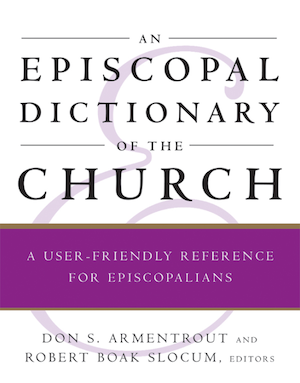
Glossary definitions provided courtesy of Church Publishing Incorporated, New York, NY,(All Rights reserved) from “An Episcopal Dictionary of the Church, A User Friendly Reference for Episcopalians,” Don S. Armentrout and Robert Boak Slocum, editors.