
Glossary of Terms
Eucharistic Vestments
Traditional liturgical garments worn at the celebration of the eucharist. In medieval times in the western church, priests officiating at the altar wore six garments over the cassock. These were the amice (a loose collar or hood), the alb (a full-length sleeved gown), and girdle. Over them was the stole, the maniple on the left […]
Eutychianism
Heretical teaching about the person of Christ associated with Eutyches (c. 378-454). He was the archimandrite (monastic superior) of a large monastery in Constantinople, and influential at the imperial court in Constantinople in the middle of the fifth century. Eutyches was caught up in the controversy then raging over the relationship between the humanity and […]
Evangelical
Formed from the noun evangel (from the Greek euanggelion, "good news"), it means simply "pertaining to the gospel." Hooker referred to the Magnificat, Benedictus, and Nunc Dimittis as "Evangelical Hymns" since their texts come from the Gospel of Luke. During the intra-Protestant controversies in Germany and Switzerland in the sixteenth and seventeenth centuries, Lutherans […]
Evangelical Catholic, The
This journal was published biweekly and then weekly from Sept. 13, 1851, until Dec. 30, 1852. It was founded and edited by William Augustus Muhlenberg. It was intended to be above the party divisions of the Episcopal Church at the time. Muhlenberg wanted to unite evangelical and catholic in the church. Its subtitle called it […]
Evangelical Catholics
This was a party or style of churchmanship which was advocated primarily by William Augustus Muhlenberg. Muhlenberg developed its ideas in his publication The Evangelical Catholic. An evangelical catholic is evangelical in stressing a personal faith in Jesus Christ and the role of the emotions in the Christian life. An evangelical catholic is catholic by […]
Evangelical Movement, Evangelicalism
Evangelicalism first expressed itself in the Episcopal Church during the Great Awakening. From 1811 until 1873, there was a very significant evangelical movement or party within the Episcopal Church. The beginning of the movement can be dated from the consecration of Alexander Viets Griswold as Bishop of the Eastern Diocese on May 29, 1811. The […]
Evangelical Quarterly, The
It was published by the Protestant Episcopal Society for the Promotion of Christian Knowledge, also known as the Evangelical Knowledge Society. It was published in Philadelphia from Jan. 1860, until Sept. 1862.
Evangelism, Evangelist
From the Greek euangelion, "good news." An evangelist is one who tells the story of Jesus. The epistle to the Ephesians (4:11) names evangelists after apostles and prophets in the list of ministers in the NT church. Little else is said about evangelists or evangelism except that Philip was an evangelist (Acts 21:8), and Paul […]
Evans, Hugh Davey
(Apr. 26, 1792-July 16, 1868). Lay theologian and defender of high church principles. He was born in Baltimore, Maryland. Evans began to study law when he was eighteen, and entered practice on Aug. 19, 1815. Throughout his life, Evans was a widely published author and an editor of church journals. From 1843 until 1856, he […]
Eve (liturgical)
The evening or day before a feast or other important celebration. Depending on local customs and practice, the celebration of a feast may begin on the eve of the feast. In many parishes, the principal Christmas services take place on Christmas Eve. The BCP provides directions for a Vigil of Pentecost (pp. 175, 227). The […]
Evening Prayer
One of the principal Daily Offices. Evening Prayer has been the title for the Evening Office in Anglican worship since the 1552 revision of the Prayer Book. The BCP provides forms for Daily Evening Prayer in traditional and contemporary language (pp. 61, 115). Evening Prayer may begin with an opening sentence of scripture and with […]
Evensong
Since the late middle ages “evensong” has been the popular name for vespers (from the Latin vesperis, “evening”), the Evening Office of the western church. Cranmer used it in the 1549 BCP. Although in 1552 he replaced it with “Evening Prayer,” the common name remains “evensong.” In many Anglican cathedrals and other large churches, especially […]
Every Member Canvass
A parochial stewardship campaign that invites every member of the parish to make a pledge for the upcoming year. The campaign may urge the parishioners to offer their time, talent, and treasure. Members of the parish pledge to give a certain amount of money to the church. The campaign may encourage parishioners to tithe as […]
Evolution
A process of development or unfolding. A dynamic "evolutionary" understanding of the development of the cosmos and the forms of life within it appeared in European thought before the nineteenth century. The theory of evolution was forcefully introduced into the English scene by Charles Darwin's Origin of Species (1859). Darwin argued that new species of […]
Ewer
A pitcher for pouring water. It is typically made of silver or another precious metal, or pottery. A ewer may be used to pour water into the font before the prayer of thanksgiving over the water at baptism, or to fill basins for the washing of feet on Maundy Thursday. Images of a ewer and […]
Ewer, Ferdinand Cartwright
(May 22, 1826-Oct. 10, 1883). Priest and leading nineteenth-century Anglo-catholic. He was born on Nantucket Island, Massachusetts. He graduated from Harvard College in 1849, and joined the California gold rush. In California he worked as an engineer and a newspaper editor. Ewer was a self-proclaimed agnostic, but he returned to the Episcopal Church in the […]
Ex Opere Operantis
From the Latin, meaning “by the work of the doer.” In sacramental theology, the phrase concerns the proper disposition of the minister or recipient of a sacrament. It does not deny the objective reality of the sacraments, but it indicates that the proper disposition is needed for the sacrament's full effectiveness in the life of […]
Ex Opere Operato
From the Latin, meaning “by the work done.” In sacramental theology, the objective reality and effectiveness of the sacraments when validly celebrated, regardless of the subjective attitudes or qualities of the ministers or recipients. For example, the real presence of Christ in the eucharist is not diminished by the lack of faith of one who […]
Exaltation of the Cross
See Holy Cross Day.
Excommunication
The disciplinary exclusion of a person from receiving communion by competent religious authority. It represents exclusion from the corporate life of the church. Excommunication was intended to encourage repentance and not meant to be a punishment. The Prayer Book Disciplinary Rubrics for the Holy Eucharist provide that if the priest “knows that a person who […]
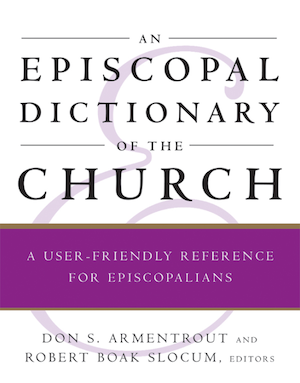
Glossary definitions provided courtesy of Church Publishing Incorporated, New York, NY,(All Rights reserved) from “An Episcopal Dictionary of the Church, A User Friendly Reference for Episcopalians,” Don S. Armentrout and Robert Boak Slocum, editors.