
Glossary of Terms
Montgomery, James
(Nov. 4, 1771-Apr. 30, 1854). British newspaper editor and hymn writer. Montgomery was born in Irvine, Ayrshire, England. He was the son of Moravian missionary parents who intended that he become a minister. However, he was dismissed from seminary in 1792 because of his preoccupation with writing poetry. He became assistant to the editor and […]
Moore, Clement Clarke
(July 15, 1779-July 10, 1863). Seminary professor and renowned poet. He was born in Chelsea in New York City. Moore graduated from Columbia College in 1798. He studied for the ordained ministry but was never ordained. In 1809 he published A Compendious Lexicon of the Hebrew Language: In Two Vols. It was a major publication […]
Moore, Richard Channing
(Aug. 21, 1762-Nov. 12, 1841). A leading evangelical bishop who was known for his prayer meetings and informal services. He was born in New York City. Moore studied medicine. After practicing medicine for a while, he studied for the ordained ministry under Bishop Samuel Provoost of New York. He was ordained deacon on July 15, […]
Moral Theology
Theology that focuses on development of moral principles and norms and their application to human actions in general and to particular situations. Moral theology provides a systematic framework for casuistry and has reflected the concerns of casuistry. Traditional moral theologies broadly assumed the theology of Thomas Aquinas (1225-1274). Roman Catholic texts began with a consideration […]
More Hymns and Spiritual Songs
A 1971 hymnal supplement, prepared by the Joint Commission on Church Music of the Episcopal Church and published in a loose-leaf format. It has a wide variety of musical resources, including traditional hymns, folk songs, and ancient melodies. The first section of the collection, “Songs for Liturgy,” contained settings of music for the offices and […]
Moreau, Jules Laurence
(Dec. 9, 1917-June 12, 1971). Historian and editor. He was born in Irvington, New Jersey. Moreau received his B.A. from Lehigh University in 1940; his S.T.B. in 1947 and his S.T.M. in 1953 from the General Theological Seminary; and his M.A. in 1953 and his Ph.D. in 1960 from Northwestern University. He was ordained deacon […]
Morehouse, Clifford Phelps
(Apr. 18, 1904-Feb. 17, 1977). Editor, author, publisher, and ecumenist. He was born in Milwaukee, Wisconsin. Morehouse received his B.A. in 1925 from Harvard University and his M.A. from Marquette University in 1937. He was secretary of the Morehouse-Barlow Publishing Company, 1925-1939, vice-president, 1932-1964, and president, 1964-1968. Morehouse was managing editor of The Living Church, […]
Morehouse, Frederic Cook
(Mar. 19, 1868-June 25, 1932). Editor, author, publisher, and ecumenist. He was born in Milwaukee, and educated privately. In 1885 he assisted his father, Linden Husted Morehouse, in establishing The Young Churchman Company, the name of which was changed in 1918 to Morehouse Publishing Company. From 1896 to 1900, Morehouse edited The Church Eclectic, and […]
Morgan, Emily Malbone
(Dec. 10, 1862-Feb. 27, 1937). Founder of the Society of the Companions of the Holy Cross. She was born in Hartford, Connecticut, the youngest child of a wealthy family. As early as 1889 she established a number of summer vacation homes for urban working women in rural Connecticut and Massachusetts. She financed these homes by […]
Morning Prayer
In many times and places, daybreak has been a time of prayer. Jews prayed in their synagogues at sunrise as well as at other times each day. This Jewish pattern of prayer formed the basis of the Christian monastic Daily Office, with its prayers or “hours” at seven times in each day. Thomas Cranmer’s revision […]
Moscow Agreed Statement
This statement was issued in Aug. 1976 by the Anglican-Orthodox Joint Doctrinal Commission. Subjects treated were: 1) the knowledge of God, 2) the inspiration and authority of Holy Scripture, 3) scripture and tradition, 4) the authority of councils, 5) the Filioque clause, 6) the church as the eucharistic community, and 7) the invocation of the […]
Most Reverend
See Reverend, The.
Motet
A composition based on a sacred Latin text, sung by two or more voices. It was traditionally unaccompanied. The text sung by the upper part was a paraphrase of the plainchant text sung by the tenor or lower part. The motet was polyphonic (multiple tones) and polytextual (multiple texts). Additional parts add additional paraphrased texts […]
Mother House
Traditionally, it is the headquarters for a community where the superior lives. It is distinguished from branch houses or dependent foundations of the community.
Mothering Sunday
” The fourth Sunday in Lent, also known as Refreshment Sunday and Laetare Sunday. It was the traditional mid-Lent Sunday. It was a time of refreshment and relaxing the penitential discipline of Lent. Rose-pink vestments were allowed to take the place of the purple vestments of Lent. The traditional epistle for the fourth Sunday in […]
Movable Feast
A feast of the church year that is not celebrated on a fixed date. The date of the movable feast’s celebration in each year is determined by other liturgical rules. The church year has two cycles of feasts and holy days, one dependent on the movable date of Easter Day and the other dependent on […]
Mozarabic Rite
The ancient liturgy of the Christian church in Spain. Its center was at Toledo. The term is derived from Arabic, “a would-be Arab.” Its use stems from the centuries when Spain was under Arab or Moslem rule. Elements from eastern rites found their way into the liturgy of the church in Spain. The Mozarabic Rite […]
Mozetta, or Mozzetta
A short cape that covers the shoulders. It is fastened at the neck, and it may have a hood. It is traditionally worn by bishops and other ecclesiastical dignitaries.
Muhlenberg Memorial
Statement presented by William Augustus Muhlenberg, rector of the Church of the Holy Communion, New York City, and others to the House of Bishops of the Episcopal Church at the 1853 General Convention. It reflected Muhlenberg's ecumenical vision of a church both catholic and reformed that could include all Christians. It proposed “some ecclesiastical system, […]
Muhlenberg, John Peter Gabriel
(Oct. 1, 1746-Oct. 1, 1807). An eighteenth-century Anglican priest who served Lutheran congregations. He was born in Trappe, Montgomery County, Pennsylvania. He went to Halle, Germany, for his education. After several years he returned to America. He studied for the Lutheran ministry with Carl Magnus von Wrangel, Provost of the Swedish churches on the Delaware. […]
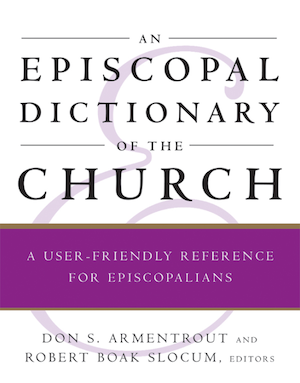
Glossary definitions provided courtesy of Church Publishing Incorporated, New York, NY,(All Rights reserved) from “An Episcopal Dictionary of the Church, A User Friendly Reference for Episcopalians,” Don S. Armentrout and Robert Boak Slocum, editors.