
Glossary of Terms
Southwestern Brazil, Missionary District of
On Sept. 30, 1949, the House of Bishops divided the Missionary District of Southern Brazil into three missionary districts-Southwestern Brazil, Southern Brazil, and Central Brazil. On Oct. 20, 1964, the House of Bishops voted for an independent Brazilian Church, and in 1965 the Episcopal Church of Brazil became an independent Province of the Anglican Communion. […]
Southwestern Diocese
The 1832 General Convention voted that the dioceses of Mississippi and Alabama, and the clergy and churches in the State of Louisiana could associate and join in the election of a bishop. Delegations from these three areas met at Christ Church, New Orleans, on Mar. 4-5, 1835, and formed the Southwestern Diocese. They elected Francis […]
Southwestern Virginia, Diocese of
The 1919 General Convention voted to divide the Diocese of Southern Virginia. The primary convention of the Diocese of Southwestern Virginia was held at St. John's Church, Roanoke, Dec. 10-11, 1919. The Diocese is composed of the following counties: Alleghany, Amherst, Augusta, Bath, Bedford, Bland, Botetourt, Buchanan, Campbell, Carroll, Craig, Dickinson, Floyd, Franklin, Giles, Grayson, […]
Spalding, Franklin Spencer
(Mar. 13, 1865-Sept. 25, 1914). A leading advocate of the Social Gospel, known as the “socialist bishop.” He was born in Erie, Pennsylvania. He graduated from Princeton in 1887 and from the General Theological Seminary in 1901. He was ordained deacon on June 3, 1891, and began his ministry as pastor of All Saints' Church, […]
Sparrow, William
(Mar. 12, 1801-Jan. 17, 1874). Leading evangelical theologian and opponent of Tractarianism. He was born in Charlestown, Massachusetts. His family moved to Huron County, Ohio, and Sparrow became involved with the educational enterprises of Bishop Philander Chase. He taught at a school in Worthington, Ohio, administered by Bishop Chase's son, and then at Cincinnati College, […]
Spirit of Missions, The
This monthly journal was published by the Board of Missions of the Episcopal Church. The first issue appeared in Jan. 1836, and the last issue appeared in Dec. 1939. It was continued by Forth. The Spirit of Missions is one of the major primary sources for the history of the Episcopal Church. Standard of the […]
Spiritual Director
A person, lay or ordained, with whom one communicates concerning the spiritual life may also be known as a soul-friend, soul-mate, or spiritual companion. A director listens and, when appropriate, responds by giving “direction” which may include spiritual advice, help with discernment, suggested reading or action, or a question to ponder. Different directors have different […]
Spiritual Gifts
Also called charisms, and partially listed in 1 Cor 12:4-11, these are graces granted by the Holy Spirit to empower the faithful to perform specific tasks. Called gratiae gratis datae (freely given graces) by the scholastics, they are at the service of charity (1 Cor 13:13). Given over and above the fundamental gift of faith […]
Spirituality
An interest and intentional participation in the spiritual life, providing a context for open and direct experience of God and the entire spiritual realm at an intensely personal level. Spirituality concerns the whole of life in the context of faith. Resources for spirituality include participation in retreats, quiet days, spiritual direction, and use of books, […]
Spokane, Diocese of
On Oct. 13, 1853, the General Convention created the Missionary District of Oregon and Washington Territory. On Oct. 15, 1880, the General Convention divided it into the Missionary District of Oregon and the Missionary District of Washington. On Oct. 20, 1892, the General Convention divided the Missionary District of Washington into the Missionary District of […]
Springfield, Diocese of
The 1877 General Convention voted to divide the Diocese of Illinois into the dioceses of Illinois, Quincy and Springfield. The primary convention of the Diocese of Springfield met at St. Paul's Church, Springfield, Dec. 18-19, 1877. It includes the following counties: Carr, Champaign, Christian, Clark, Coles, Cumberland, De Witt, Douglass, Edgar, Greene, Jersey, Logan, Macon, […]
St
Andrew's College, Jackson, Mississippi. St. Andrew's College opened on Jan. 1, 1852, with the Rev. Meyer Lewin (1816-1886) as president. It was under the jurisdiction of the Diocese of Mississippi. It received its charter on Oct. 16, 1852, and was the first college with its own grounds and buildings to be established in Jackson. It […]
St Andrew’s Divinity School, Syracuse, New York
Founded by Bishop Frederic Dan Huntington of Central New York, it opened on Sept. 16, 1876, and closed in 1905. The school's principal scholar was the Rev. Dr. William Dexter Wilson, who was dean, 1880-1900.
St Andrew’s Theological Seminary, Mexico City
The oldest Anglican institution of theological education in the Spanish-speaking world. It was founded in 1894, by the Rev. Henry Forrester. The seminary is accredited by ALIET (Asociacion Latinoamericana Internacional de Escuelas Teologicas, Latin American Association of Theological Schools). It participates in a consortium of seminaries called the Comunidad Teologica. It was a seminary of […]
St Andrew’s-Sewanee School, Sewanee, Tennessee (SAS)
Successor to several late nineteenth-/early twentieth-century schools. St. Andrew's Industrial and Training School for Boys opened on Sept. 21, 1905, near Gibson's Switch, Tennessee, near Sewanee. Later in 1905 the Order of the Holy Cross took over the school. In Apr. 1906 it officially adopted the school as a “work of the Order.” In 1888 […]
St Ann’s Church for the Deaf
The idea of a church for the deaf came to the Rev. Thomas Gallaudet while he was ministering to a deaf teenager who was a student at the New York School for the Deaf, New York City. Gallaudet, with the support of the Bishop of New York, established St. Ann's Church for the Deaf. The […]
St Augustine College, Chicago, Illinois
A bilingual institution of higher education created to make the American system of higher education accessible to a non-traditional student population with an emphasis on those of Hispanic descent. It was granted operating authority by the Illinois State Board of Higher Education on Oct. 7, 1980. It is a coeducational, two-year college with an emphasis […]
St Augustine, Missionary College of, Benicia, California
One of several schools founded by James Lloyd Breck. In Dec. 1867, he bought the twenty-acre tract and buildings which belonged to the recently closed Benicia Collegiate Institute and Law School at Benicia, California. Breck opened his Missionary College in 1868. Breck also established St. Mary's School for girls on the same campus. St. Mary's […]
St Augustine’s College, Raleigh, North Carolina
A historically African American, coeducational institution, offering the bachelor's degree. The leader in its founding was Joseph Brinton Smith, executive director of the Freedman's Commission of the Episcopal Church. It was chartered on July 19, 1867, at St. Augustine's Normal School and Collegiate Institute and received its first four students on Jan. 13, 1868. From […]
St Clement’s Church, Philadelphia
On Sept. 13, 1855, a charter was granted to “The rector, Church Wardens, and Vestrymen of St. Clement's Church in the City of Philadelphia.” The cornerstone of the new church was laid on May 12, 1856, by Bishop Alonzo Potter. The church was consecrated on Apr. 12, 1864. The influence of the Catholic Revival, sometimes […]
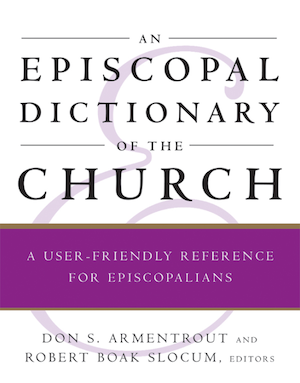
Glossary definitions provided courtesy of Church Publishing Incorporated, New York, NY,(All Rights reserved) from “An Episcopal Dictionary of the Church, A User Friendly Reference for Episcopalians,” Don S. Armentrout and Robert Boak Slocum, editors.