
Glossary of Terms
Widow
A woman who has remained unmarried since the death of her husband. In biblical times, women were very much dependent on male relatives for their welfare. A woman could find herself in a vulnerable and defenseless position when her husband died. An untimely and early death of the husband could be seen as judgment for […]
Wilberforce, William
(Aug. 24, 1759-July 29, 1833). English philanthropist, reformer, orator, and evangelical layman. He was born in Hull, Yorkshire. Wilberforce studied at St. John's College, Cambridge University, 1776-1779. In 1780 he was elected to the House of Commons representing Hull. It was in the House of Commons that he worked against slavery and the slave trade. […]
Wilkinson, Christopher
(d. Apr. 15, 1729). Second Commissary to Maryland. Bishop of London John Robinson appointed Wilkinson Commissary of the Eastern Shore of Maryland in 1716. He served until his death.
Willan, Healey
(Oct. 12, 1880-Feb. 16, 1968). Renowned composer of church music. He was born in Balham, in Surrey, England. He trained at St. Saviour's, Eastbourne. After advanced study in organ and piano, he served several churches in and near London. In 1913 he came to Toronto, Ontario, Canada, as head of the music theory department at […]
William and Mary, College of
First Anglican college in the American colonies. It was founded by James Blair, the first Commissary to Virginia. On Feb. 8, 1693, King William III and Queen Mary II granted a charter. On Dec. 20, 1693, 330 acres were purchased at “Middle Plantation,” now Williamsburg, for the school. The cornerstone of the first building was […]
William Smith College
William Smith, a nurseryman in Geneva, New York, wanted to establish a college for women in Geneva. Though his family were members of the Episcopal Church, Smith had moved towards spiritualism. President Langdon Cheves Stewardson of Hobart College, Geneva, suggested to Smith a women's college. The new college was to be associated with Hobart, sharing […]
Williams, Channing Moore
(July 18, 1829-Dec. 2, 1910). Missionary Bishop to China and Japan. He was born in Richmond, Virginia. Williams received the M.A. degree from the College of William and Mary in 1852. He graduated from the Virginia Theological Seminary in 1855, and was ordained deacon on July 1, 1855. In Nov. 1855 he sailed for Shanghai […]
Williams, Charles David
(July 30, 1860-Feb. 14, 1923). Bishop, theologian, and social gospel advocate. He was born in Bellevue, Ohio. Williams received his B.A. in 1880 and his M.A. in 1893 from Kenyon College. He studied for the ordained ministry at Bexley Hall. Williams was ordained deacon on June 17, 1883, and priest on Oct. 30, 1884. He […]
Williams, David McKinley
(1887-1978). American church musician, composer, and teacher. He was born in Carnarvonshire, Wales. Williams began his career in church music as a chorister in the choir of the Cathedral of St. John, Denver. At the age of thirteen he became the organist of St. Peter's Church, Denver. In 1908 he went to New York to […]
Williams, John
(Aug. 30, 1817-Feb. 7, 1899). Founder of Berkeley Divinity School and eleventh Presiding Bishop. He was born in Deerfield, Massachusetts. In 1831 he began his studies at Harvard College. He became an Episcopalian, and at the end of his sophomore year he transferred to Washington College, Hartford, Connecticut, where he graduated in 1835. From 1837 […]
Williams, Peter, Jr.
(c. 1780-Oct. 17, 1840). The second African American ordained to the Episcopal priesthood. He was born in New Brunswick, New Jersey. Williams's father, Peter Williams, Sr., was one of the founders of the African Methodist Episcopal Zion Church in New York City. Williams, Jr., became associated with a congregation of African American Episcopalians who worshiped […]
Williams, Ralph Vaughan
( See Vaughan Williams, Ralph.
Willibrord
(658-Nov. 7, 739). He was born in Northumbria, England. He was educated in the monastery at Ripon, where he became a monk. After study in Ireland, he decided he wanted to become a missionary. In 690 he and eleven companions crossed the English Channel to Frisia (Holland). He was consecrated Bishop on Nov. 22, 695. […]
Wilmer, Richard Hooker
(Mar. 15, 1816-June 14, 1900). The only bishop consecrated by the Protestant Episcopal Church in the Confederate States. He was born in Alexandria, Virginia. His father was William Holland Wilmer, a founder and one of the original members of the faculty of the Virginia Theological Seminary. Richard Wilmer graduated from Yale College in 1836 and […]
Wilmer, William Holland
(Oct. 29, 1782-July 24, 1827). Founder and one of the two original members of the faculty of the Virginia Theological Seminary. He was born in Kent County, Maryland, and educated at Washington College, Kent County. He was ordained deacon on Feb. 19, 1808, and began his ordained ministry at Chester Parish, Chestertown, Maryland. On June […]
Wilson, Bird
(Jan. 8, 1777-Apr. 14, 1859). Professor of theology and priest. He was born in Carlisle, Pennsylvania. Wilson graduated from the University of Pennsylvania in 1792, and was admitted to the bar in 1797. He was president judge of the Court of Common Pleas, Seventh Circuit, Pennsylvania, 1802-1818. Wilson studied for the ordained ministry under Bishop […]
Wilson, William Dexter
(Feb. 28, 1816-July 30, 1900). Widely published writer in mathematics, philosophy, and church history. He was born in Stoddard, New Hampshire, and graduated from Harvard Divinity School in 1838. After four years as a Unitarian minister, he joined the Episcopal Church. Wilson was ordained deacon on Apr. 7, 1842, and priest on Sept. 21, 1847. […]
Windham House, New York City
National graduate training center for women workers in the Episcopal Church. It was purchased by the Woman's Auxiliary as a memorial to Bishop Daniel S. Tuttle. The house was named for Windham, New York, which was Tuttle's birthplace. It opened in 1928. It served as a residential center for furloughed missionaries or women who were […]
Windsor Statement
This agreed statement on eucharistic doctrine was finalized by the Anglican-Roman Catholic International Commission (ARCIC) at Windsor in 1971. It was eventually included within the ARCIC Final Report (1982). The commission reached consensus on the eucharist as sacrifice and the real presence. An “Elucidation” issued by the commission in 1979 explained that it had reached […]
Wine
Alcoholic beverage made from the fermented juice of grapes. Wine and bread are the essential elements of the eucharist. Wine is associated with celebration, fellowship, and joy. In Judaism, bread and wine were used in household worship such as the Sabbath meal and the Passover meal. The synoptic gospels identify Jesus’ Last Supper with his […]
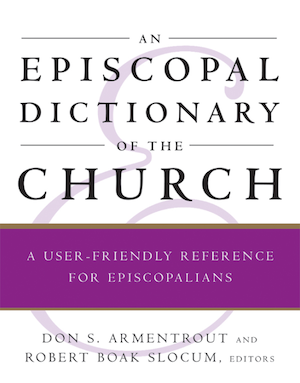
Glossary definitions provided courtesy of Church Publishing Incorporated, New York, NY,(All Rights reserved) from “An Episcopal Dictionary of the Church, A User Friendly Reference for Episcopalians,” Don S. Armentrout and Robert Boak Slocum, editors.