
Glossary of Terms
Aaronic Blessing
Prayer of blessing drawn from Nm 6:24-26. An optional blessing at the close of An Order of Worship for the Evening (BCP, p. 114). The form of committal in the Burial of the Dead is an adaptation of the Aaronic Blessing (BCP, pp. 485, 501). It is provided as a Seasonal Blessing by the BOS […]
Abbess
Female leader or superior of a religious community, usually a community following the Benedictine Rule. In community matters, the abbess has the same authority as an abbot, but without the abbot's sacramental function. The abbess is the spiritual, administrative, and jurisdictional superior of the community.
Abbey
A monastic community of religious persons along with the buildings of the community. The abbey consists of monks ruled by an abbot, or of nuns under an abbess. Abbeys are independent of the jurisdiction of the local bishop. The traditional plan of the buildings included an oratory (chapel), a chapter room (for assemblies of the […]
Abbot
Male leader or superior of a religious community. The title is derived from the Latin abbas or the Aramaic abba, “Father.” The abbot functions as the “father” of the community. He is elected for life and receives authority from a bishop. The role of the abbot is to regulate the life of the community in […]
Abjuration
A solemn renunciation of any belief, thing, or person to which one was previously loyal. This formal retraction of errors, made before witnesses, often concerned matters of apostasy, heresy, or schism. Prior to 1972, this solemn disavowal was required of baptized Christians being received into the Roman Catholic Church. The Greek Church has required particular […]
Abjure
See Abjuration.
Ablutions
Liturgical and ceremonial cleaning of the paten and chalice with water, or with water and wine, following the communion of the people at the Holy Eucharist. If the consecrated bread and wine are not reserved for later use, they are consumed by the ordained and lay ministers of the eucharist either after the communion of […]
Absalom Jones Theological Institute
A unit of the Interdenominational Theological Center, Atlanta, from 1972 to 1978. Named for the first African American priest in the Episcopal Church, it was to be a resource institution for Episcopal seminarians who wanted to serve African American communities. Its only dean was Quinland Reeves Gordon.
Absolution
The formal act by a bishop or priest of pronouncing God’s forgiveness of sins through Jesus Christ. The absolution of sins reflects the ministry of reconciliation committed by Christ to the church. Absolution may be pronounced following private confession of sins, as provided for by the two forms for The Reconciliation of a Penitent in […]
Abstinence, Days of
See Days of Abstinence.
Acclamation
A salutation or greeting in the opening dialogue of the eucharistic liturgy arranged by versicle and response and varied according to the liturgical season. The memorial acclamation is a congregational response that may follow the institution narrative in the eucharistic prayers.
Acolyte
In contemporary Anglicanism, a general term which covers not only servers, torchbearers, and lighters of candles but also crucifers, thurifers, and banner-bearers. Acolytes are mentioned as a minor order (along with porters, lectors, and exorcists) as early as a letter of Pope Cornelius to Fabius of Antioch in 252. They were also mentioned in Cyprian’s […]
Adams, William
(July 3, 1813-Jan. 2, 1897). One of the founders of Nashotah House, he was born in Monaghan, Ireland, and received his B.A. in 1836 from Trinity College, Dublin. In 1838 he came to the United States and entered the General Theological Seminary, New York, graduating in 1841. He was ordained deacon on June 27, 1841, […]
Addison, James Thayer
(Mar. 21, 1887-Feb. 13, 1953). A leader and authority in overseas missionary work, Addison was born in Fitchburg, Massachusetts, and received his B.A. from Harvard in 1909. He received his B.D. from the Episcopal Theological School in 1913. Addison was ordained deacon on June 7, 1913, and priest on Dec. 13, 1913. After serving as […]
Adiaphora
From the Greek, “things indifferent,” matters which can be accepted or rejected without prejudice to belief. Such practices or beliefs may be tolerated or permitted, but may not be required of faithful members of the church. A sixteenth-century dispute among German Protestants over Roman Catholic practices such as Extreme Unction and Confirmation was finally resolved […]
Adonai
A Hebrew word literally meaning “my lord,” or simply “lord.” It is frequently used in the OT to refer to human lords. However, in the period following the Exile when the proper name for God, Yahweh, was understood to be too holy to pronounce, Adonai was substituted. In most English translations, following this tradition, the […]
Adoptionism
The teaching that Jesus was born an “ordinary man” who lived an exemplary life pleasing to God and was consequently “adopted” by God as the divine Son. The moment of adoption was usually considered to be his baptism. Jesus' resurrection was also considered by some the moment of his adoption. Adoptionism relaxes the paradoxical divine-human […]
Adoration
An expression of supreme love and worship for God alone. Adoration, one of the six principal kinds of prayer, “is the lifting up of the heart and mind to God, asking nothing but to enjoy God's presence.” (BCP, p. 857).
Advent
The first season of the church year, beginning with the fourth Sunday before Christmas and continuing through the day before Christmas. The name is derived from a Latin word for “coming.” The season is a time of preparation and expectation for the coming celebration of our Lord's nativity, and for the final coming of Christ […]
Advent Festival of Lessons and Music
A service held during the pre-Christmas Advent season in which the reading of the scriptural history of salvation from the creation to the coming of Christ is interspersed with the singing of the great music of the season, including but not limited to carols. A traditional form of service is included in the BOS. The […]
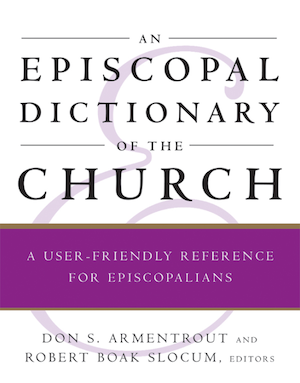
Glossary definitions provided courtesy of Church Publishing Incorporated, New York, NY,(All Rights reserved) from “An Episcopal Dictionary of the Church, A User Friendly Reference for Episcopalians,” Don S. Armentrout and Robert Boak Slocum, editors.