
This page is available in: Español
Bible Study: Proper 9 (A) – July 5, 2026
July 05, 2026
[RCL]: Genesis 24:34-38, 42-49, 58-67; Psalm 45:11-18; Romans 7:14-25a; Matthew 11:16-19, 25-30
Opening Prayer |
O God, you have taught us to keep all your commandments by loving you and our neighbor: Grant us the grace of your Holy Spirit, that we may be devoted to you with our whole heart, and united to one another with pure affection; through Jesus Christ our Lord, who lives and reigns with you and the Holy Spirit, one God, for ever and ever. Amen.
Context |
It may be helpful, in approaching today’s passage from the Gospel according to Matthew, to note that it comes on the heels of an interesting encounter: John the Baptist has been thrown in prison (possibly for criticizing Herod’s marriage to his brother’s ex-wife). Surprisingly, John’s disciples—to whom we presume John has repeated his powerful announcement that Jesus is the Lamb of God, Savior of the World—are then sent by John to ask Jesus if he is indeed “the one who was to come” (11:3). Finding himself in jail, the bold, camel hair-wearing, locust-eating baptizer now seems to wonder if he’s made a mistake. Perhaps his expectation of what would happen was different. Jesus is gathering and teaching crowds, but he certainly isn’t in charge of the world as they know it.
A beautiful thing about what comes next is how Jesus speaks not with condemnation for John’s doubt, but with compassion for his disturbed mind. He sends John’s disciples back to tell the story of what they’ve seen of Jesus’s ministry: healings of the blind, lame, and diseased, and the preaching of good news to the poor. Then he spends some time praising John, declaring him a prophet, “the greatest of those born of women,” even going so far as to say that John is “Elijah who is to come”—and note there the interesting verb tense here: John is Elijah, and Elijah is yet to come. This context is where our passage begins.
Theological Reflection |
In today’s reading from Matthew, Jesus first compares his listeners to children who are unhappy with their playmates. Scholars disagree on what exactly is being taught in this section and how the children’s argument applies to John the Baptist. What we can see is that the children Jesus references are complaining, essentially saying, “We wanted to play wedding, and you wouldn’t do that, we wanted to play funeral, and that didn’t work for you either.” No matter what is suggested as an option, the children won’t agree on what to play.
The listeners are asked to understand themselves as capricious children, unhappy both with John for his strangely ascetic practices and with Jesus for his more luxuriant ones (which, by the way, match their own). No matter how Jesus or John act, these “children” are unhappy and complaining. The children don’t know what they want—or perhaps they don’t want enough, or perhaps they don’t want anything at all.
It could be, as C.S. Lewis observed in his famous sermon, “The Weight of Glory,” “that Our Lord finds our desires not too strong, but too weak. We are half-hearted creatures, fooling about with drink and sex and ambition when infinite joy is offered us, like an ignorant child who wants to go on making mud pies in a slum because he cannot imagine what is meant by the offer of a holiday at the sea.”
After offering a description of his activities among the people as an answer to the question John’s disciples ask, Jesus then says, “Yet Wisdom is vindicated by her deeds.” This implies that, complaints notwithstanding, it is action which reveals the virtue and righteousness of a teaching—and of a teacher. This idea of the primacy of action will continue to be developed throughout this passage, including during an interlude skipped over in today’s lection, which describes some cities as having rejected the teachings of Jesus—and thus the salvation extended to them—because they did not respond to the works he did there.
Next, Jesus prays, again bringing children to the forefront. He worships God for revealing salvation to “simple people” and “infants,” rather than to the “wise and intelligent.” Again we see that the kingdom of God does not depend on those same markers of success the world values. Those listening are invited and drawn to Jesus, regardless of their level of education. Jesus reveals what is truly necessary: not knowledge, but relationship. He teaches that the Father has handed over “all things” to him, and that no one knows the Father except the Son and “anyone to whom the Son chooses to reveal him.” This teaching establishes both his authority and the vast open generosity of his invitation. The revelation of the Father is an embodied one, accessed through knowing the one he sent.
The final section of today’s gospel passage holds one of the most beautiful statements attributed to Jesus: He calls all to come to him; all who are weary, who bear burdens, who are human. All are invited to come to Jesus and learn from his example of life with—and in—God. Rest can be found in Jesus himself: God’s fullness incarnate, God’s will walking, breathing, healing, speaking, holding, feeding, weeping, laughing, loving. It is God who is gentle and humble in heart, offering rest to all those who come to Jesus.
Discussion Questions |
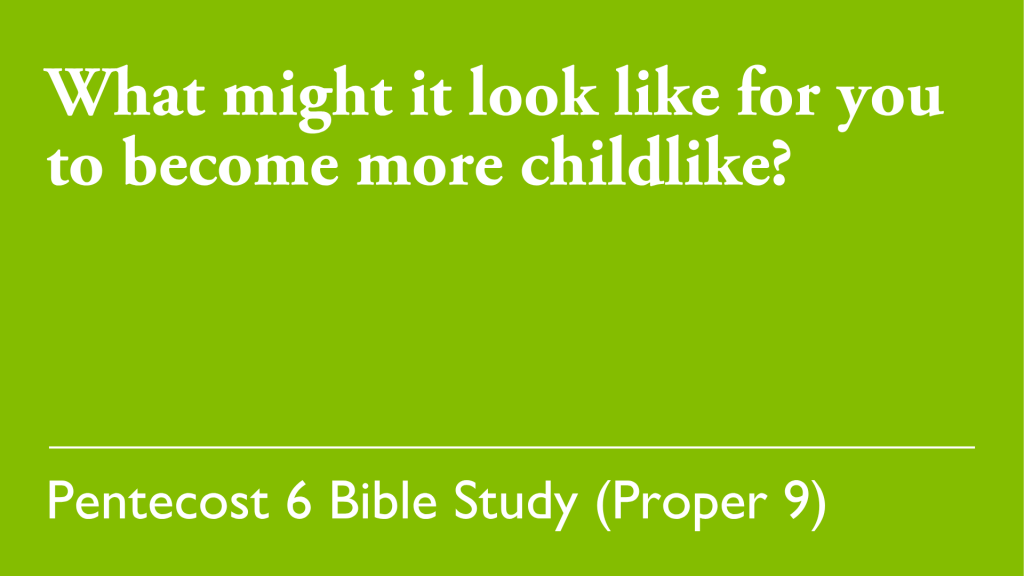
- What might it look like for you to become more childlike? What are one or two things, specifically, would you need to do or change?
- Talk about a time when God was gentle or humble with you. What was that experience like?
- If we believe, as Jesus says, that childlike simplicity is a positive trait, what should change in our interactions with the world and one another?)
Faith in Practice |
Spend some time this week observing a child at rest or play. (Bonus points if it’s an infant!) Invite God to observe with you, and see what you might learn.
Misty Krasawski is a nominee for holy orders in the Episcopal Diocese of Tennessee. Previously, she earned a Master of Letters in Bible and the Contemporary World from the University of St. Andrews, Scotland. She has eight children ages 16-33, three daughters- and one son-in-law, as well as four grandchildren, and has spent decades in ministry to children, youth, and mothers with Whole Heart Ministries and in her local church. She would love to spend more time exploring the intersections of maternity, theology, and feminism, and believes that better theology helps us all move toward a better world.
This page is available in: Español
Don’t forget to subscribe to the Sermons That Work podcast to hear this sermon and more on your favorite podcasting app! Recordings are released the Thursday before each liturgical date.
Receive Free Weekly Sermons That Work Resources!

This page is available in: Español