
Glossary of Terms
Executive Council of the Episcopal Church
The national body that administers the program and policies adopted by the General Convention. It was called the National Council from 1919-1964. It is currently composed of twenty members elected by General Convention, eighteen members elected by the Provincial Synods, and the following ex officio members: the presiding bishop, the president of the House of […]
Exegesis
Literally a “leading out.” The term is used in biblical studies to signify the drawing out of the meaning of the texts of Holy Scripture. Some biblical scholars, notably Rudolf Bultmann, use the term to indicate what the text means to the contemporary reader or hearer. Others, such as Krister Stendahl, use the term for […]
Exhortation
An earnest admonishment. Two exhortations to prepare the congregation for communion were published in the 1548 Order for Communion, and these were included in the 1549 BCP. A third exhortation was added in the 1552 BCP. The 1928 BCP also included three exhortations, but the 1979 BCP has only one, a conflation of prior material […]
Exorcism
The driving out of evil spirits from persons or places with authority derived from Christ. The NT records exorcisms performed by Jesus, e.g., Mk 5:1-13, and by the apostles, e.g., Acts 16:18. The BOS does not provide a rite of exorcism, but it gives these guidelines: “Those who find themselves in need of such a […]
Exorcist
From early times certain Christians with charismatic gifts have been recognized to have the power to exorcise. Exorcist was also one of the old minor orders. Originally it designated a person whose liturgical duties included laying hands on catechumens (those preparing for baptism) and energumens (those possessed by unclean spirits). It was later one of […]
Exposition (Sacramental)
Exhibition of the consecrated eucharistic bread for the purpose of devotion. The practice became common in the fourteenth century. It is an extension of the practice of the elevation of the host to be seen by the people during the words of institution in the eucharist. Popular devotion to the sacrament and the desire to […]
Extempore Prayer
A free-form prayer without text. It may or may not reflect a stream of consciousness of prayer by the one who prays. Considerable preparation may have taken place before the prayer was offered, or the prayer may be a spontaneous expression. Extempore prayer is distinguished from prayers which are read or memorized.
Extreme Unction
Use of oil for the anointing of the sick at the time of death. After the seventh century, western Christianity associated the rites of anointing with penitence and death. This differed from the earlier practice of anointing for healing and recovery from illness. Unction became a rite reserved for situations in extremis, near death the various movements […]
EYC
See Episcopal Young Church People (EYC).
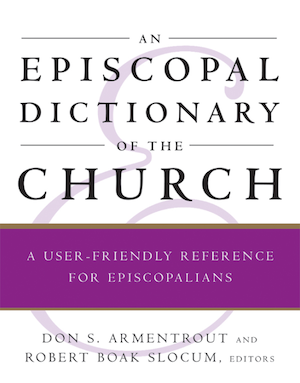
Glossary definitions provided courtesy of Church Publishing Incorporated, New York, NY,(All Rights reserved) from “An Episcopal Dictionary of the Church, A User Friendly Reference for Episcopalians,” Don S. Armentrout and Robert Boak Slocum, editors.