
Glossary of Terms
St Paul’s College, Palmyra, Missouri
The Governor Clark Mission was established in Feb. 1848 on fifty-seven acres of land in Marion County which was purchased by the Rt. Rev. Cicero Stephens Hawks, the second Bishop of Missouri. On Feb. 24, 1853, the legislature incorporated the school as St. Paul's College. In June 1889 St. Paul's graduated its last class, and […]
St Paul’s College, Texas
The Rev. Charles Gillette (1813-Mar. 6, 1869) founded St. Paul's College. It opened on Jan. 5, 1852, at Anderson, as the Anderson Female Institute and Texas Diocesan School. It received a charter on Feb. 4, 1853, as St. Paul's College. On Apr. 5, 1855, the board of trustees voted to move the school to Austin, […]
St Paul’s School, Concord, New Hampshire
A leading co-educational college preparatory school in the United States. It was founded on Apr. 3, 1856, by a Boston physician, George Cheyne Shattuck, Jr. Dr. Shattuck wanted to educate his sons in a place where natural beauty could play a part in the boys' education. St. Paul's was influenced by two other schools. The […]
St Paul’s University, Tokyo
Founded in 1874 by Bishop Channing Moore Williams, it officially became St. Paul's College in 1907. Native Japanese leadership assumed administration in 1920 and it acquired university status in 1922. It was reorganized and became co-educational in 1949. The graduate school was established in 1951.
St Philip’s Church, Charleston, South Carolina
Oldest religious congregation in South Carolina. It was formed around 1670, when a colony of settlers disembarked in Apr. at “Albemarle Point.” By 1679 the settlers had moved to the peninsula between the Ashley and Cooper Rivers to form Charles Town, named after Charles II, King of England at the time. The first permanent church […]
St Philip’s Church, New York
This African American congregation was founded in 1818. It was the second African American Episcopal congregation in the United States after St. Thomas African Episcopal Church, Philadelphia. The first members of St. Philip's had been members of Trinity Parish, New York. The leader of the parish was Peter Williams, Jr., a lay reader, “Absalom Jones's […]
St Philip’s College, San Antonio, Texas
St. Philip's College was founded in 1898 by the Rt. Rev. James Steptoe Johnston (1843-1924), the second Bishop of West Texas, as St. Philip's Normal and Industrial School, to prepare African American people for the responsibilities of citizenship. In Sept. 1902 Artemisia Bowden (1884-1969) took charge of the school, and in 1927 it became St. […]
St Stephen’s College
See Bard College, Annandale-on-Hudson, New York.
St Stephen’s College Theological Department
St. Stephen's College (now Bard) was established on Mar. 20, 1860. Under its second warden, the Rev. Thomas Richey, a theology department with a three-year course was established. Three young men began the course, but soon decided “that they could accomplish their objectives more satisfactorily in some of the older seminaries.”
St Thomas African Episcopal Church, Philadelphia
See Free African Society.
St Thomas Choir School, New York City
A boarding school for boys in fifth through eighth grades who sing in the choir of St. Thomas Church on Fifth Avenue in New York City. It was founded in 1919 under the direction of Dr. T. Tertius Noble, organist and choirmaster at St. Thomas Church. It is one of the few remaining choir schools […]
St Thomas Church, New York
This parish was organized on Dec. 25, 1823. The first church building was constructed in 1824-1825, at the corner of Broadway and Houston Street. The present building, erected in 1868-1870, and designed by Richard Upjohn, is at the northwest corner of Fifth Avenue and 53rd Street. The cornerstone of this building was laid on Oct. […]
Standing Commissions
See Commissions of the General Convention; See Standing Commissions alphabetized by subject.
Standing Committee
The ecclesiastical authority of the diocese in the absence of a bishop. The Canons of 1789 made four references to an organization known as the Standing Committee. It formed its duties over the next forty-three years. In 1832 the General Convention brought all the functions of the Standing Committee under Canon Four, adding that where […]
Stanley, Clifford Leland
(Mar. 16, 1902-Oct. 11, 1994). Theologian and professor. He was born in Williamsport, Pennsylvania. Stanley received his B.A. in 1924 and his M.A. in 1925, both from the University of Virginia. He received his B.D. in 1928 from the Virginia Theological Seminary. Stanley was ordained deacon on June 5, 1928, and priest on Dec. 19, […]
Stanton, Elizabeth Cady
(Nov. 12, 1815-Oct. 26, 1902). Women's rights leader. She was born in Johnstown, New York. Stanton graduated from Emma Willard's Female Seminary in Troy, New York, in 1832. She had an early interest in the abolition of slavery and the temperance movement. Stanton attended the World's Anti-Slavery Convention in London with her husband, Henry Stanton, […]
Stephen, Saint, Deacon and Martyr
(First Christian martyr. He was a Hellenist, a Greek-speaking Jew born and reared outside Palestine. His name is Greek, meaning “crown.” He was one of the seven chosen by the Jerusalem congregation to see that the Hellenistic Jewish Christians got their fair share of the contributions. Stephen's preaching caused a revolution in the attitude of […]
Stewardship
Our personal response to God's generosity in the way we share our resources of time, talent, and money. Stewardship reflects our commitment to making God's love known through the realities of human life and our use of all that God has given us. It is also our service to God's world and our care of […]
Stewart, Marshall Boyer
(Sept. 4, 1880-July 28, 1956). Educator and theologian. He was born in Galveston, Texas. He received his B.A. in 1902 and his M.A. in 1907, both from Trinity College, Hartford, Connecticut. He received his B.D. from the General Theological Seminary in 1906. Stewart was ordained deacon on June 18, 1905, and priest on Dec. 21, […]
Stigmata
Wounds, like those of Christ's, imprinted on the body of a believer by a special act of divine grace or by an involuntary psychosomatic process. Actual self-inflicted wounds are not stigmata. St. Francis of Assisi is said to have received the stigmata in the thirteenth century. The attitude of the church towards stigmata is guarded.
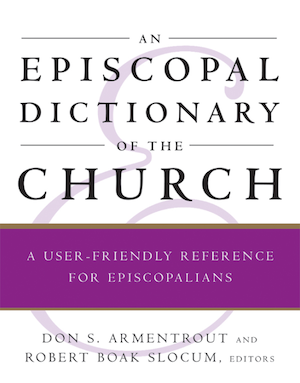
Glossary definitions provided courtesy of Church Publishing Incorporated, New York, NY,(All Rights reserved) from “An Episcopal Dictionary of the Church, A User Friendly Reference for Episcopalians,” Don S. Armentrout and Robert Boak Slocum, editors.