
Glossary of Terms
Simon and Jude, Saints and Apostles
(Two of the apostles. Very little is known about them. Simon is known as Simon the Canaanaean and Simon the Zealot. He was probably a member of the political sect known as the Zealots, which was violently opposed to the domination of Palestine by Rome. Tradition claims that he carried the Christian faith to Egypt, […]
Simul justus et peccator
Latin phrase meaning “at once justified and a sinner.” It is associated with Martin Luther and Protestant thought concerning salvation. The righteousness of Christ is imputed to us by God and received by faith. We are thus justified by a righteousness that is extrinsic and alien to us personally. Although we are pronounced righteous by […]
Sin
Following our own will instead of following the will of God, thereby being centered on ourselves instead of God and distorting our relationships with God, other people, and creation (see BCP, p. 848). Sin is intentional disobedience and rebellion against God. It alienates us from our true selves. Sin is a misuse of human free […]
Sisco, Curtis Winfield, Jr.
(May 1, 1958-Nov. 23, 1992). Priest and liturgical editor. He was born in Philadelphia. Sisco was a graduate of Temple University and General Theological Seminary. He was ordained priest in 1987. He served as a consultant to the National Council of Churches in New York, 1985-1986, diocesan intern, St. Simons', Philadelphia, 1986-1987, and rector, St. […]
Sister
The term has been applied to female Christians since the earliest NT times. The language of family kinship recalls the closeness of the bond that is shared by those who live in Christ. For example, the Gospel of Mk (3:35) records Jesus' statement that “Whoever does the will of God is my brother and sister […]
Situation Ethics
Moral decision-making understood as highly specific to the situation or context. Situation ethics is often contrasted with a focus on moral principles or duties which are seen as leading to formalism and legalism. A variety of reasons may be used to support a situational ethic. Most combine an existentialist emphasis on the uniqueness of each […]
Skiles, William West
(Oct. 12, 1807-Dec. 8, 1862). Missionary deacon and pioneer monastic in Southern Appalachia. He was born in Hertford, North Carolina. When Bishop Levi S. Ives of North Carolina decided to establish a mission in the Watauga region of North Carolina in 1844, he invited Skiles to be the manager of the farm and the teacher […]
Smart, Christopher
(Apr. 11, 1722-May 20, 1771). English religious poet. He was born in Shipbourne, Kent, England. Smart was educated at Durham Grammar School and Pembroke Hall, Cambridge. He was elected a scholar of Cambridge University in 1742, and a fellow of Pembroke Hall in 1745. Emotional instability soon became evident, and in 1749 he lost his […]
Smith, Benjamin Bosworth
(June 13, 1794-May 31, 1884). Bishop of Kentucky and ninth Presiding Bishop. He was born in Bristol, Rhode Island. Smith graduated from Brown University in 1816. He was ordained deacon on Apr. 23, 1817, and priest on June 24, 1818. He began his ordained ministry at St. Michael's Church, Marblehead, Massachusetts, and then moved to […]
Smith, Captain John
(Jan. 1579-June 21, 1631). An organizer of the Virginia Company of London. Smith was born in Willoughby, Lincolnshire, England. He promoted the Virginia Company's plan to found a colony in America. In 1606 he and 143 other colonists sailed to Virginia. They landed at Jamestown on May 24, 1607. Legend claims that he was rescued […]
Smith, John Cotton
(Aug. 4, 1826-Jan. 9, 1882). Nineteenth-century broad churchman. He was born in Andover, Massachusetts. Smith attended Phillips Academy, Andover, and graduated from Bowdoin College in 1847. After studying theology at Kenyon College, he was ordained deacon on May 6, 1849, and priest on Aug. 4, 1850. He began his ministry as rector of St. John's […]
Smith, Robert
(Aug. 25, 1732-Oct. 28, 1801). First Bishop of South Carolina. He was born in the County of Norfolk, England. Smith studied at Caius College and Gonville College, Cambridge University, and received his B.A. in 1753. Smith was ordained deacon on Mar. 7, 1756, and priest on Dec. 21, 1756. He emigrated to America. Smith became […]
Smith, William
(Sept. 7, 1727-May 14, 1803). Educator and priest. Born in Aberdeen, Scotland, Smith received his M.A. degree from the University of Aberdeen in 1747. He lived in London after graduation and served as an agent for the Society for the Education of Parochial Schoolmasters and then for the Society for the Propagation of the Gospel. […]
Smith, William
(1754-Apr. 6, 1821). Leading priest and musician. He was born probably at Aberdeen, Scotland, and possibly attended the University of Aberdeen. Smith came to the American colonies in 1785 as a priest in the Scottish Nonjuring Episcopal Church. He served from Jan. until July 1785 as minister at Trinity Church, Oxford, and All Saints, Pequestan, […]
Sobornost
1) A Russian theological term indicating a conciliar and ecumenical ideal of the church, based on a spiritual unity of freedom and love. This interior communion of the church is contrasted with Protestant individualism and the external ordering of the Roman Catholic Church. The term is a neologism, or new word, based on the Russian […]
Social Gospel
The Social Gospel movement, which began towards the end of the nineteenth century and continued until World War I, was chiefly a response to the failure of mainline Protestant churches to address the social realities of poverty and industrialization. Their tendency had been to concern themselves exclusively with individual salvation and economic prosperity. As a […]
Social Justice
Justice indicates what is right or fair. Social justice is concerned with the fairness of transactions and distribution. What is called commutative justice considers such matters as contracts and due process of law. Commutative justice is focused on civil law, but it includes matters of criminal law in the case of punishment for theft. Distributive […]
Sodality
A pious fellowship or guild that promotes the Christian life of its members and may include other religious purposes such as evangelism or outreach to the needy. Although the term has been associated with Roman Catholic laity, there have been Anglican and Episcopal sodalities. See Living Rosary of Our Lady and S. Dominic.
Solemn Collects
The solemn collects are derived from the most ancient western form of the prayers of the people. The biddings date from the third or fourth century, and the collects date from the fifth century. The ancient solemn collects appear in the Gelasian and Gregorian sacramentaries. The practice of kneeling for the bidding and standing for […]
Solitary
See Eremitic; see Hermit, Hermitess.
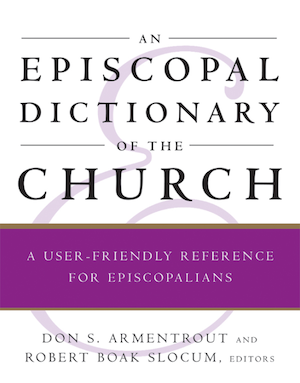
Glossary definitions provided courtesy of Church Publishing Incorporated, New York, NY,(All Rights reserved) from “An Episcopal Dictionary of the Church, A User Friendly Reference for Episcopalians,” Don S. Armentrout and Robert Boak Slocum, editors.