
Glossary of Terms
Tetragrammaton
A word from Greek meaning “four letters.” It refers to the four consonants of the biblical name of God, Yahweh, YHWH. From ancient times it was considered too sacred to be pronounced, and Adonai was substituted for it. The Prayer Book Psalter and the King James OT rendered the name of God “Lord,” and the […]
Texas, Diocese of
From Dec. 8, 1838, until Oct. 16, 1841, the Republic of Texas was under the episcopal jurisdiction of Leonidas Polk, Missionary Bishop of Arkansas and the Indian Territory. Texas was at that time a foreign mission. Polk also served Texas when he was Bishop of Louisiana. On Oct. 26, 1844, George Washington Freeman was consecrated […]
Th.D.
( The Doctor of Theology degree presupposes a first theological degree and is to equip persons for teaching and research in theological seminaries, colleges, and universities.
Th.M.
The Master of Theology degree presupposes the M. Div. degree and is an academic program stressing fuller mastery of resources in one of the theological disciplines.
Thanksgiving (Prayer)
The Catechism identifies thanksgiving as one of the seven principal kinds of prayer (BCP, p. 856). We offer thanksgiving to God “for all the blessings of this life, for our redemption, and for whatever draws us closer to God” (p. 857). The eucharistic prayer, from the Sursum corda through the people's Amen, is known as […]
Thanksgiving Day
A national holiday and day of thanks. Thanksgiving Day is celebrated in the United States on the fourth Thursday in Nov. This custom is based on the celebration of three days of prayer and feasting by the Plymouth, Massachusetts, colonists in 1621. There was also a Thanksgiving celebration with prayer by members of the Berkeley […]
Thanksgiving for the Birth or Adoption of a Child
The BCP (p. 439) states that after the birth or adoption of a child, the parents and other family members should come to the church to be welcomed by the congregation and give thanks to God. It is desirable that this be done at a Sunday service. The BCP provides a form for A Thanksgiving […]
Thanksgiving, Great
Prayer of consecration said over bread and wine at the eucharist. The BCP uses the title “The Great Thanksgiving” as a major subheading in bold typeface for both eucharistic rites (BCP, pp. 333, 361), thus recovering one of the ancient designations for the eucharistic prayer. See Eucharistic Prayer.
Theodicy
A defense of the existence of God despite the presence of evil and suffering in the world. The term was coined by Gottfried W. Leibniz (1646-1716). It is drawn from Greek words meaning God and justice, and it justifies God's omnipotence, omniscience, and benevolence in the face of evil. Theodicies often emphasize the importance of […]
Theodore of Tarsus
(602-Sept. 19, 690). Scholar and reformer. He was born in Tarsus, Cilicia, in Asia Minor. Theodore was a lay monk when he was chosen by Pope Vitalian to become Archbishop of Canterbury. After he was ordained a subdeacon, Theodore was consecrated the seventh Archbishop of Canterbury on Mar. 26, 668, where he served until his […]
Theologian
A person who is knowledgeable concerning theology. Theologians may be members of the clergy or lay people. For example, William Stringfellow (1928-1985) was one of the best known Episcopal theologians of the twentieth century. He was a lay person without advanced academic training in theology. Stringfellow identified the power of death with the forces of […]
Theological Seminary of the Protestant Episcopal Church of the Diocese of South Carolina
The 1858 Convention of the Diocese of South Carolina authorized a diocesan seminary and elected a board of trustees. It was located in Camden where Bishop Thomas Davis resided. It opened on Jan. 18, 1859, with three students and four faculty members. In Oct. 1859 William Porcher DuBose entered this seminary. It closed on June […]
Theological Virtues
A virtue is the perfection of a human power or capacity. As distinct from the cardinal virtues which we can develop, the theological virtues are the perfection of human powers given by the grace of God. Cited first in 1 Cor 13:13, faith, hope, and love are described as theological virtues by Augustine. This tradition […]
Theology
The term is derived from two Greek words meaning, respectively, “God” and “the study of” or “the knowledge of.” It was used prior to the Christian era in Greek philosophy to mean the study of the gods. It became an important term in Christian usage in two senses. First, in the writings of the Greek […]
Theophany
The term is from two Greek words meaning “God” and “appearance.” A theophany is a manifestation of God, usually with both visual and audible elements. For example, God appears to Moses in a burning bush and commissions him to lead the Hebrew people out of slavery in Egypt (Ex 3:1-12). Later at Sinai there are […]
Theosis
A term used in the tradition of Orthodox theology to refer to the participation of the human person in the life of God. It is also known as deification or divinization. It means “being made God” and reflects the dominant Orthodox understanding of salvation in Christ. Athanasius urged that God became man so that we […]
Third Order
An association of those who live in the secular world while affiliated with a religious order. Although the members of the third order do not live in a religious community, they share the spirit and some of the practices of the order. The members of the third order, known as tertiaries, may have a distinctive […]
Third Services
See Mission Services (Third Services).
Thirty-Nine Articles, or Articles of Religion
The Thirty-Nine Articles were the result of a long process in which the Church of England attempted to provide a theological foundation for its existence during the doctrinal conflicts of the sixteenth century. The conflicts arose from the competing views between Protestants and Roman Catholics as well as controversy within the Church of England itself. […]
Thomas à Kempis
(c. 1380-1471). Monastic, priest, and spiritual writer. He was born in Kempen near Koln, Germany. Kempis was educated in the school at Deventer, the Netherlands. It was run by the Brethren of the Common Life, who stressed the necessity of imitating the life of Christ by loving one's neighbor as oneself. He entered the Augustinian […]
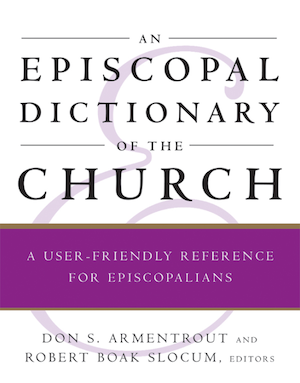
Glossary definitions provided courtesy of Church Publishing Incorporated, New York, NY,(All Rights reserved) from “An Episcopal Dictionary of the Church, A User Friendly Reference for Episcopalians,” Don S. Armentrout and Robert Boak Slocum, editors.