
Glossary of Terms
Elizabethan Settlement
Religious and political arrangements worked out during the reign of Elizabeth I in England. Elizabeth I (1533-1603), daughter of Henry VIII and Anne Boleyn, became Queen of England in 1558. Religious differences threatened the stability of England at that time. England had been officially Protestant under the rule of Edward VI from 1547 to 1553 […]
Ellerton, John
(Dec. 16, 1826-June 15, 1893). Hymn writer. He was born in London. He was educated at King William's College on the Isle of Man, and at Trinity College, Cambridge. Shortly after his ordination he began writing hymns for the children of St. Nicholas' Church, Brighton, where he was curate. While vicar of Grewe Green, Cheshire, […]
Ellinwood, Leonard Webster
(Feb. 13, 1905-July 8, 1994). Hymnal editor and music historian. He was born in Thomaston, Connecticut, and received his B.A. from Aurora College in 1926. He received his Master of Music degree in 1934 and his Doctor of Philosophy degree in 1936 from the Eastman School of Music. He taught at Michigan State University before […]
Elliott, Stephen
(Aug. 31, 1806-Dec. 21, 1866). Bishop and educator. He was born in Beaufort, South Carolina. In the fall of 1822 he entered the sophomore class at Harvard, and the next year he transferred to Carolina College in Charleston. After studying law for two years, he was admitted to the bar in 1827. In 1830 he […]
Elohim
A Hebrew word in the plural which occasionally means pagan gods, superhuman creatures, or earthly judges in the OT; but the term usually refers to Israel's one God, Yahweh. Although the word is plural, it typically appears with singular verbs when the term refers to God. The use of the plural form may be explained […]
Elohist, The
One of four sources for the composition of the Pentateuch, according to a theory accepted by many biblical scholars. Known as Documentary Theology, the theory assigns the name Elohist to the source that consistently uses the Hebrew word Elohim for God until the call of Moses in Ex 3, when the proper name Yahweh is […]
Ely, Richard Theodore
(Apr. 13, 1854-Oct. 4, 1943). Social Gospel advocate. He was born in Ripley, New York. He received a B.A. from Columbia University in 1876 and a Ph.D. from Heidelberg University in Germany in 1879. He taught economics at Johns Hopkins University (1881-1892) and at the University of Wisconsin (1892-1925). He also directed research institutes at […]
Emancipation, African American, and the Episcopal Church
Beginning with the founding of the Society for the Propagation of the Gospel in Foreign Parts in 1701, Anglican slave holders sought to incorporate African Americans within the traditions of Anglicanism. In the nineteenth century, evangelicals developed an active, paternalistic ministry among slaves. White Episcopalians encouraged household servants to sit in special sections in their […]
Ember Day Letter
Every postulant or candidate for holy orders in the Episcopal Church is required by canon to report to the bishop four times a year, during the Ember Weeks. The report must be made in person or by letter, and must include reflection on the person's academic experience as well as personal and spiritual development. See […]
Ember Days
Three days which occur four times a year: the Wednesday, Friday, and Saturday after St. Lucy's Day (Dec. 13), Ash Wednesday, the Day of Pentecost, and Holy Cross Day (Sept. 14). The name comes from the Latin title Quattuor tempora, meaning “four times.” In ancient Italy the times (originally three) were associated with sowing, harvest, […]
Ember Weeks
The four weeks in each year during which the Ember Days occur. See Ember Days.
Emery, Julia Chester
(Sept. 26, 1846-Jan. 9, 1922). Leader of women's ministry. She came to New York in 1874 to edit The Young Christian Soldier. In 1876 she was appointed secretary of the Woman's Auxiliary to the Board of Missions (WA). Emery held that position for the next forty years, resigning in 1916. She directed the expansion of […]
Emery, Margaret Theresa
(Aug. 3, 1849-July 20, 1925). She worked in the national office of the Woman's Auxiliary of the Episcopal Church from 1876 until 1919. She edited The Young Christian Soldier and directed the Auxiliary's program to provide supplies for foreign and domestic missionaries in “mission boxes” provided by local chapters. Julia Chester Emery, Mary Abbot Emery, […]
Emery, Mary Abbot
(Mrs. Alvi Tabor Twing) (Feb. 23, 1843-Oct. 14, 1901). The oldest daughter of Charles and Susan Hilton Emery, she was appointed secretary of the newly formed Woman's Auxiliary to the Board of Missions in 1871. She was chiefly responsible for the early development of that organization. Though she resigned as secretary in 1876 to marry […]
Emery, Susan Lavinia
(Sept. 26, 1846-Mar. 1, 1914). She wrote children's stories and edited The Young Christian Soldier, the Episcopal Church's missionary magazine for children, from 1871 until 1875. Julia Chester Emery, Margaret Theresa Emery, and Mary Abbot Emery were her sisters.
Emma of Hawaii
( See Kamehameha and Emma, King and Queen of Hawaii.)
Emmanuel
A Hebrew word that means “God is with us.” It is mentioned in Is 7:14 as a sign from the Lord and the name of a child to be born. In the NT it is used only in Matthew at the beginning of his gospel as a way of understanding the significance of Jesus. Many […]
Emmanuel Movement
The Rev. Dr. Elwood Worcester became the rector of Emmanuel Church, Boston, in 1904, and served there until his retirement in 1929. While at Emmanuel Church he worked on combining religion and science, resulting in a healing ministry which lasted until his retirement. The movement began when Worcester developed a program for the treatment of […]
Empie, Adam
(Sept. 5, 1785-Nov. 6, 1860). College president and rector. He was born in Schenectady, New York. Empie was educated at Union College, Schenectady, and decided to enter the ordained ministry of the Episcopal Church. He was ordained deacon on July 30, 1809, and began his ministry as assistant at St. George's Church, Hempstead, Long Island. […]
English Hymnal, The
A British hymnal published in 1906 under the leadership of Percy Dearmer as general editor and Ralph Vaughan Williams as musical editor. A second edition including minor but important changes was published in 1933, and a more comprehensive revision, The New English Hymnal, was published in 1986. The first two editions had a strong influence […]
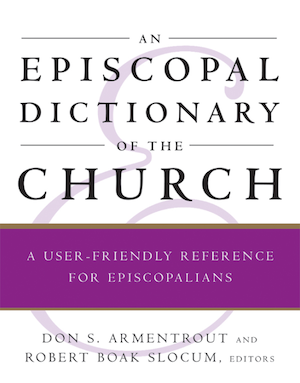
Glossary definitions provided courtesy of Church Publishing Incorporated, New York, NY,(All Rights reserved) from “An Episcopal Dictionary of the Church, A User Friendly Reference for Episcopalians,” Don S. Armentrout and Robert Boak Slocum, editors.