
Glossary of Terms
St Faith’s Deaconess Training School, New York
See New York Training School for Deaconesses (NYTSD).
St Francis Academy, Salina, Kansas
A national, not-for-profit behavioral health care organization serving children, adolescents, and their families. The Rt. Rev. Robert Herbert “Father Bob” Mize (1870-1956), founded St. Francis Academy (originally the St. Francis Boys' Home) in 1945. At that time he was the retired Bishop of Western Kansas. The first residential facility was located in Ellsworth, Kansas, and […]
St James College, Fountain Rock, Hagerstown, Maryland
St. James College was founded by the Rt. Rev. William Rollinson Whittingham, the fourth Bishop of Maryland, and the Rev. Theodore Benedict Lyman (1815-1893), rector of St. John's Church, Hagerstown. St. James was to be patterned after St. Paul's School, College Point, New York. Bishop Whittingham arranged for the Rev. John Barrett Kerfoot (1816-1881) to […]
St John the Evangelist, College of, Denver and Greeley, Colorado
The goals for the College of St. John the Evangelist were never fully realized. Jarvis Hall for boys, Wolfe Hall for girls, and Matthews Hall for theological students operated sporadically from 1879 to 1937. No degrees were ever awarded.
St John’s Church, Richmond, Virginia
Historic seat of Henrico Parish, one of the oldest parishes in the United States. The plantation parish of Henrico began in 1611 with the Rev. Alexander Whitaker as its first rector. In 1617 plans were made for the “University and Colledge” of Henrico, and in 1619 ten thousand acres were granted for the college. In […]
St John’s College, Annapolis, Maryland
In 1696 “King William's School” opened as a free school at Annapolis “to instruct youth in Arithmetick, Navigation and all useful learning, but chiefly for the fitting such as are disposed to study divinity.” Governor Nicholson gave the land for a school building which was completed in 1701. In Nov. 1784 the Maryland legislature passed […]
St John’s College, Spartanburg, South Carolina
St. John's College opened in Jan. 1852 as St. John's School for Boys, under the leadership of the Rev. John DeWitt McCollough (1822-1902). It was never really a college, and it closed in 1862 because of the Civil War. In Oct. 1866 the Theological Seminary of South Carolina reopened St. John's campus but closed on […]
St John’s Hall
A preparatory school for boys in Delafield, Wisconsin, founded by James DeKoven in 1858. DeKoven was the warden of the school. It exemplified DeKoven's belief that students should live as a family in one building. The depression of 1859 caused it to merge with Racine College. DeKoven served as the warden of Racine College until […]
St John’s University, Shanghai
The Episcopal Church began an institution for boys in Shanghai around 1851. It was the foundation for St. John's. The school was founded by the Rt. Rev. Samuel Isaac Joseph Schereschewsky, Bishop of Shanghai, 1877-1883. The cornerstone of the building was laid on Easter Monday, Apr. 14, 1879, and a house for the bishop was […]
St Luke’s Church, Smithfield, Virginia
This church, also known as Old Brick Church, is near Smithfield in Isle of Wight County. It claims the distinction of being the oldest Episcopal Church in Virginia and the oldest building of English origin still standing in the United States. Historians think it was built in 1632 because three bricks were found imprinted with […]
St Luke’s Journal of Theology
See Sewanee Theological Review.
St Margaret’s House (School for Christian Service and Deaconess Training School of the Pacific)
Anita Adela Hodgkin was received as a candidate for the office of deaconess by Bishop William F. Nichols of California on Apr. 3, 1907. May Bostick Mott was received as a prospective deaconess by Bishop Nichols on May 18, 1908. Both women were members of St. Mark's Church, Berkeley, where Edward Lambe Parsons was the […]
St Mark’s College, Grand Rapids, Michigan
In 1850 a charter was obtained for the establishment of an institution for academic, collegiate, and theological learning to be known as St. Mark's College. The only president was the Rev. Charles C. Taylor (d. 1855). St. Mark's College was abandoned in 1851.
St Mary’s College, Dallas, Texas
The Rt. Rev. Alexander Charles Garrett, the first Bishop of Dallas, founded this school for women. A cornerstone was laid on July 4, 1876, but classes did not begin until Sept. 10, 1889. By 1900 the school offered a four-year program leading to a Bachelor of Arts degree. With the exception of Bishop Garrett, the […]
St Mary’s College, Raleigh, North Carolina
This school opened on May 12, 1842. In 1954 the name was changed to St. Mary's Junior College. It is now called St. Mary's College. It is a two-year school with a liberal arts curriculum for women.
St Mary’s Hall, Burlington, New Jersey
In 1836 Bishop George Washington Doane of New Jersey bought an existing school for girls in Burlington and renamed it St. Mary's Hall. The new school opened on May 1, 1837, with fifty-two students. In 1849 the assets of St. Mary's Hall were transferred to the Trustees of Burlington College, which Doane had founded in […]
St Michael’s Church, Charleston, South Carolina
Historic seat of St. Michael's parish. By an act of the South Carolina General Assembly on June 14, 1751, the parish of St. Philip's was divided and the parish of St. Michael established. Construction of the building took about a decade. The building is an important example of colonial architecture and is largely unchanged after […]
St Patrick’s Breastplate
See Breastplate of St. Patrick.
St Paul’s College, College Point (Flushing), New York
The cornerstone of St. Paul's College was laid on Oct. 15, 1836, by the Rev. William Augustus Muhlenberg. The Christian religion was the center of education for Muhlenberg, and the school was to train missionaries and teachers. It closed in 1848.
St Paul’s College, Lawrenceville, Virginia
St. Paul's Normal and Industrial School was founded on Sept. 24, 1888, by the Rev. James Solomon Russell (1857-1935). In 1906 it became a part of the American Church Institute for Negroes. On Dec. 30, 1941, the name was changed to St. Paul's Polytechnic Institute, and on Feb. 27, 1957, to St. Paul's College. St. […]
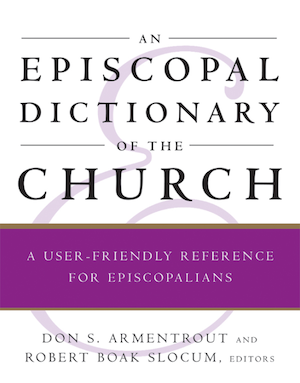
Glossary definitions provided courtesy of Church Publishing Incorporated, New York, NY,(All Rights reserved) from “An Episcopal Dictionary of the Church, A User Friendly Reference for Episcopalians,” Don S. Armentrout and Robert Boak Slocum, editors.